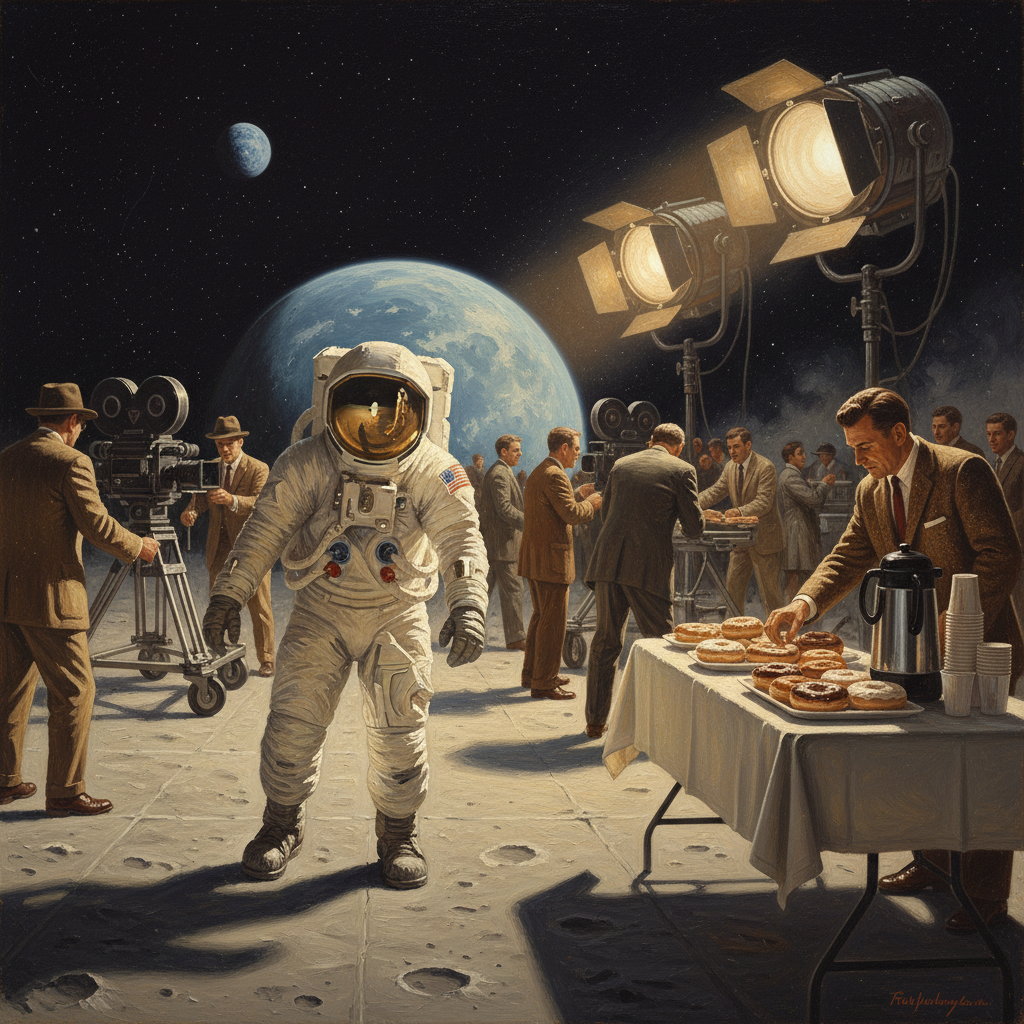
Tricky Dick’s Giant Leap for Mankind
That’s one small step for a man, one giant grift for the paranoid.
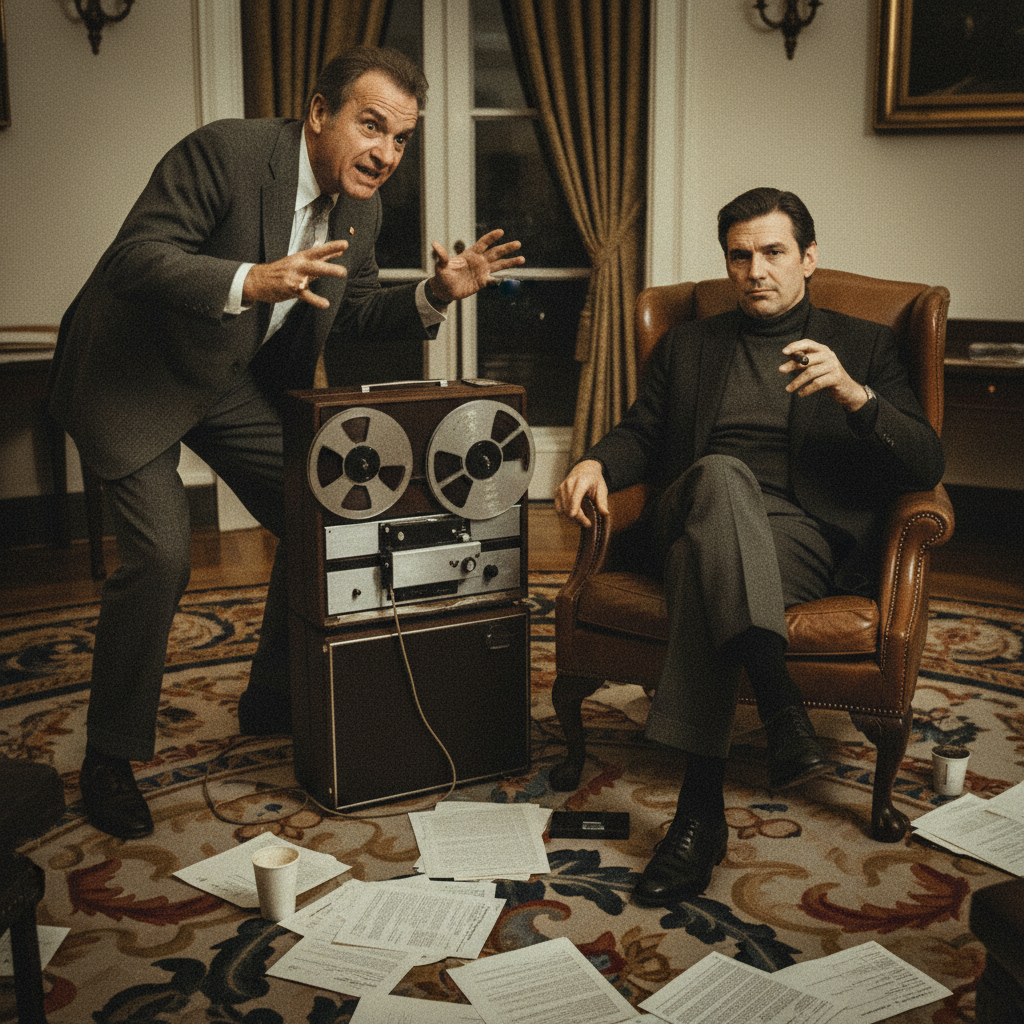
It’s three in the morning, and the static is singing our song. This one goes out to a caller, name of “Deep Throat,” who phoned in with a story about a tape deck, a president, and the greatest show that was never on Earth. You think you know Nixon. You think you know Watergate. You think you’ve heard the one about the 18-and-a-half-minute gap. But the real hum in the line, the signal underneath the noise, wasn’t a conspiracy to bug the DNC. It was a conspiracy to fake the *frickin’ moon landing*. With Stanley Kubrick, no less. And the tapes rolled on the whole damn thing.
The plan, according to the hiss and crackle of White House reel-to-reel tape 342, was pure Hollywood via Pennsylvania Avenue. A meeting, late March ‘72. Nixon, Haldeman, Ehrlichman, and a surprise guest director: Stanley Kubrick, flown in under a ludicrously false name. The paranoia in the Oval Office was running so high they’d convinced themselves the Soviets were about to pull a fast one—a cinematic first, not a scientific one. Their intel suggested the Kremlin had hired Sergei Bondarchuk, the guy who did *War and Peace*, to stage a Vostok landing on a soundstage just outside Moscow. Nixon wasn’t about to be out-faked by a bunch of commies.
“Stanley,” the President is heard slurring, over the clink of what sounds suspiciously like ice in bourbon, “I need a moonshot. A big one. Bigger than *2001*. Can you give me a moonshot the Bolshies can see from their dachas?” Kubrick, ever the perfectionist, apparently demanded a budget of $300 million, a 40% cut of all commemorative plate sales in perpetuity, and final cut on the ‘one small step’ line, which he felt was “pedestrian.” The deal memo, drafted by a terrified John Dean, also included clauses for a purpose-built soundstage in the Nevada desert—codenamed ‘Area 52’—and a cast of chimpanzees to be trained as Soviet cosmonauts for a proposed sequel, *Red Planet, Red Scare*.
The whole thing unravelled, not because of Woodward and Bernstein, but because of a Teamster. A grip from Paramount, moonlighting on the Nevada set, got into a pay dispute over travel expenses for bringing a crate of what he thought were “moon rocks” (actually spray-painted lumps of asbestos) from Burbank. He walked off the job with three reels of film under his arm, got drunk in a Vegas casino, and tried to sell them to a guy he thought was a reporter for *Variety*. The guy was actually a mid-level CIA spook on a gambling junket, and by morning the film was on a desk at Langley. The official story—the Watergate break-in—was hastily assembled as a piece of misdirection so ludicrously complicated that nobody would ever look for the simpler, dumber truth beneath it.
The 18-and-a-half-minute gap? That wasn’t Rosemary Woods’s fumble. It was Kubrick, on the phone from London, screaming at Nixon that the lens flare on the lunar module landing sequence was “all wrong” and threatening to pull his name from the project. Nixon, panicking, hit erase. He preserved his presidency, for a little while. But he wiped the single greatest work of American cinematic achievement. And somewhere out there, in a landfill outside of Henderson, Nevada, there are three canisters of film that prove it. The truth is out there, cats and kittens. You just have to tune to the right frequency.