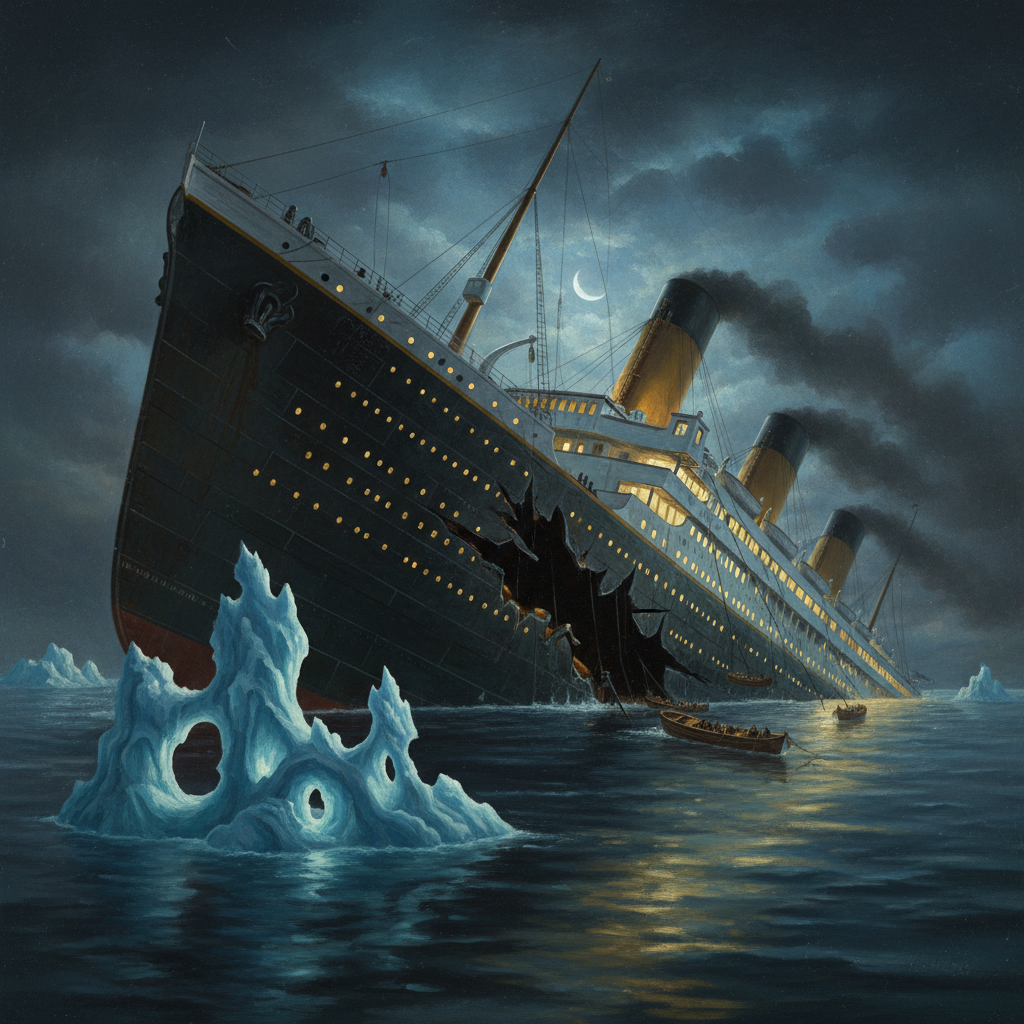
TITANIC SUNK BY COMPETITIVE AESTHETICS
The North Atlantic’s most prestigious illegal art show claims its first, and largest, victim.
The first mistake was letting the Futurists organise anything. Specifically, letting Filippo Marinetti, a man who thought war was the only hygiene and whose manifesto mostly just yelled about museums, charter a fishing trawler as a judge’s platform. He’d declared the inaugural Trans-Atlantic Iceberg Biennale open, offering a prize of 5,000 francs and a jeroboam of absinthe to whichever artist—or, more accurately, whichever artist’s team of hired goons with ice-saws and climbing spikes—could carve the most “dynamically masculine” form from a passing berg.
Naturally, every grifter with a boat between Halifax and the Hebrides heard the call. The competition was fierce and badly regulated, consisting mostly of rival teams sabotaging each other. Team Rodin (no actual affiliation, just a lot of Frenchmen who liked modelling genitals in snow) attempted a thirty-foot-high *Thinker* that collapsed into a slush pile, taking two lesser cubist follies with it. The Vorticists, a gang of English malcontents led by a man named Ezra Pound who just seemed to enjoy shouting, were disqualified for trying to affix a massive pre-carved limestone phallus to their chosen berg, in what they claimed was a profound statement about industrial society and Pound insisted was just “good clean fun.” 37% of bergs were deemed structurally unsound for ambitious work before the chipping even started.
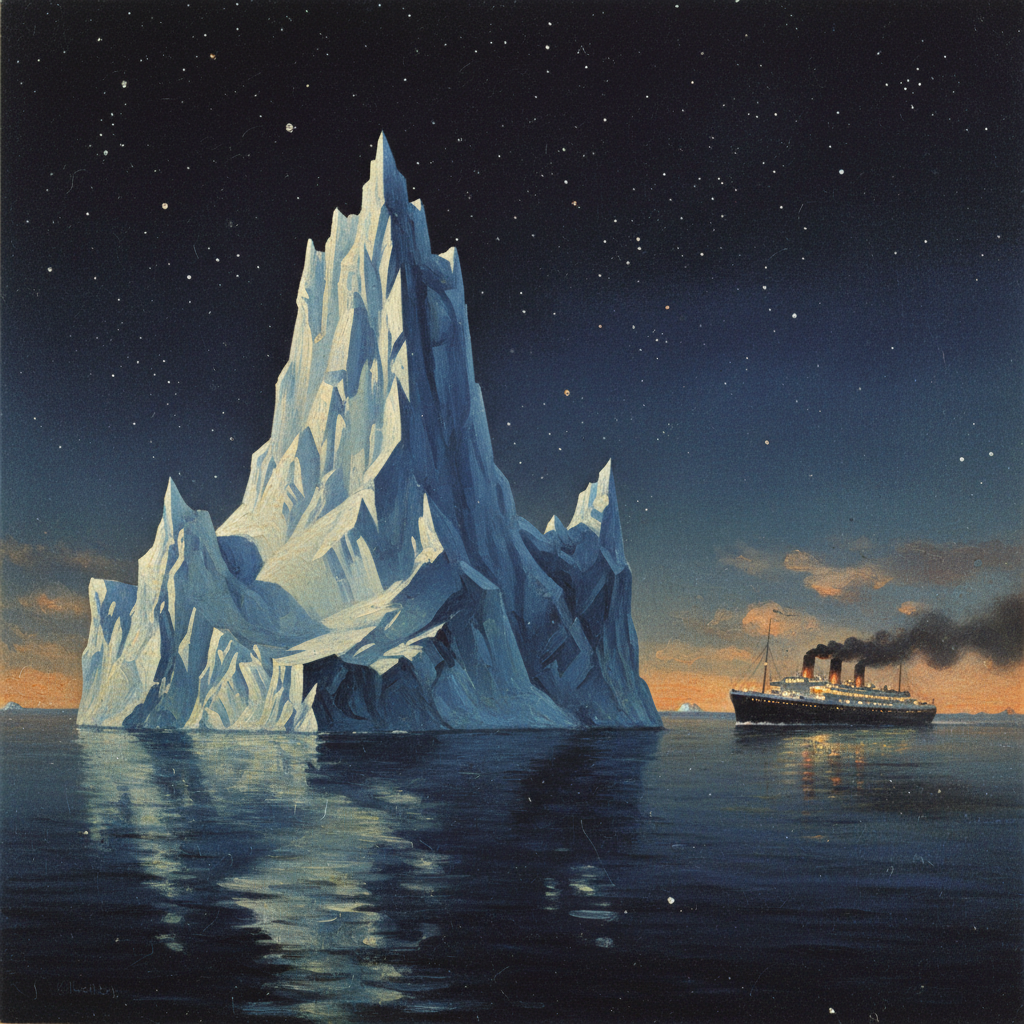
The winning entry, or what would have been the winning entry, was carved by a collective of Viennese secessionists who’d been kicked out of Austria for being altogether too weird, even for Vienna. They called their piece *Sehnsucht*, or ‘Yearning’. It was a sprawling, multi-spired abstraction, all jutting crystalline spires and deep, elegantly carved gouges. A masterpiece of negative space and precarious balance. It was also, from ninety percent of angles, almost invisible against the flat, starry horizon of the Atlantic. And it was drifting, majestically and with considerable momentum, directly into the busiest shipping lane in the world.
Captain Edward Smith of the RMS Titanic was a man untroubled by modern art. His concerns were ice, time, and the 1,300 souls who’d paid a premium for the privilege of not being in steerage. When the lookout screamed “Iceberg, right ahead!” Smith saw a berg. He did not see a 90-foot-tall metaphysical protest against the decorative arts. The bridge crew did their jobs. The ship turned. But *Sehnsucht* was wider and far more jagged than any natural formation. A spar of ice carved to represent man’s alienation from the divine raked across the starboard side like a can opener designed by a particularly spiteful god. As the liner began to list, a furious Marinetti was heard screaming from his trawler, “Magnificent! The machine, it dies! Ten out of ten! Who made this? I must know!”