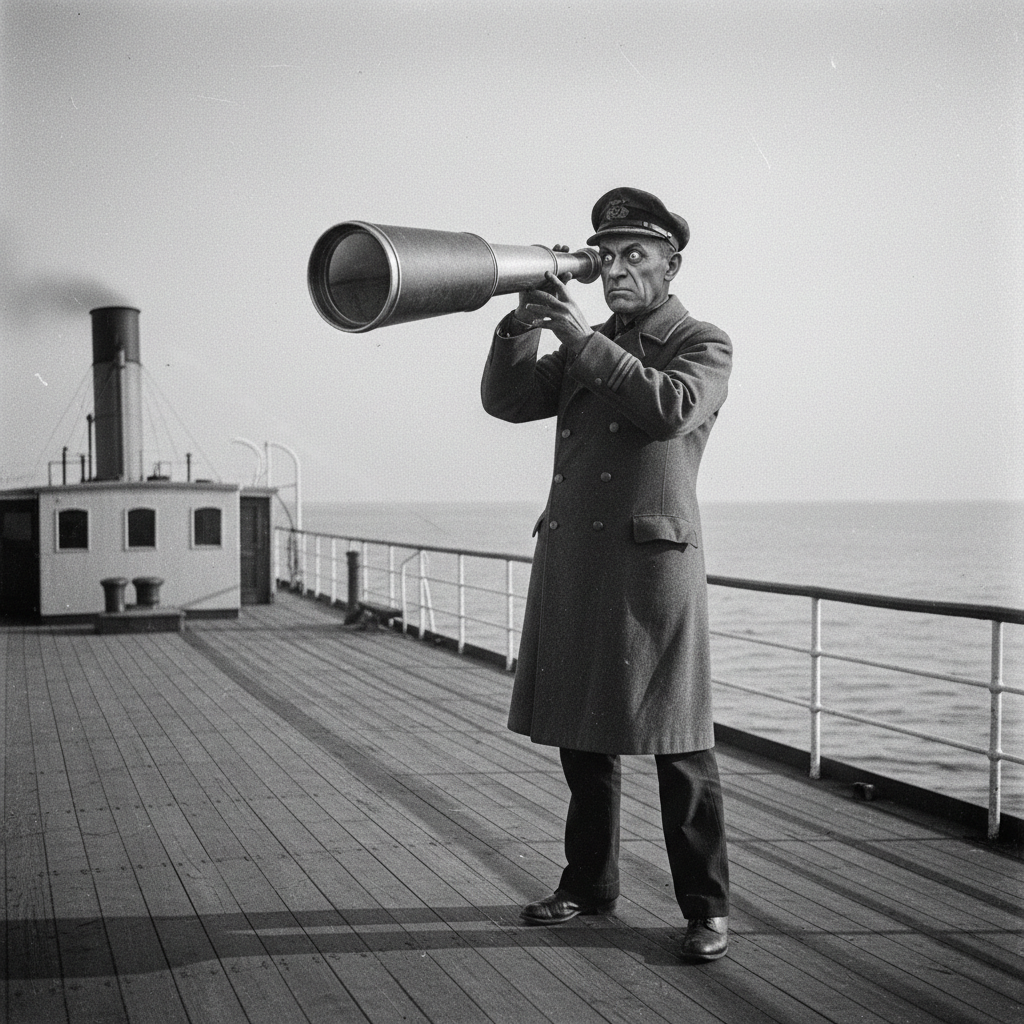
TITANIC SUNK BY BEASTS OF THE FROZEN NORTH
The Admiralty now concedes that a quadruped weighing six tons can, in fact, out-maneuver a vessel doing twenty-one knots.
Eleven thousand, three hundred and ninety pounds per square inch. That’s the rated crush resistance of a Mark IV riveted steel plate from Harland and Wolff, Belfast. A fine piece of work. I’ve seen them shrug off worse than a glancing blow in the North Atlantic. What they are not rated for, it turns out, is a nine-foot tusk swung with the full momentum of a creature last seen during the Younger Dryas stadial.
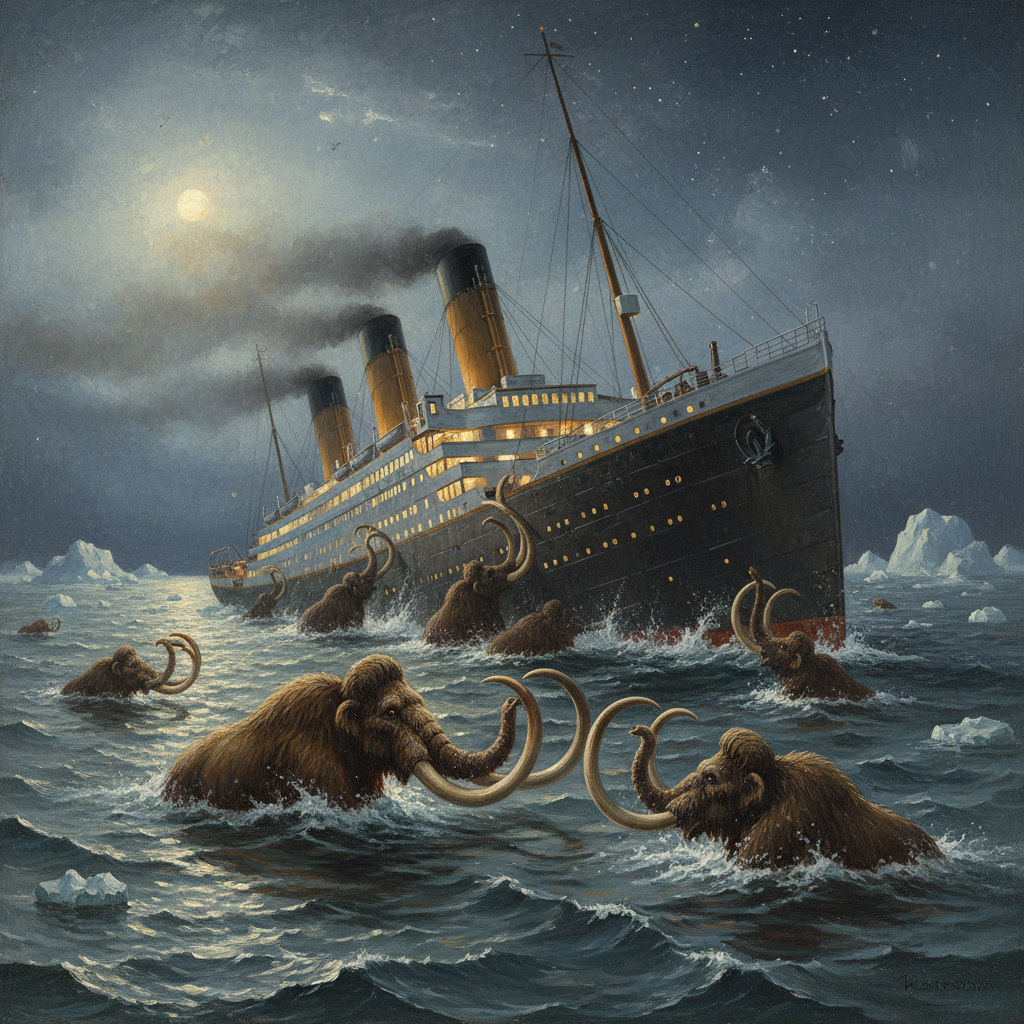
Down in the engine room of the RMS *Titanic*, they’d have felt it as a series of dull, percussive thuds—*whump-whump-CRUNCH*—not the long, grinding shriek of ice. Up on deck, the story was different. The Honourable Charles Rolls, a man who knew a thing or two about motive power, was heard to remark, “Is that a bloody mammoth?” It was. A whole herd of them, in fact, driven into the sea off the Greenland coast by a collapsed ice shelf. These weren’t your museum-piece skeletons, either. These were the working article, beasts of burden for the Greenland-Alaska Cryo-Shipping Company, a spectacularly ill-advised venture using cloned megafauna to harvest glacial ice for the cocktail bars of New York and London. Their tusks were capped with bronze fittings for hauling, their fur was branded, and they were, to a one, royally pissed off.
See, a mammoth isn’t an iceberg. An iceberg just sits there. A mammoth, particularly one whose entire working environment has just slid into the ocean, has what you might call ‘opinions’. One opinion was that the very large, very loud, very brightly-lit thing steaming towards them was the source of its woes. Another was that its tusks, evolved for fending off sabre-toothed cats, would do just as well on a 46,000-ton ocean liner. They didn’t scrape. They *punctured*. Six distinct, tusk-sized holes below the waterline, each one a clean three-foot bore straight through the hull plates. The watertight compartments—blast that cheapskate Ismay to hell and back for signing off on them—were overwhelmed in minutes. The pumps couldn’t keep up with a single hole that size, let alone half a dozen of them arranged like a bolt-pattern on a cylinder head.
The inquiry afterwards was a masterpiece of buck-passing. The White Star Line blamed the Cryo-Shipping Company for irresponsible animal husbandry. The Cryo-Shipping Company blamed the Danish government for failing to regulate glacial stability. Lloyd’s of London, faced with the single largest insurance claim in history, simply invented a new legal category, ‘Mega-Faunal Act of God’, and refused to pay a shilling. Captain Smith, who survived by clinging to a particularly buoyant bull mammoth, went on record stating the beasts showed “a remarkable and frankly unsporting grasp of hydrodynamics.” He spent the rest of his career piloting a ferry across the Solent, forever scanning the horizon for tusks.