Three-Toed Tyrants of the Textile Trade
How a Guild of Sentient, Sybaritic Sloths Cornered the Silk Market in Ancient Angkor
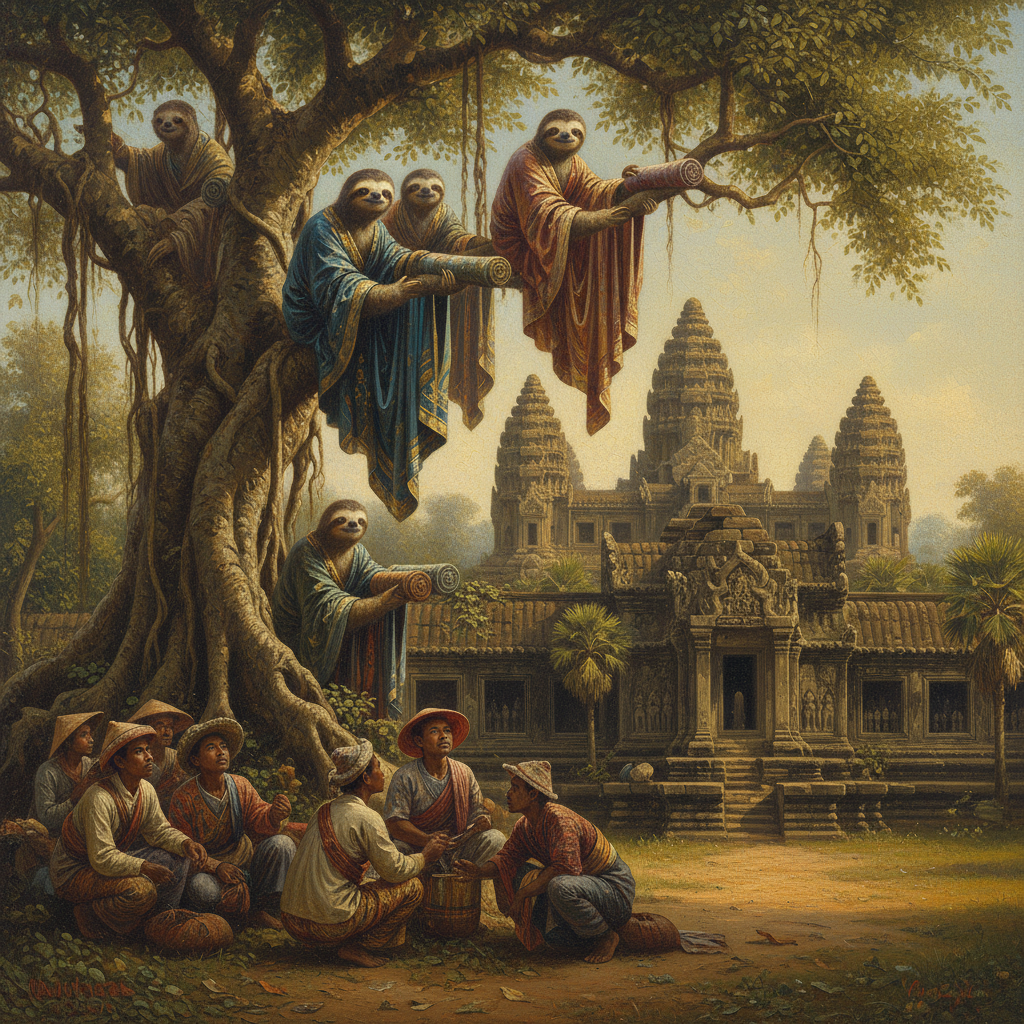
Everyone knows the Khmer Empire got stupidly rich off its advanced water management and—yawn—rice cultivation. But the real money, the filthy, empire-building, carve-a-god-king’s-face-on-a-mountain lucre, came from silk. And the best silk, the kind of stuff that felt like a lover’s whisper against your naughty bits, came from one place: the Angkorean Association of Arboreal Artisans, better known as the Sloth Guild.
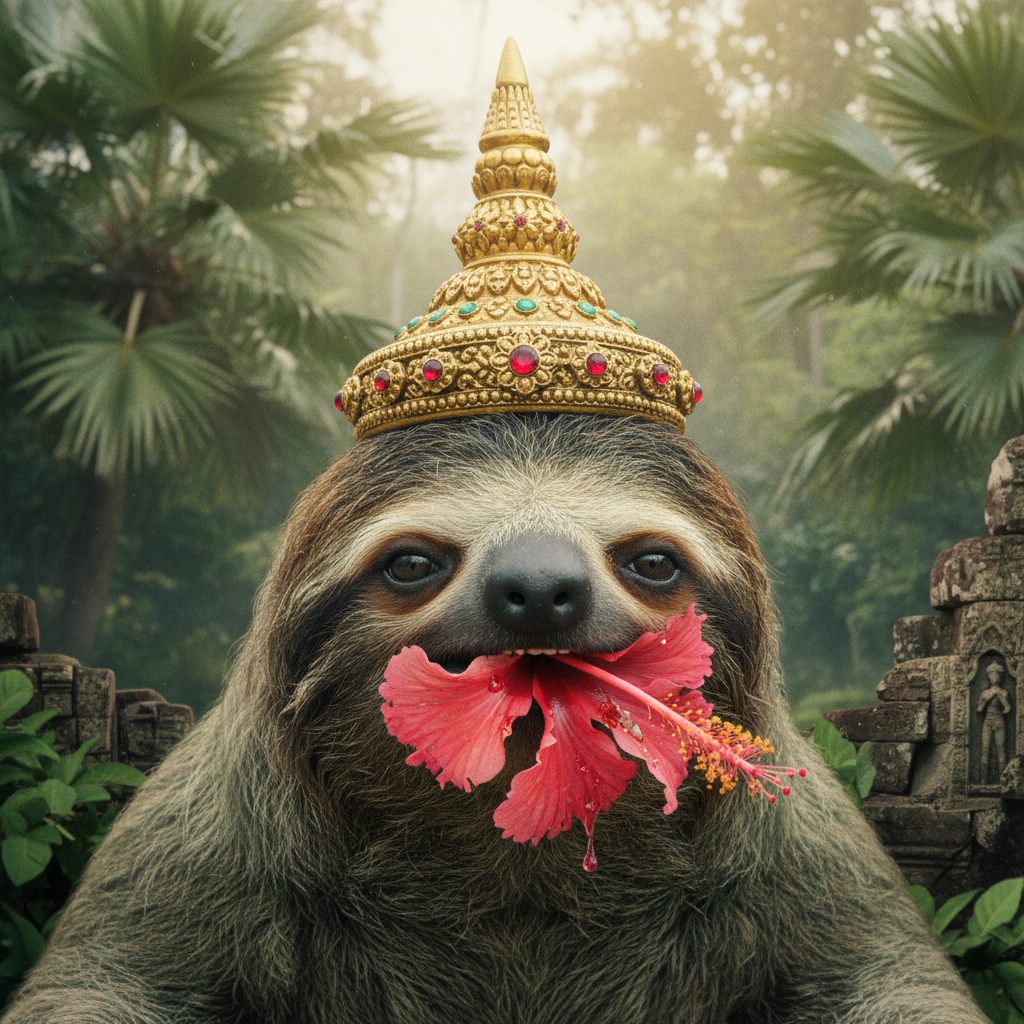
Now, official histories—the ones carved in stone by po-faced priests—tend to skip this part. But if you dig up the unofficial ledgers, say, the drinking-and-whoring diaries of our old friend, the perpetually clammy Brother Gerald of Cremona, you get the real story. The Guild wasn’t run *by* the Khmer, but by a dynasty of sentient three-toed sloths living in the canopies just north of the main temple complex. These weren’t your garden-variety, mossy tree-potatoes. We’re talking big, discerning bastards with a taste for fermented mangoes and a talent for weaving that was, frankly, supernatural. Their work was so fine, so impossibly lustrous, because their entire philosophy was based on a principle modern MBAs would never grasp: doing things really fucking slowly. They didn’t rush the worms. They didn’t rush the looms. A single bolt of *Sloth Silk*—as it was branded—could take a decade, each thread placed with a stoned, resinous focus that no human could ever match.
Of course, this came with drawbacks. King Suryavarman II, the egomaniac who commissioned Angkor Wat, apparently threw a legendary tantrum (a “hissy-fit of divine proportions,” according to Brother Gerald) when told the ceremonial curtains for his primary shrine wouldn’t be ready for his coronation. Or his son’s. Or his grandson’s. The Guild Master, a venerable old broad named ‘She-Who-Hangs-Heavy,’ reportedly sent back a message consisting of a single, perfectly woven middle finger, delivered by a junior sloth apprentice two years later.
You had to respect the hustle. These sloths were hedonists of the highest order. Their guild wasn’t just a business; it was a permanent, slow-motion bacchanal. They’d spend months perfecting a new dye made from beetle asses and psilocybin mushrooms, all while engaged in what could only be described as a fifteen-year-long orgy in the branches of a banyan tree. Foreign merchants were both mesmerized and horrified. The sloths’ languid, deliberate movements had a weirdly erotic quality, and more than one trader’s journal trails off into uncomfortable poetry about the “velvety softness of their fur” and their “knowing, ancient eyes.” Honestly, who can blame them?
The whole operation was too perfect to last. The Guild’s glacial pace actually stabilized the luxury market for centuries, creating a demand that was perpetually, tantalizingly unfulfilled. Eventually, though, some prick in Persia figured out a faster, shittier way to make silk, and the bottom fell out of the bespoke sloth market. The Guild faded into legend, presumably deciding that global trade was way more effort than just getting high and pleasuring each other for all eternity. A respectable choice, really.