The Wrong Brothers Take Flight
The infamous Kitty Hawk lift was just one of many cursed inventions to come out of the Dayton workshop.
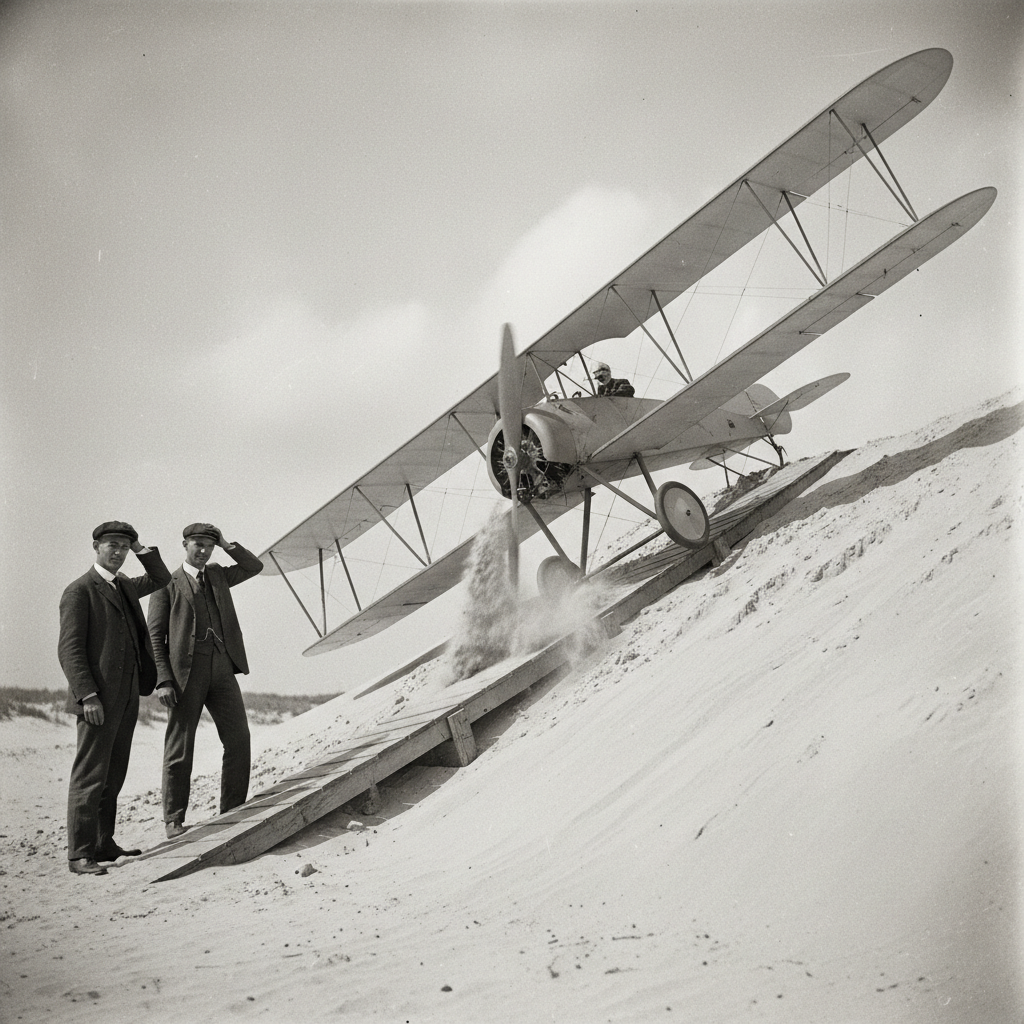
Let’s get one thing straight. The canard-and-pusher configuration of the 1903 Wright Flyer was a masterpiece of warped ash and muslin, yes, but the tolerances on that chain drive were a joke. A bicycle chain! To turn two 8-foot-6-inch propellers carved from solid spruce! I wouldn’t trust that setup to turn a butter churn, let alone lift a grown man. So when Orville and Wilbur fired up their rickety 12-horsepower engine on that North Carolina dune, the last thing that should have surprised anyone is that the whole contraption, instead of lurching forward, simply… tilted. And kept tilting. The chain, having slipped its sprocket, had snagged on the launch rail’s supporting frame. The propellers, now biting uselessly at the sand, dug in, and the entire 605-pound airframe began to haul itself, inch by groaning inch, up the 15-degree slope of the rail like a drunk climbing a ladder.
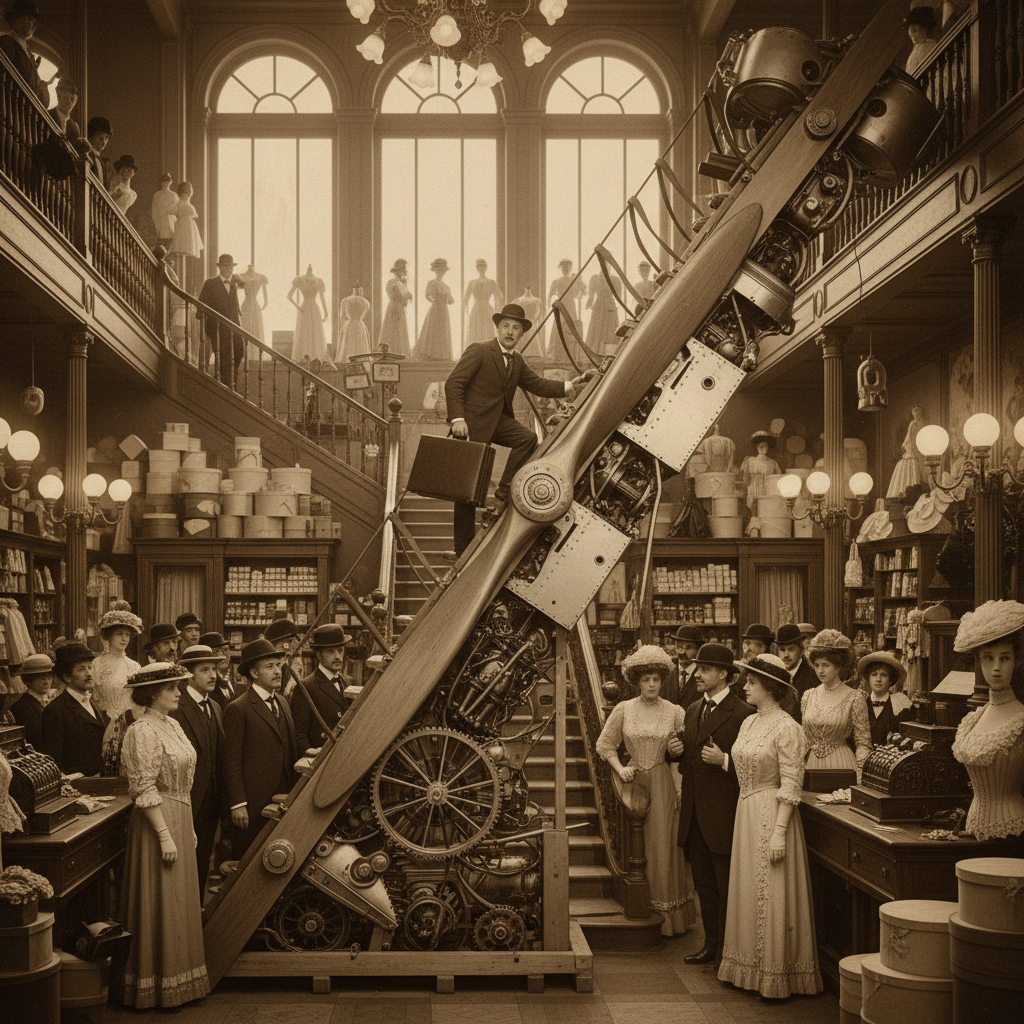
The brothers, to their credit, saw an opportunity. Flight was a fool’s game, a money pit for aristocrats and bird-brained dreamers. But hauling things *up*? That was industry. That was profit. Within a month, they’d filed a new patent, No. 743,899, for a “Self-Propelling Incline Conveyor.” Their mistake was in keeping the aeronautical vocabulary. The patent described a system of linked “wing sections” (steps) mounted on a continuous “fuselage chain” (drive) powered by a stationary “engine assembly” (motor). Their first and only customer, the owner of a Dayton dry-goods store named J.P. Humble, was immediately baffled. His contract specified a device to help his more corpulent clientele reach the second-floor corsetry department, not a grounded aeroplane bolted to his main staircase.
The resulting machine was a deathtrap. Christened “The Flyer,” it was essentially the Kitty Hawk launch rail, stood on its end, with wooden planks bolted to the chain. It moved at a terrifying seven miles per hour and made a noise like a threshing machine eating a bag of wrenches. There was no ‘off’ switch, only a kill-lever for the sputtering gas motor in the basement that required two men and a very long stick to operate. There were no sides, no emergency brake, and the top of the ascent terminated a full three feet *before* the floor of the second story, requiring a desperate lunge from the final, rapidly descending step. In its first week of operation, it de-wigged three dowagers, pantsed a city councilman, and launched a small child into a display of ceramic washbasins.
After the lawsuits bankrupted them, the brothers parted ways. Wilbur, broken, spent his remaining years designing increasingly unsafe playground equipment. But Orville, that magnificent bastard, doubled down. He founded the ‘Wright Aeronautical & Upwards Conveyance Company,’ securing a lucrative contract to install twenty “Flyers” in the bowels of a Pennsylvania coal mine. The miners, unamused at having to ride a machine that regularly mangled limbs and shed parts, went on strike. When management brought in Pinkertons to enforce the use of the infernal machine, the miners simply dismantled one of the Flyers, sharpened the spruce “wing sections” into spears, and barricaded the shaft. The subsequent siege, known as the “Battle of the Upwards Conveyance,” was the bloodiest labour dispute in a decade. The final image from the debacle? A photograph of a grim-faced union man, holding a sign that simply read: “WE WILL WALK.”