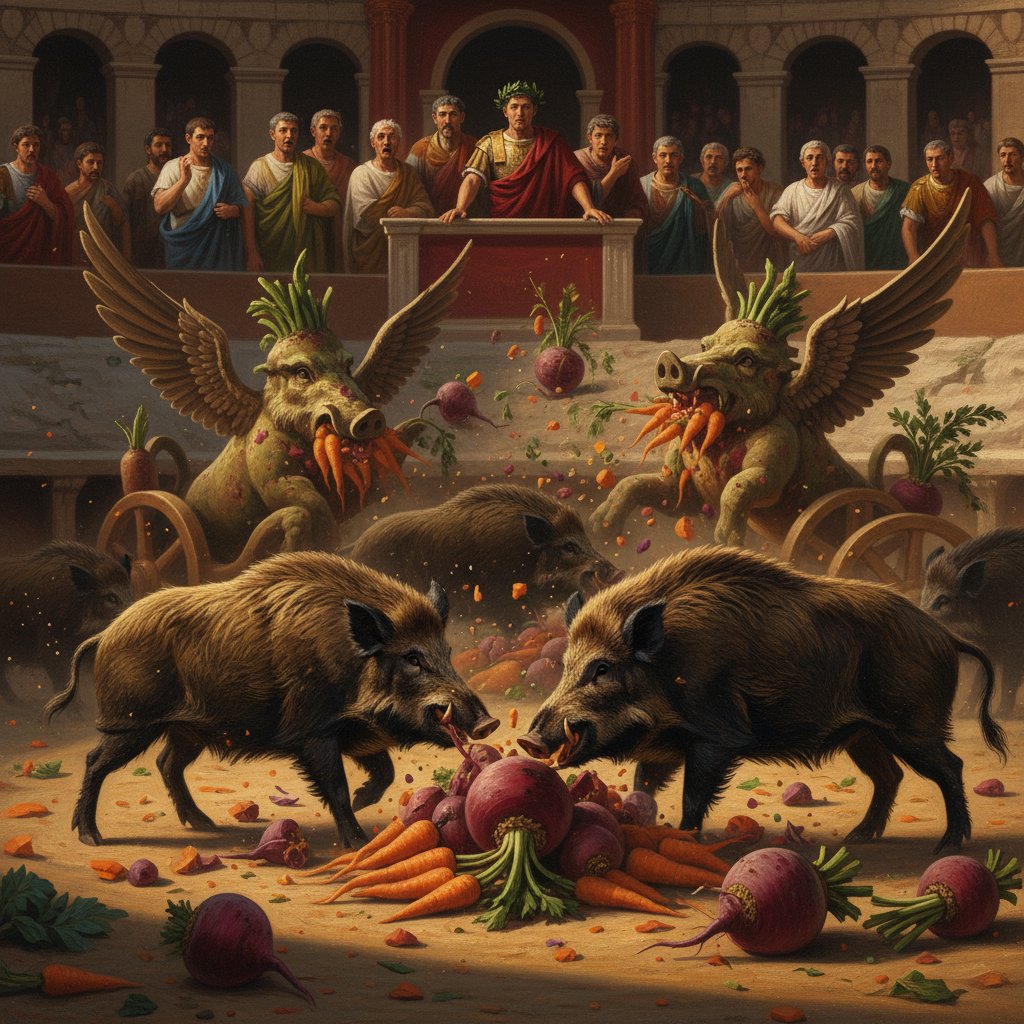
The Turnip Triumphs
That time a disastrously bad translation of an Etruscan fertility rite saw the Roman Senate replace gladiatorial combat with competitive root-vegetable carving.
The Romans, it must be said at the outset, never truly understood the Etruscans, a people whose mercurial, occasionally dour, sensibilities were as alien to the Latin mind as the smoky entrails upon which their haruspices so gloomily pronounced. My disgraced former colleague, the execrable Professor Beard (no, not that one), has long maintained that Rome’s absorption of its northern neighbours was a cultural triumph; it was, of course, a catastrophe from which the peninsula has yet to recover, a slow poisoning of a once-robust Republican spirit. The final, and perhaps most farcical, act of this long-running Etruscan revenge came not with a dagger, but with a dictionary.
At issue was the translation of the *Libri Fulgurales*, one of the few Etruscan texts not immediately pulped for building materials or used to stuff cushions. A junior quaestor, one Appius Claudius Crassus—a nephew of the great triumvir, and possessed of none of his uncle’s grasping intellect but double his arrogance—was tasked with rendering a particularly obscure passage concerning a spring fertility festival into serviceable Latin. The rite in question involved the ceremonial presentation of prize-winning tubers to the goddess Turan, accompanied by a ritualised mock-combat between priests. Crassus, whose grasp of the Etruscan definite article was tenuous at best and who seems to have confused the word for ‘sword’ (*ensis*) with the word for ‘parsnip’ (*pastinaca*), produced a translation of such staggering incompetence that it would have earned a lesser man a swift introduction to the Tarpeian Rock.
His version, presented to a Senate committee already addled by a tedious debate on grain subsidies and a particularly enervating batch of Falernian wine, suggested that the Etruscans had maintained civilizational harmony for centuries not through bloodshed, but through the public, competitive sculpting of root vegetables. The mock-combat was misinterpreted as an artistic rivalry; the offering to the goddess, a juried prize-giving. The senators, moved to tears by what they perceived as a lost age of rustic piety—*O, ubi est illa simplicitas antiqua?*—and perpetually worried about the city’s spiralling budget for feeding and housing gladiators whose primary marketable skill was creative disembowelment, saw an opportunity. In a fit of misguided fiscal and moral rectitude, they voted to replace the *ludi gladiatori* with the *ludi vegetabilis*. All of them.
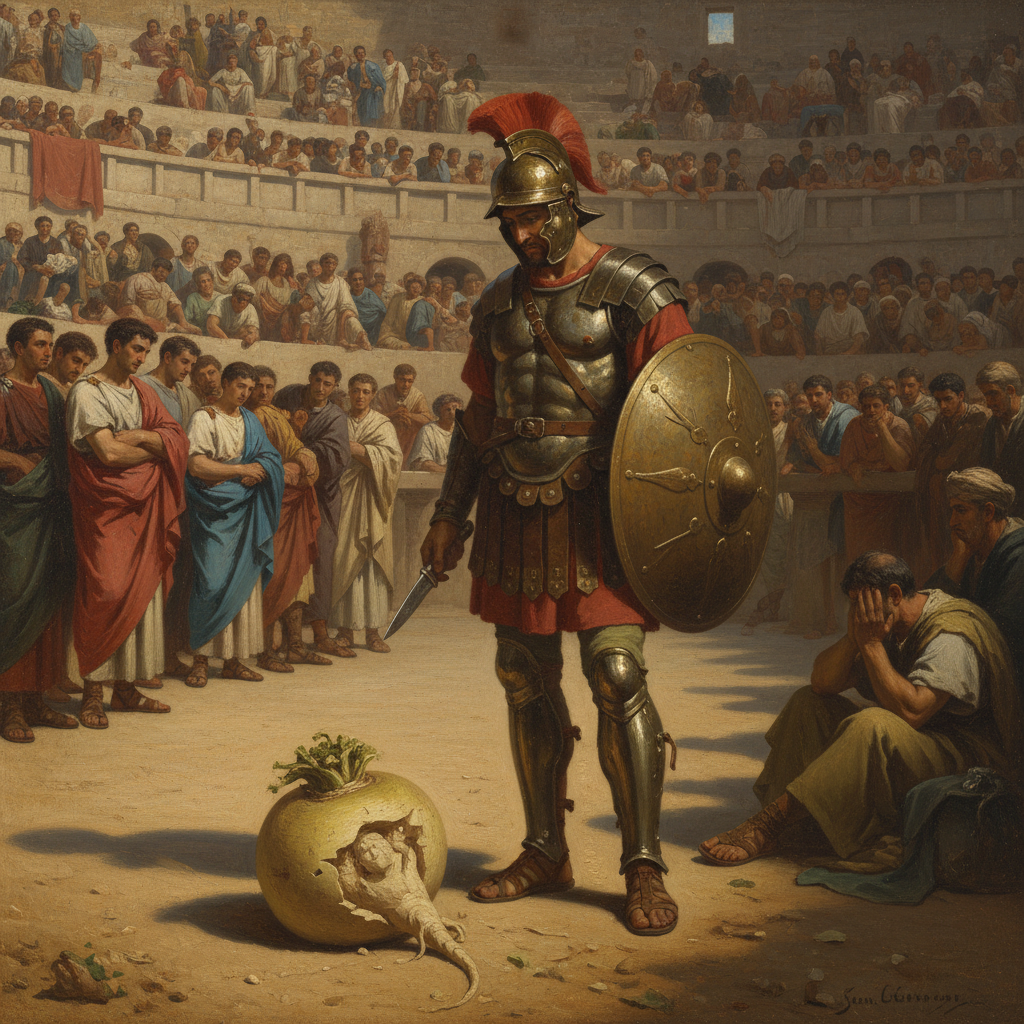
The public reaction was, to put it mildly, unenthusiastic. Where once the sands of the Colosseum had been soaked with the blood of Thracian and Samnite, they were now littered with the mangled peels of beets and the discarded tops of carrots. The inaugural games saw a former legionary attempt to carve the Rape of the Sabine Women into a large yam, only to slip and geld himself with his own whittling knife. The crowd, which had been on the verge of rioting, went silent, then broke into the first spontaneous applause of the day. The only truly popular event became the ‘Damnatio ad Bestias’, where criminals were smeared with honey and tossed not to lions, but to a vast and ravenous horde of imported Umbrian boars, who found them, and the surrounding vegetable arrangements, equally delicious. The Flavian Amphitheatre, once a temple to martial prowess, became a sticky, smelling monument to agrarian failure. A truly wretched business.