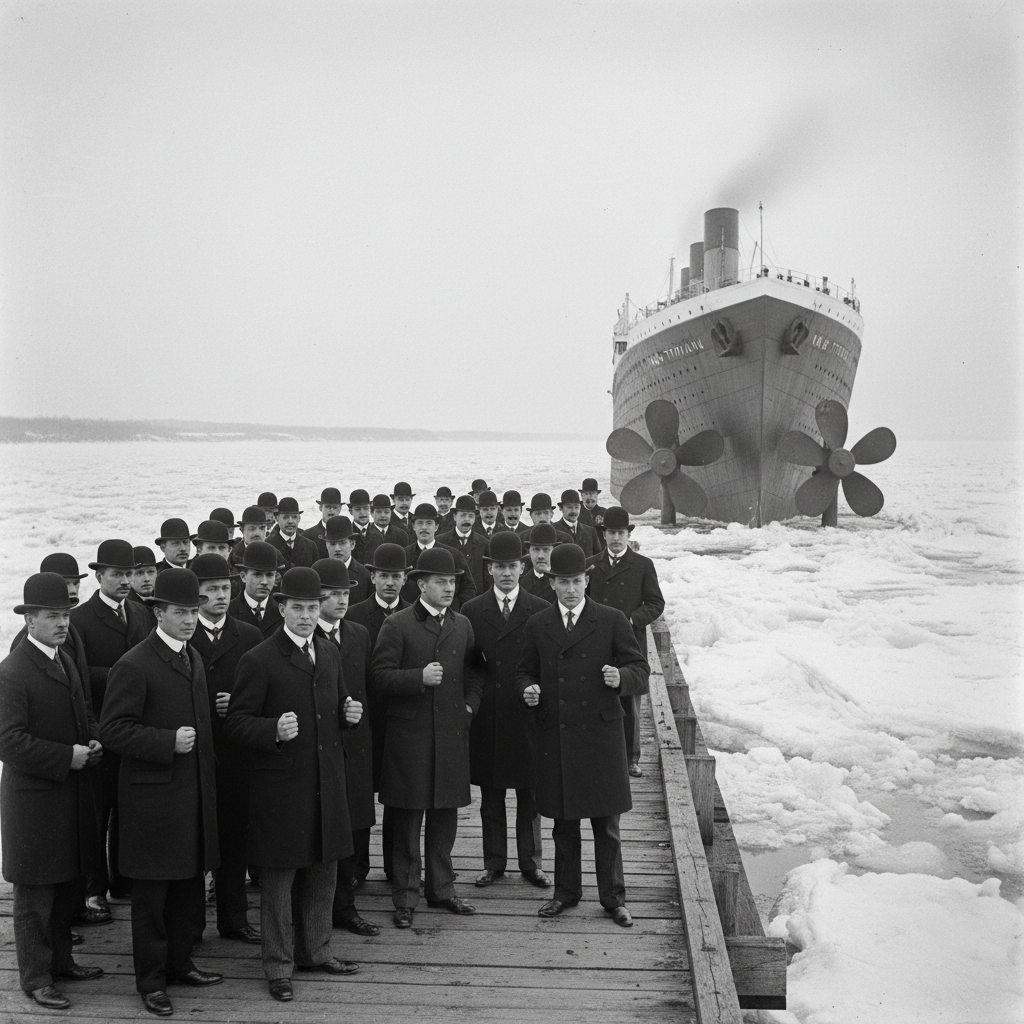
The Titanic, On Ice, In a Bad Way
That time the White Star Line’s unsinkable marvel became London’s most expensive and inconvenient bridge.
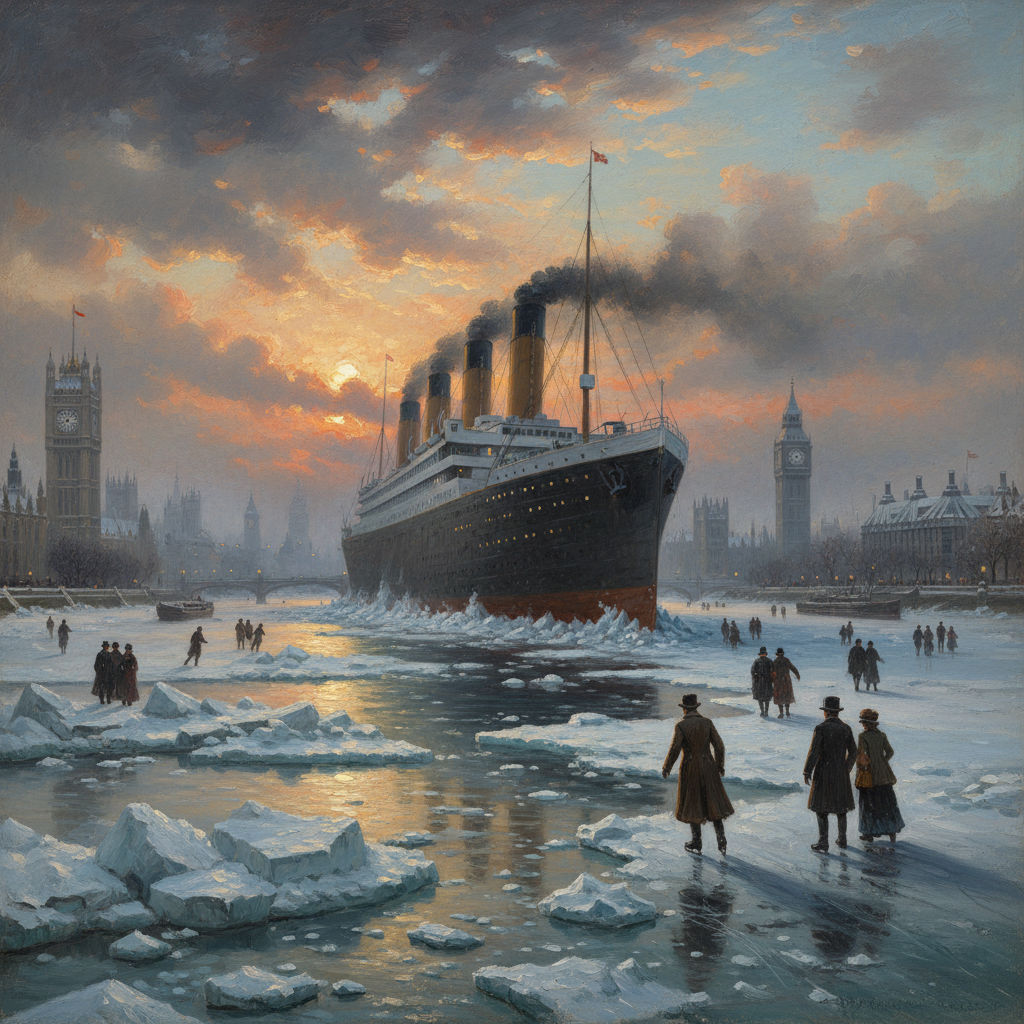
The dendrochronology is clear. The ring for 1912 in the oaks of the New Forest is thin, pale, and constricted. It speaks of a bitter, unseasonable cold. A cold front, channelled by an atmospheric blocking pattern nobody at the Met Office understood, slammed south across the British Isles in the second week of April. It wasn’t the North Atlantic that claimed the RMS *Titanic*; it was an entirely avoidable, deeply embarrassing patch of river ice, ten miles east of Gravesend, on the Thames.
The freeze was a consequence of the Maunder Minimum—a period of vanishingly few sunspots—arriving eighty years late and with a petty disposition. While the rest of the world’s scientists were marvelling at the dawn of quantum physics, the sun decided to take an unscheduled holiday. For the *Titanic*, poised for her maiden voyage from Southampton, the timing was exquisite. A last-minute switch of departure port to London, a publicity masterstroke by a J. Bruce Ismay eager to show his prize off to the capital’s elite, proved to be the fatal error. The ship, built to smash through North Atlantic pack ice, found herself wedged solid in the freshly frozen Thames Estuary, its hull groaning like a pinched aristocrat.
The first week was a farce. White Star Line assured the press that this was a temporary, almost picturesque, delay. Passengers were plied with bouillon and brandy on the frozen promenade deck. Londoners with a few shillings to spare could skate up to the immobilised leviathan and get a tobacconist’s photograph taken. But as the freeze held, the mood soured. The ship’s 840 tons of coal, intended for a transatlantic sprint, were now being burned just to keep the lights on and the pipes from bursting. The 40 tons of potatoes were rationed. The ship’s orchestra, having exhausted ‘The Blue Danube’, reportedly attempted a mournful dirge on foghorns, a performance the *Daily Mail* described as “a clarion call from the bowels of a constipated god.”
By May, the *Titanic* was no longer a ship; it was a crisis. The Port of London Authority, citing the ‘Thames Conservancy Act of 1857, section 4, sub-paragraph C’, declared the vessel a public nuisance and a hazard to navigation, a finding Ismay contested on the grounds that nothing *else* was navigating the bloody river either. Royal Engineers were brought in to see if they could dynamite the ice, an idea quietly shelved when it was pointed out that the resulting shockwave would likely pop the *Titanic*’s hull rivets “like a string of cheap pearls.” The ship was evacuated, its passengers decamping at Tilbury with their holiday plans in tatters, leaving the pride of the White Star Line a silent, frozen monument to bad solar weather and worse PR.
The great thaw, when it finally came in late June, was not the release everyone hoped for. The shifting ice did what the iceberg never could, warping the hull plates and straining the great ship’s spine. She was eventually towed, not to New York, but to the Harland & Wolff shipyard in Belfast, arriving with a distinct list and a smell of spoiled cabbage. The unsinkable ship had been defeated not by an act of God, but by a meteorological tantrum and the fine print on a river conservancy act. Her new name, under new, less ambitious owners, was the SS *Slightly Bent*.