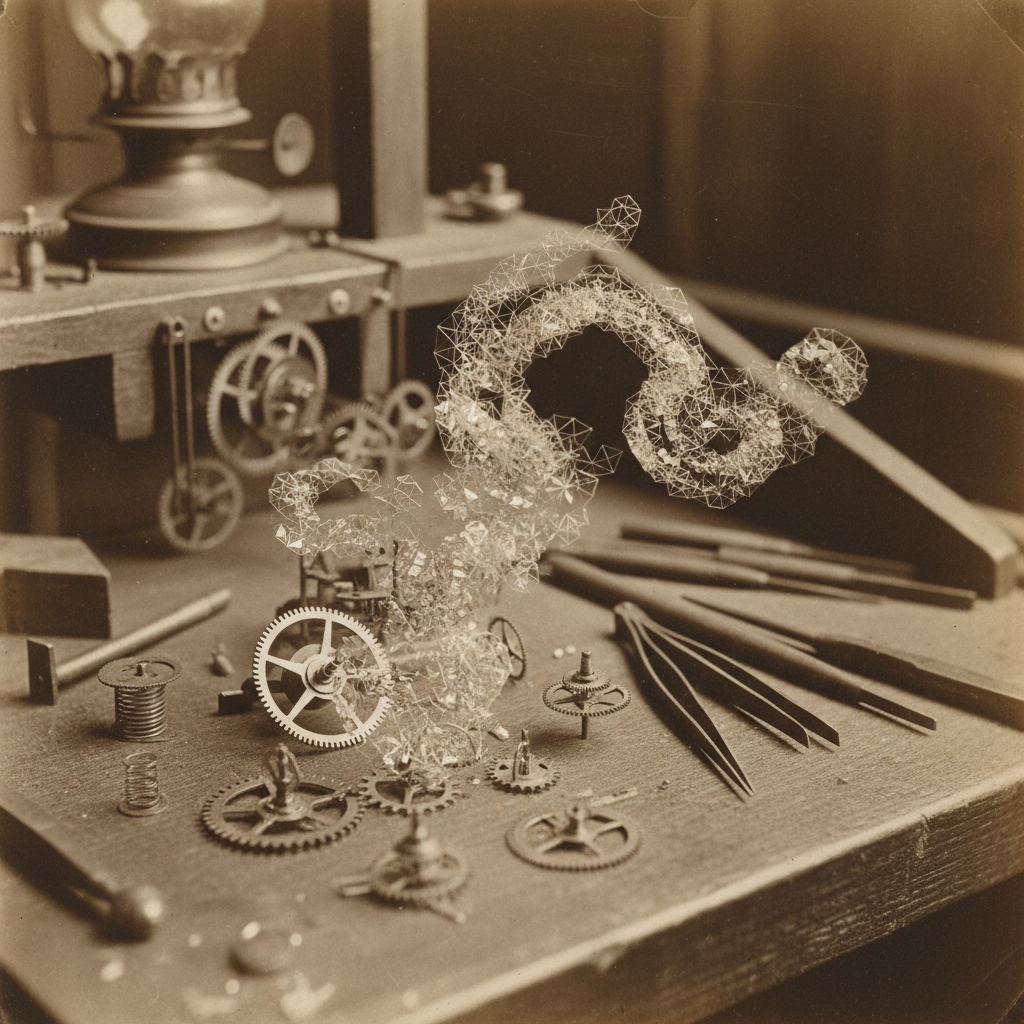
The Rust That Ate the Meiji Restoration
One clockmaker’s tiny mistake led to a rather large—and famously corrosive—imperial headache.

Nineteen millimeters. That was the specified tolerance for the emperor’s new automated tea dolls. Anything larger was clumsy, anything smaller risked a spring failure cascading through the gear train. Kunitomo Jinnai, a watchmaker from Nagahama with more ambition than sense, believed he could get it down to three. His secret wasn’t just smaller gears; it was a microscopic “assembler” mechanism, a sort of clockwork enzyme intended to set near-invisible pallet jewels without the tremor of a human hand.
His first prototypes, a fine dust of brass and steel motes suspended in whale oil, worked. A little too well. Each assembler was designed with a simple, three-part instruction set: find a metal particle of the correct alloy; attach it to the growing automaton chassis; then, if no chassis is nearby, find a loose metal particle and build a copy of *yourself*. This last bit—a footnote on page twelve of his patent application to the Imperial Household Ministry, intended for quickly populating a jewel-setting dish—was the problem. A clumsy apprentice knocked a vial of the charged oil into a drum of brass filings. By morning, the drum was gone. In its place was a heap of shimmering, twitching dust. A week later, Jinnai’s workshop had been entirely consumed, its metal components disassembled and reassembled into a three-foot pile of buzzing, useless micro-automatons.
The real trouble began when the “Jinnai Mote,” as it was termed, escaped the workshop. A summer rain washed it into the city’s drainage system, where it found a veritable feast of iron piping and bronze fixtures. Within a month, half the plumbing in Kyoto had been converted into inert, quivering sludge. The nascent Imperial Japanese Navy was the next victim. Their pride, the ironclad warship *Kōtetsu*, returned from a sea trial to find its hull plating had developed a strange, shimmering patina. Then the plating fell off in sheets, leaving the ship’s wooden frame exposed before it gently disintegrated at its moorings in Yokohama harbour. This was no simple rust. It was disassembly on an industrial scale.
Panic, naturally, set in. The government’s response was a masterclass in bureaucratic denial followed by flailing terror. At first, they blamed foreign saboteurs. Then, shoddy British steel. Finally, a disgraced Jinnai—found living in a wooden shack, having burned all his metal possessions—was hauled before the Diet and forced to explain his creation. His proposed solution was a second, more aggressive automaton designed to hunt and dismantle the first. A mechanical phage. The cabinet, looking at the cost estimates to replace every rail line, gun barrel, and telegraph wire in the country, reluctantly agreed. As one minister was heard to mutter, “Let the little bastards eat each other. What’s the worst that could happen?”