The Night Minsmere Went Mad With Gunpowder
That wasn’t a dragon, you daft sods, that was Tuesday.
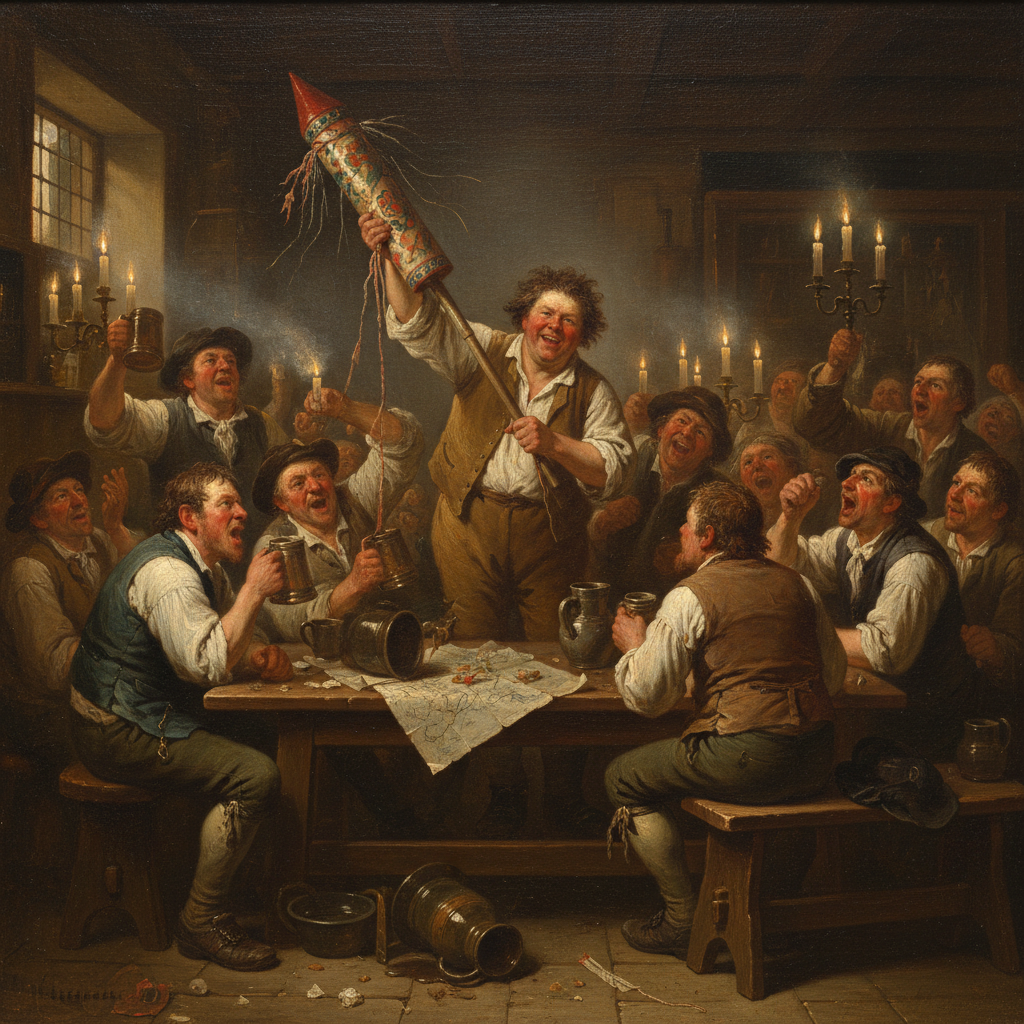
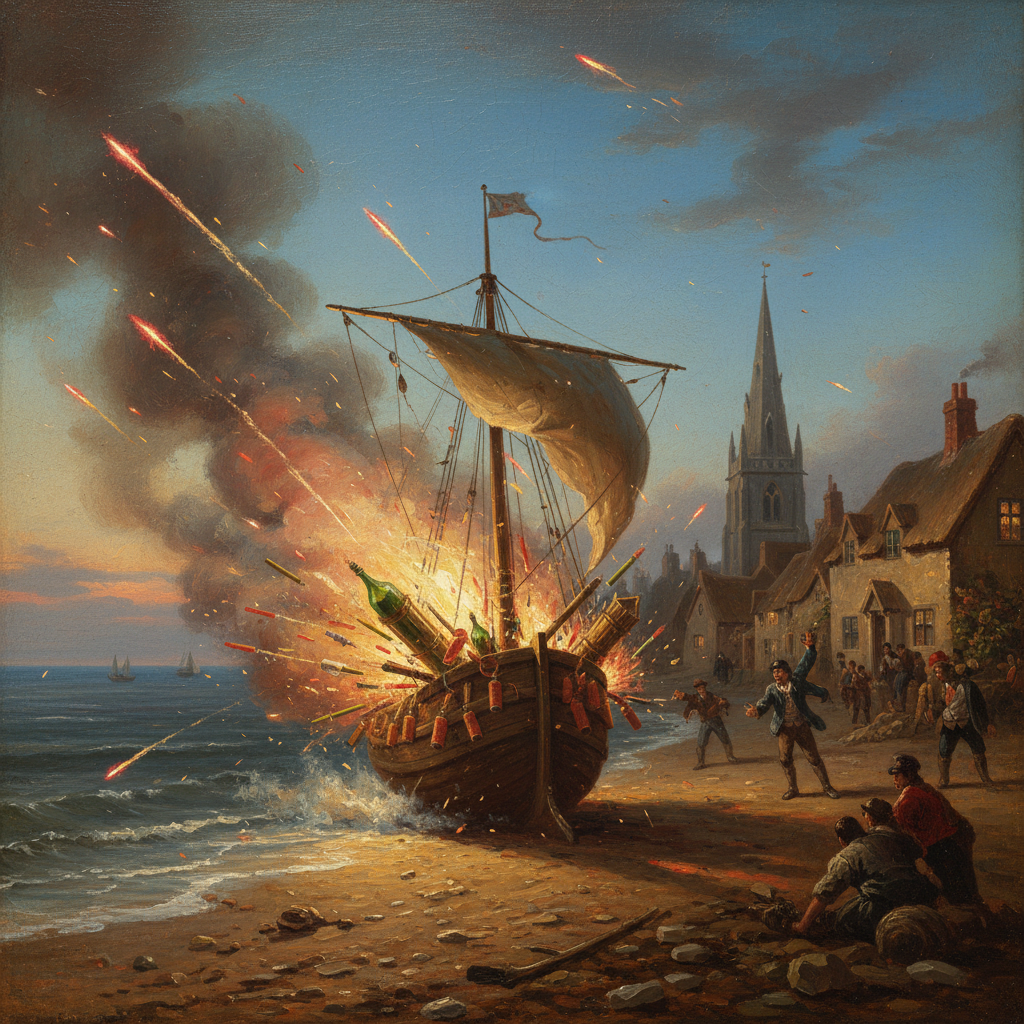
'''Do you know what they say about a gift that arrives by sea? My grandmother told me that you must always ask what the ocean asked for in return. Sometimes it’s a ship, sometimes it’s a sailor’s life, and sometimes, if you are very, very unlucky, it is the quiet of your village for a generation. The good people of Minsmere, Suffolk, learned this the hard way in 1780. What the sea gave them was a shipwreck, a broken-backed merchantman called the *Triumphant Turtle* that had been bound for the Christ-child fairs in Hamburg. What it asked in return was their sobriety. And what the ship spilled on their shingle was not the cheap German toys the manifest promised, but forty-eight crates of finest-grade celebratory fireworks from Liuuyang. Forty-eight crates of gunpowder, silk, and paper, all stamped with a dragon and a warning in a language no one in Suffolk could read. A gift, indeed. My friend Dr. Agnes Callard—who owed me a story for that little bit of unpleasantness with the Baba Yaga archive in Perm—says the first step to hell is a bad translation. In Minsmere, it was no translation at all. The villagers, seeing the bright paper and the beautiful calligraphy, assumed they’d been blessed with a trove of exotic teas or silks. They hauled the crates inland, crowbarred one open in the vicarage, and found not fragrant leaves, but hard paper tubes, long fuses, and a great deal of black powder. And what does an Englishman do when confronted with a tube full of gunpowder? Ah, you know the answer already. He looks for a way to make it go *bang*. He does not, you will note, ask *why* a Chinese artisan might have packed it so carefully. The first experiments were modest. A few fizzers set off in a field to scare the crows. Then young Thomas Pye, a lad whose ambitions had always outstripped his sense, got the idea to strap one of the larger tubes—one painted with a particularly fierce-looking golden dragon—to a fencepost. The resulting explosion, which they called the Great Minsmere Comet, not only obliterated the fencepost but also most of the vicar’s prize-winning pumpkins and, crucially, sent the rocket casing a quarter of a mile into the air before it came down in a shower of gold sparks. This, my friends, was the moment the quiet died. It turns out that if you give a village of bored, drunk Englishmen a hoard of military-grade pyrotechnics, they will not invent a festival. They will invent an arms race. A very, very stupid arms race. Within a month, the village was divided into warring rocketry clubs. The ‘Minsmere Sky-Rippers’ and the ‘Loyal Order of Heavenly Gentlemen’ spent their days strapping firework clusters to anything that wasn’t nailed down. Wheelbarrows, beer barrels, a particularly unfortunate scarecrow named ‘Lord North,’ and, in one glorious and ill-advised test, the church steeple. The arms race reached its apex when the Sky-Rippers, high on smuggled brandy and patriotism, bolted forty-seven of the largest skyrockets to a clinker-built fishing boat they christened ‘The King George’s Revenge.’ Their goal was France. Their trajectory, however, was the local magistrate’s drawing-room window, where he was busy drawing up a warrant for their arrest. As the magistrate’s daughter later wrote in her diary, “Father was terribly cross. There was a boat in the parlour, and the curtains were on fire again.”'''