The Neighs Have It: Caligula’s Horse and the Consulship That Wasn’t a Joke
A modest proposal involving oats, a toga, and 1.8 million sesterces in backfired senatorial satire.
It is a common error, born of the lurid nonsense scribbled by Suetonius and his ilk, that the Emperor Gaius Caligula himself originated the notion of appointing his horse, Incitatus, to the consulship. The truth, as is so often the case, is both more banal and infinitely more humiliating. The idea was a joke, you see, and like most jokes made by the terminally witless, it was born of desperation in the senatorial changing rooms. The perpetrator was one Cassius Chaerea—a man whose principal contribution to history, besides a perpetually aggrieved expression, was a voice so squeaky it embarrassed pigeons.
Chaerea, along with a clutch of other patricians whose family trees were considerably more impressive than their political instincts, decided upon a little light satire. If the Princeps was going to treat them, the conscript fathers of Rome, as little more than beasts of burden, then they would show him what a *real* beast of burden looked like in office. The plan, hatched over far too much Falernian wine, was simple: during the next session, they would formally nominate Incitatus for the consulship, read a long and ludicrously laudatory speech, and expect the Emperor to storm out in a rage. They had even prepared a suitably grovelling apology. What they had not prepared for was Caligula’s reaction, which was not rage, but delight.
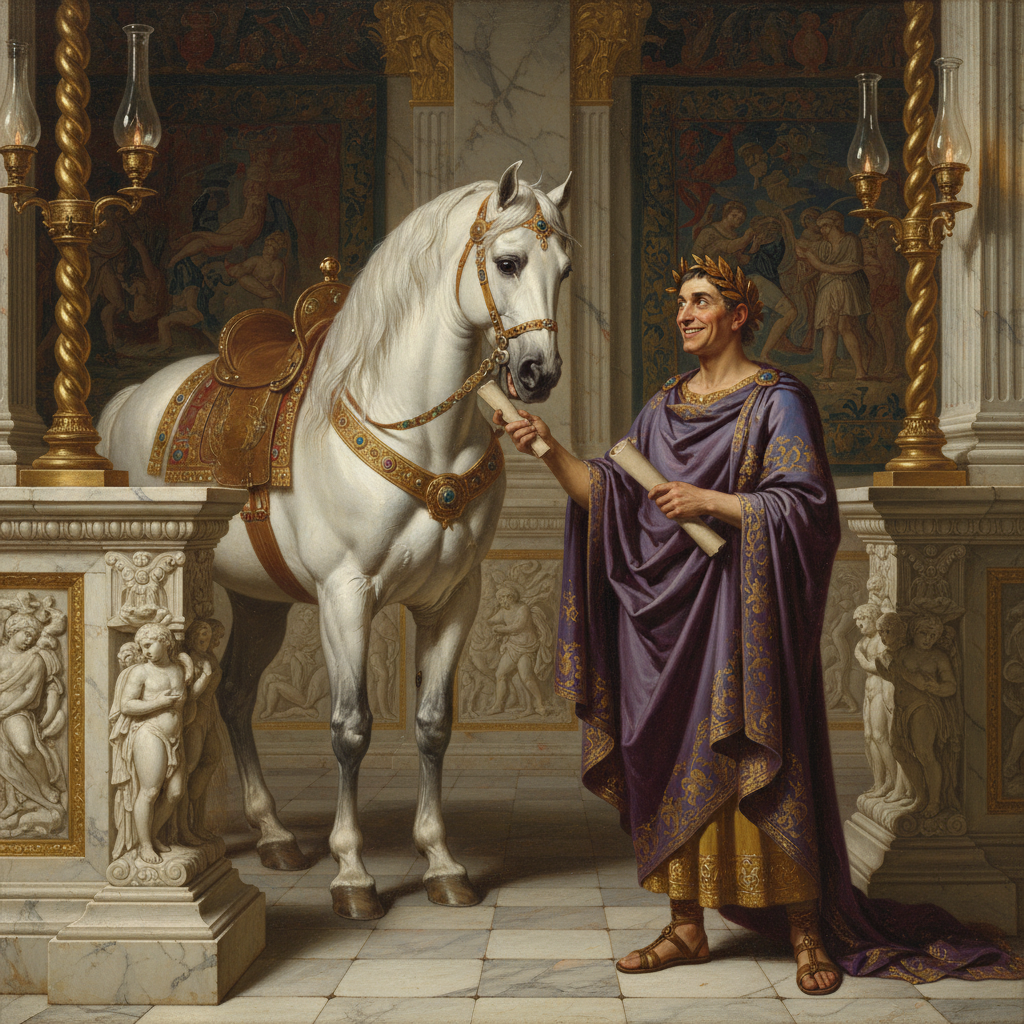
He thought it a triumph. Here, at last, was a senator with some vision. While Chaerea’s high-pitched panegyric squeaked its way through the Curia—praising the horse’s stable upbringing, its consistent policy on oats, its strong hindquarters so vital for kicking Carthage should the need arise—Caligula did not scowl. He beamed. He seconded the motion. He then improved upon it. Incitatus would not merely be consul, but *pontifex maximus* as well. And his stable, a marble affair with an ivory manger, would be designated a temple, with a monthly budget of 50,000 sesterces for sacrificial barley. The conspirators watched, their blood turning to ice-cold sludge in their veins, as the Emperor announced a salary for the new consul equivalent to 1.8 million sesterces, backdated to the start of the fiscal year.
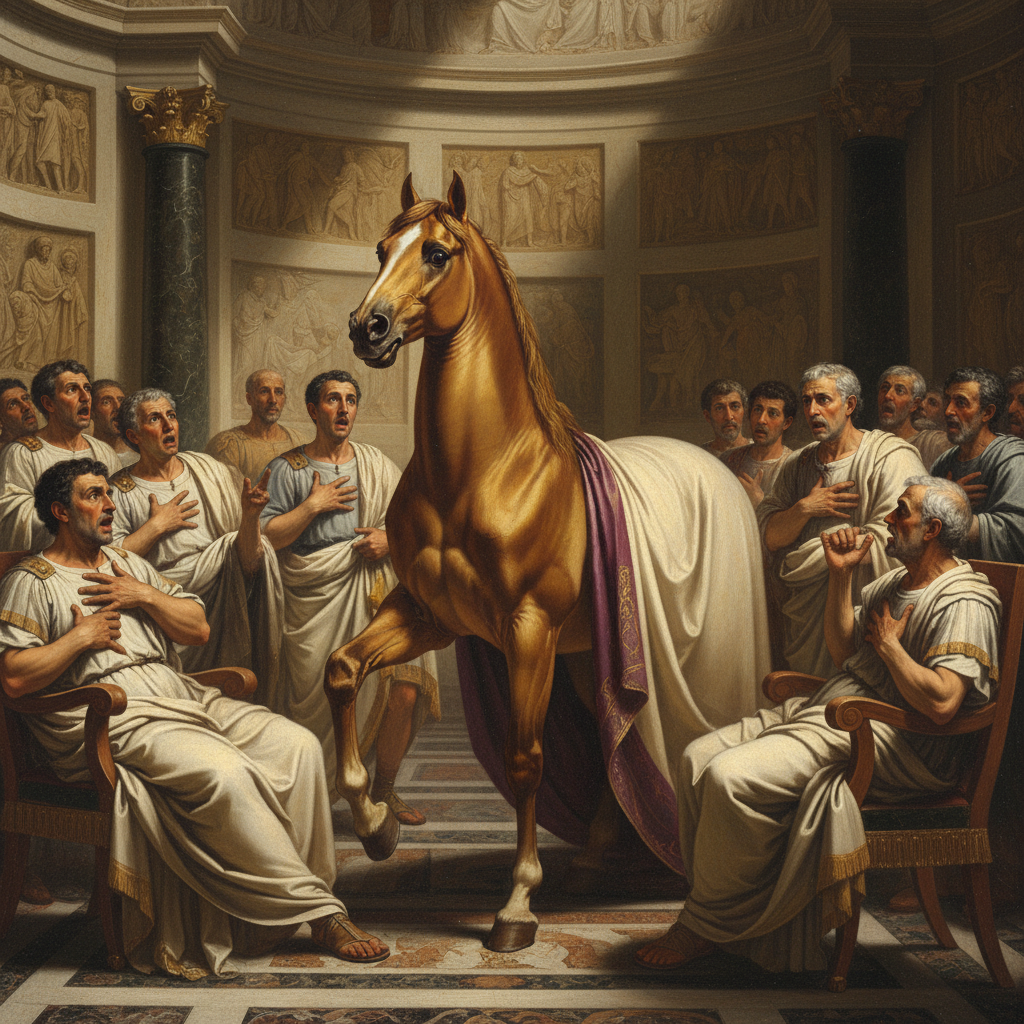
The real genius of Caligula’s counter-move, a piece of political theatre that puts him in the same league as Alcibiades trimming his dog’s tail, was his insistence on the full procedural honours. The horse, draped in a specially commissioned *toga praetexta* and led by a bewildered-looking German slave, was made to attend every senatorial session. Its opinion had to be sought on all matters of state. This led to protracted, excruciating silences in which grim-faced senators were forced to divine the will of the gods from the swish of a tail or, on one memorable occasion involving a poorly digested bale of hay, a loud and resonant fart. One junior senator, attempting to curry favour, was permanently deafened trying to interpret a sneeze during a debate on grain prices in Alexandria.
The prank, naturally, metastasized into policy. The ‘Equine Faction’ became a terrifyingly real voting bloc, its intentions interpreted solely by Caligula, who used it to break deadlocks and veto legislation he found tiresome. Chaerea and his co-conspirators were bankrupted within six months trying to keep up with the mandatory donations to the ‘Temple of Incitatus’, their every sycophantic gesture towards the horse a fresh, public humiliation. When Chaerea finally did draw a dagger, it was less from a desire to restore the Republic and more from an inability to face another meeting where the fate of the Dacian frontier was decided by which direction a horse urinated. As Tacitus might have observed, *corrumpere et corrumpi saeculum vocatur*. They make a desert and call it satire. Utterly graceless.