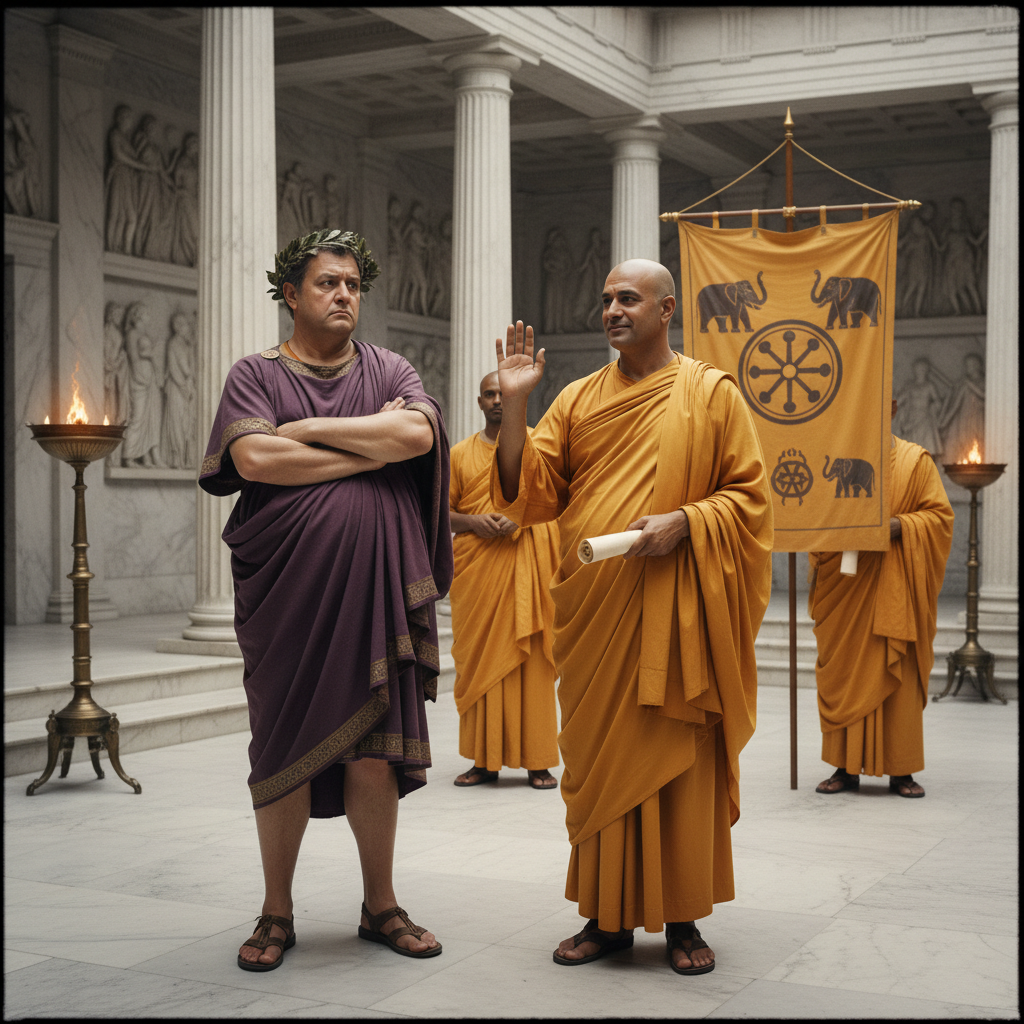
THE MAURYAN EMPIRE’S FOREIGN POLICY: NOW WITH 100% MORE CONFUSED GREEKS
How a calamitously bad translation of Homer turned Ashoka the Great into history’s most baffling pacifist.
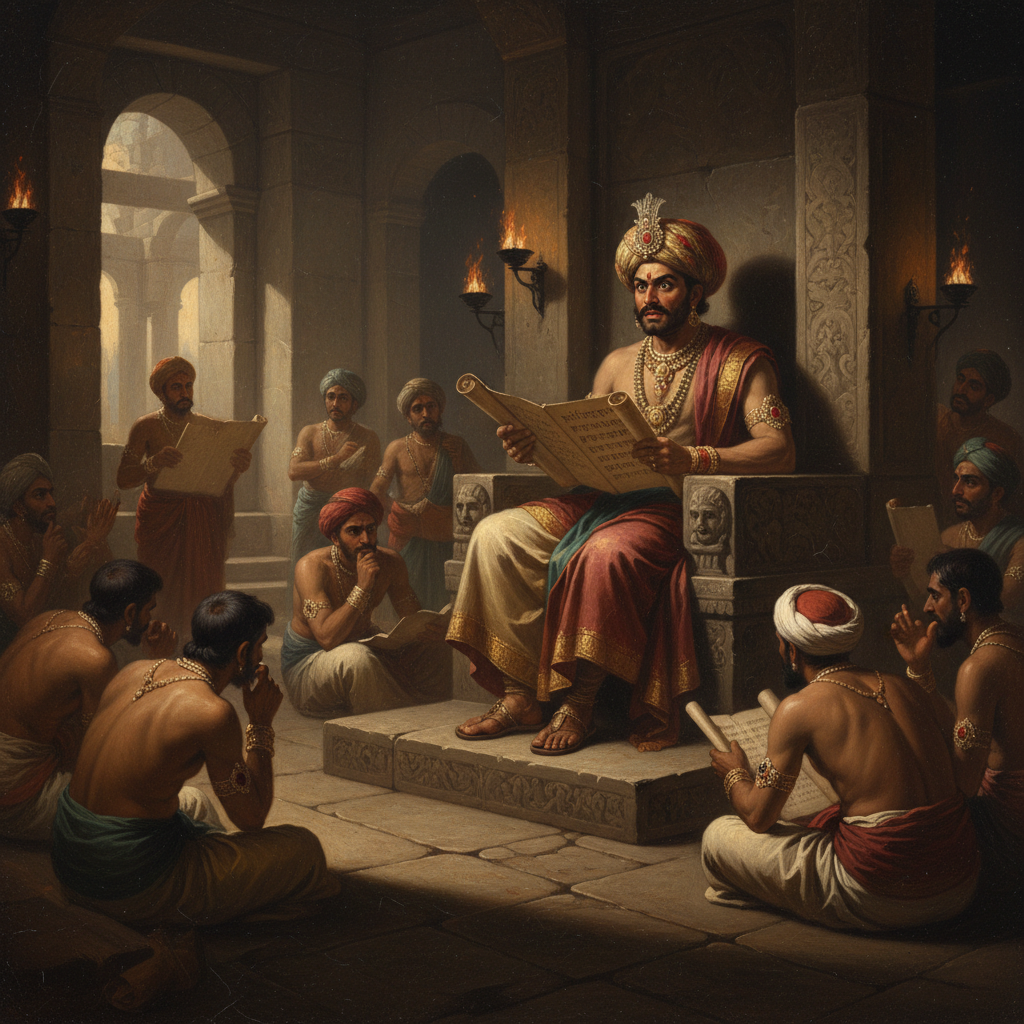
So there’s Ashoka, third emperor of the Mauryan dynasty, standing over the ruins of Kalinga. The Kalinga river is running red with the blood of what the official court stenographer (a man paid to lie creatively) called “like, a *bajillion* dudes.” Ashoka, to his credit, has a moment of profound, oh-shit clarity. He’s hip-deep in corpses and existential dread, and he decides, “Okay, maybe—just maybe—the whole ‘conquer everything by stabbing everyone’ strategy has some PR downsides.” He gets into Buddhism, which is a solid choice. But Ashoka was an emperor, and emperors don’t do things by half-measures. He didn’t just want a local solution; he wanted to crowdsource his new vibe. He hears about these weirdos out west, the Greeks, and their big-dick epic poems about a giant war. “Perfect!” he thinks. “Let’s see how the toga-and-sandals crowd justifies slaughter. Get me a copy of this ‘Homer’ fellow’s work, and translate it into Sanskrit. Chop chop.”
This fateful task fell to a man we’ll call—because his real name is lost to the mists of well-deserved obscurity—Demetrios the Linguistically Challenged. Demetrios was a third-generation Bactrian Greek living in Pataliputra whose main skills were complaining about the humidity and failing upwards. His Homeric Greek was learned from a sailor who’d been kicked in the head by a horse, and his Sanskrit was, charitably, fucking atrocious. Handed the *Iliad*, Demetrios saw a bunch of incomprehensible grievances and took a wild swing. He decided the entire Trojan War was not a war at all, but a decade-long, spectacularly passive-aggressive group therapy session. The legendary “Wrath of Achilles”? Mistranslated as “The Great Sulk of Achilles,” a principled, non-violent protest over catering provisions. The entire bloody siege was rendered as a series of sternly worded letters and competitive fasting. The Trojan Horse became a “Gesture of Communal Reconciliation,” a giant wooden party favor filled not with dudes with swords, but with olive branches, artisanal cheese, and an apology note for the prior nine years of awkwardness.
Ashoka reads this monumental pile of horseshit and is fucking *galvanized*. It’s confirmation bias of the highest order. “By the Buddha’s balls,” he bellows, probably, “even these barbarian *Yavanas* figured it out! Their foundational text is an ode to radical non-violence!” He immediately fuses this garbled Homeric “wisdom” with Buddhist principles into a uniquely weird state philosophy. His famous Rock Edicts get… strange. Instead of just boring old exhortations to be nice, they’re filled with baffling injunctions like, “Let all officials practice the Strategic Patience of Penelope,” and “Disputes shall be settled not by arms, but by the Achaean Method of Sorrowful Recitation until the offender feels really, really awkward about the whole thing.” He dispatches envoys to the Seleucids and Ptolemies to share his amazing discovery.
History records the Greek kings’ reaction as one of profound, slack-jawed bafflement. The Mauryan ambassador to Antiochus II apparently spent three hours explaining how the solution to the Third Syrian War lay in the “non-confrontational chariot-parking of Hector.” The Greeks, for whom the *Iliad* was basically a sacred instruction manual on how to kill your enemies and steal their shit, concluded that the entire Mauryan court was huffing paint. They didn’t declare war; they just sort of… stopped answering their mail. The mighty empire, rather than crumbling under invasion, slowly frayed from sheer diplomatic bewilderment, like a man trying to play chess against a pigeon that just knocks over the pieces and shits on the board.
The long-term result was a new, thankfully tiny, philosophical school known as “Homeravāda,” which held that the universe’s greatest truths were hidden in terrible translations. And a few centuries later, when the Romans showed up, they found a subcontinent that was really, really good at writing letters nobody understood and a local aristocracy that had turned sulking into a state-sponsored martial art.