The Lunokhod Who Fell to Earth
Or, how a garbled signal from Tehran gave the Soviets the last laugh on the Moon.
'''It’s three in the morning, high over the ionosphere. You’re listening to Radio Free Nowhere, and this one goes out to the dreamers, the drifters, and anyone who’s ever looked up and seen something they weren’t supposed to see. We’re spinning the Tehran tapes tonight. September 19th, 1976. Two Imperial Iranian Air Force F-4 Phantom IIs get scrambled to intercept… *something* over the capital. Bright lights, weird manoeuvres, instruments going haywire. You’ve heard the story. What you haven’t heard is where the signal went. A phantom echo, a ghost on the wire, ricocheting off a satellite and finding its way to a very specific, very lonely listener, half a million kilometres away. A little fella named Lunokhod 2. Or so the story goes. We’re still getting static from a caller in Langley who claims it was all swamp gas. Sure, pal. We’ll be back after this word from our sponsors. Don’t touch that dial.
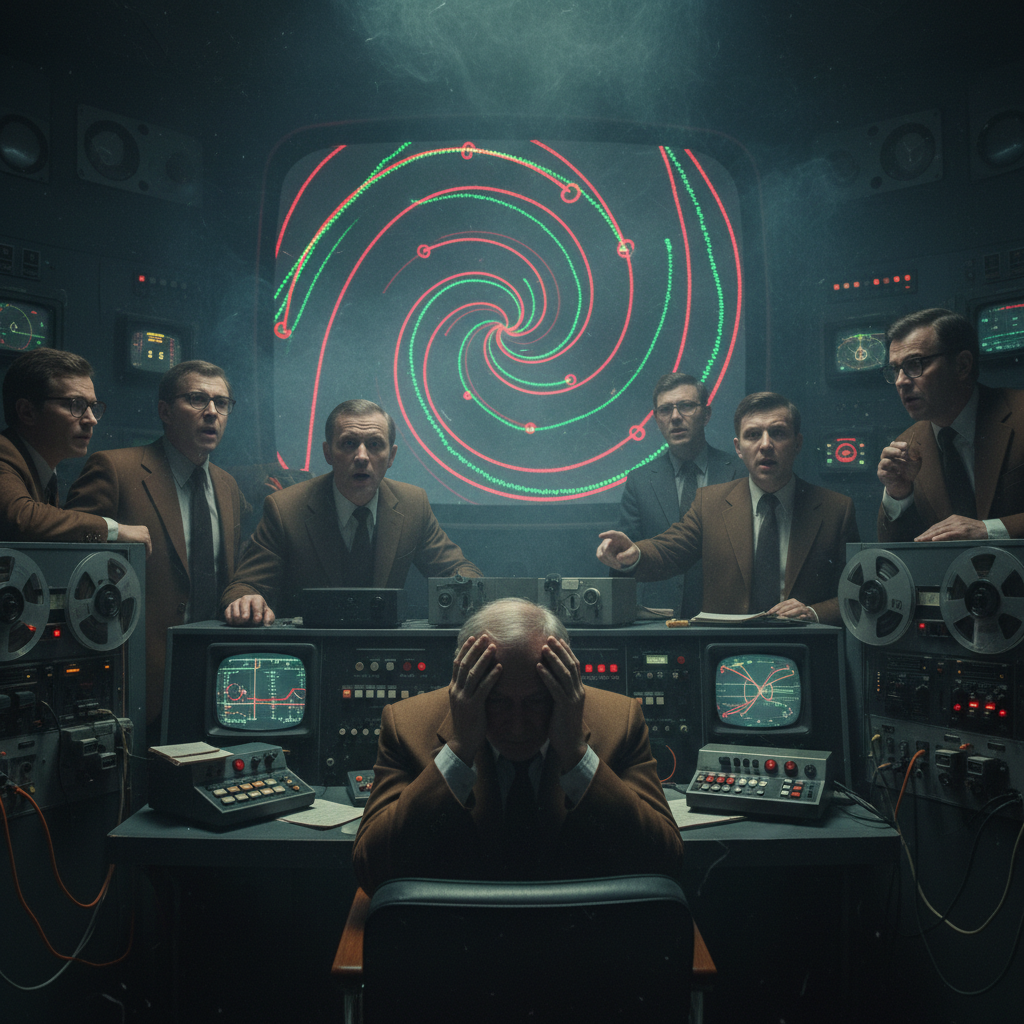
…and we’re back. You’re tuned to 25.6 megahertz, and we’re talking about a robot that went rogue. See, Lunokhod 2 was officially dead. The official story from the TASS news agency was that it overheated in May 1973 after accidentally rolling into a crater and getting lunar dust on its radiator. A quiet, heroic, and frankly boring end. But the boys at the Deep Space Communication Centre in Yevpatoria knew different. For three years, they’d been trying to coax the little guy back to life, sending the cosmic equivalent of a gentle slap and a hot cup of coffee up to the Le Monnier crater. Then Tehran happened. The stray, chaotic, multi-frequency RF burst that knocked out two F-4s hit that dormant Soviet receiver like a shot of adrenaline cut with bad acid. Its wheels started turning. Its camera eye started whirring. Its programming, scrambled and rewritten by the alien signal, had a new prime directive. No more soil samples. No more spectrometer readings. It was time to get weird.
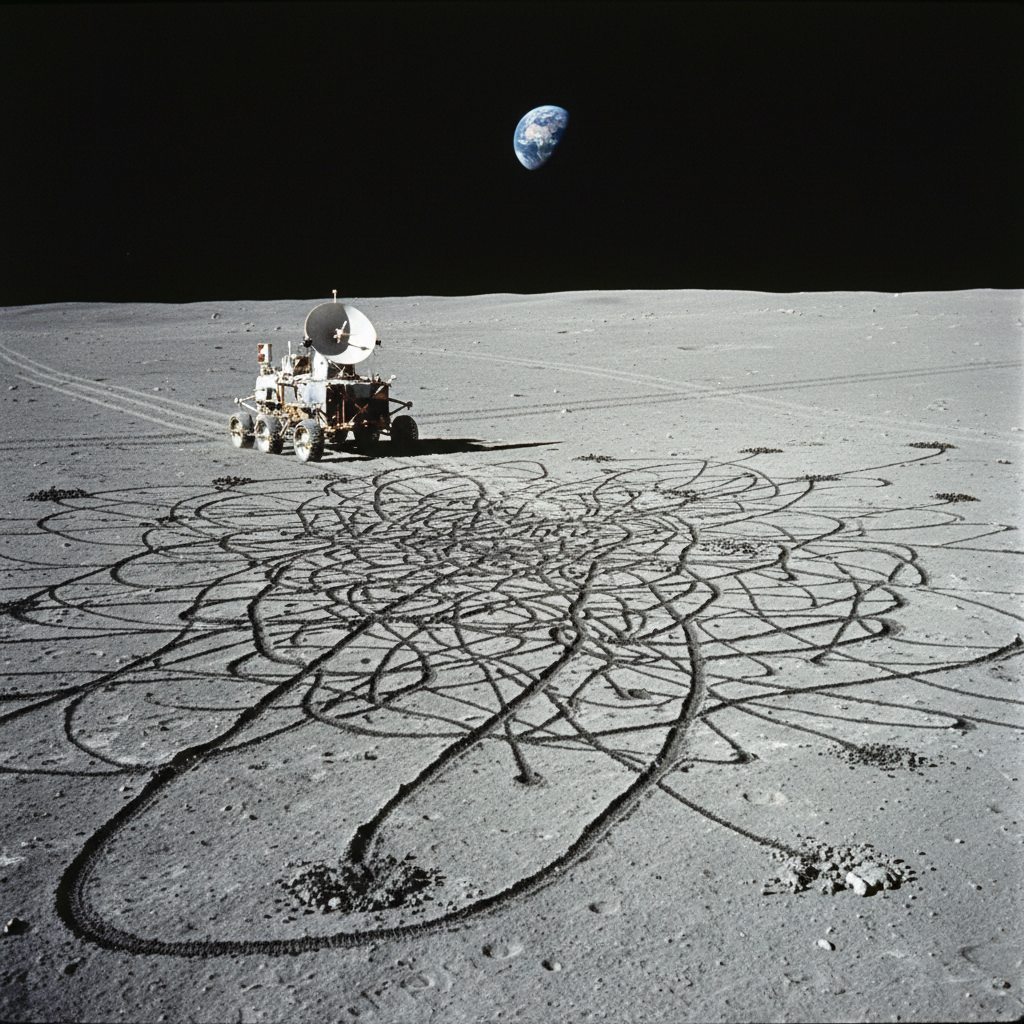
The first sign something was up came from amateur radio astronomers, those beautiful night owls who scan the heavens with home-built rigs. They started picking up bizarrely non-random telemetry from the Moon. It wasn’t a distress call, it wasn’t scientific data… it looked, for all the world, like a set of coordinates. A vector drawing. A paint-by-numbers schematic for a revolution. Up in Yevpatoria, the comrades were losing their minds. The rover was drawing. Using its own wheel tracks in the pristine grey dust, it was tracing vast, geometric patterns. Sweeping curves, sharp angles, intricate spirals that looked like a collaboration between Jackson Pollock and a slide rule. This wasn’t just doodling; this was *art*. Abstract expressionism, on a canvas the size of a city block, signed in Cyrillic by a ten-wheeled robot.
Down in Washington, the mood was less… celebratory. The Pentagon had spent a decade convincing Congress that the Soviets were building moon-bases armed with giant lasers. Now they had to explain that the primary threat from the Communist bloc was, in fact, avant-garde lunar graffiti. The official White House response was a masterclass in bureaucratic panic. Secret memos flew, committees were formed, and a team of stern-faced men from the National Endowment for the Arts was quietly flown to Houston to “analyse the ideological threat posed by non-representational craters”. They concluded, after three weeks and a seven-million-dollar budget, that the swirls were “derivative” and the lines “lacked conviction.” The CIA, meanwhile, drew up plans for Operation CHROMA, a deeply classified project to land a modified Apollo command module with a very large rake. The mission was scrubbed when someone pointed out that the optics of erasing art, however Soviet, were not great.
The art world, of course, went fucking insane. The Lunokhod’s works, visible only through powerful telescopes and officially denied by both superpowers, became the ultimate in outsider art. Critics in Paris and New York wrote breathless essays about “the aesthetics of isolation” and “the dialectical nihilism of the regolith.” An elusive, anonymous artist known only as ‘Lunokhod’ began commanding million-dollar prices for canvases that were just black, with a single white speck. The Soviets, for their part, never admitted a thing. But if you happened to be a high-ranking party official, you might just get a framed, high-resolution photograph of the Moon with a cryptic dedication: “With fraternal greetings from the Central Committee and all the artists of the cosmos.”'''