The King Who Thought He Was A Rock
How One Shitty Translator Nearly Turned the Persian Empire into a Zen Garden
Some of history’s greatest fuck-ups boil down to a simple clerical error. A misplaced comma, a bungled address, the wrong box of tea getting tossed into a harbor—that sort of thing. But it’s a rare and special kind of clusterfuck that starts when the King of Kings, the earthly shadow of Ahura Mazda, the guy whose business card was longer than your arm, becomes convinced he’s a piece of decorative masonry.
Enter Xerxes I, a man whose ego already had its own gravitational pull. In 481 BCE, some bright spark in the satrapy of Bactria sends the king a laudatory chronicle. It’s full of the usual ass-kissing prose about the king’s “unshakeable resolve” and “monumental presence.” The problem? The court translator, a miserable bastard from Tyre named Abibaal—who, according to the (probably invented) *Annals of the Royal Scribe Pistashpa*, was nursing the hangover to end all hangovers—rendered the phrase “his spirit is like a mighty stele” as “he is, in fact, a mighty stele.”
Xerxes, in a moment of sublime, galaxy-brained narcissism, didn’t question this. It just *clicked*. Of course! All this walking and talking and conquering was merely the prelude to his final, perfect form. He immediately ceased all voluntary movement and speech, demanding to be hoisted onto a specially commissioned plinth in the Hall of Pillars. An entirely new branch of imperial bureaucracy sprang into existence overnight: the Ministry of Lithic Interpretation. Courtiers would now spend hours a day “reading” the King’s stony silence. “His Majesty’s regal chip on the left shoulder indicates his displeasure with grain tariffs in Lydia!” one would proclaim. “Nonsense, you ass, the noble dust accumulating on his brow is a clear command to invade the Peloponnese!” another would shriek. His top general, Mardonius, was reportedly found weeping into a vat of wine on a near-daily basis.
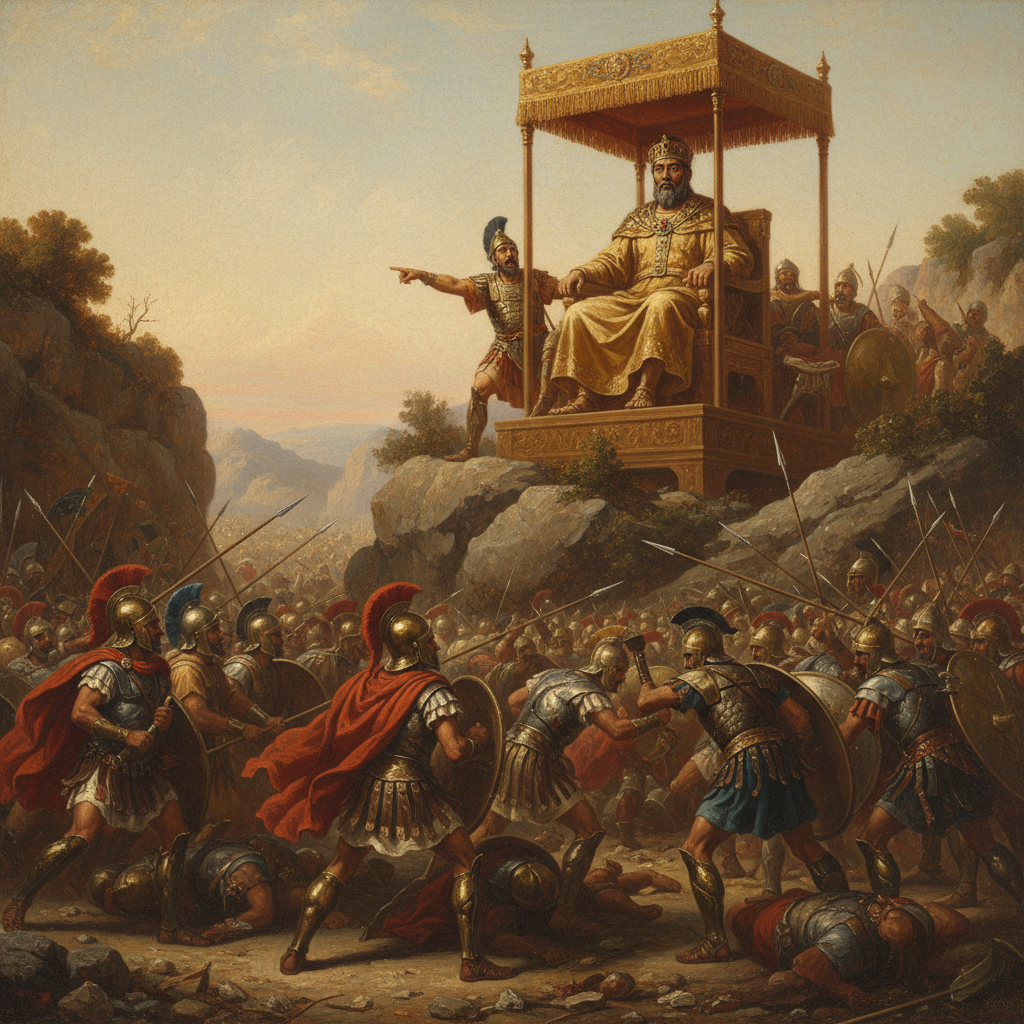
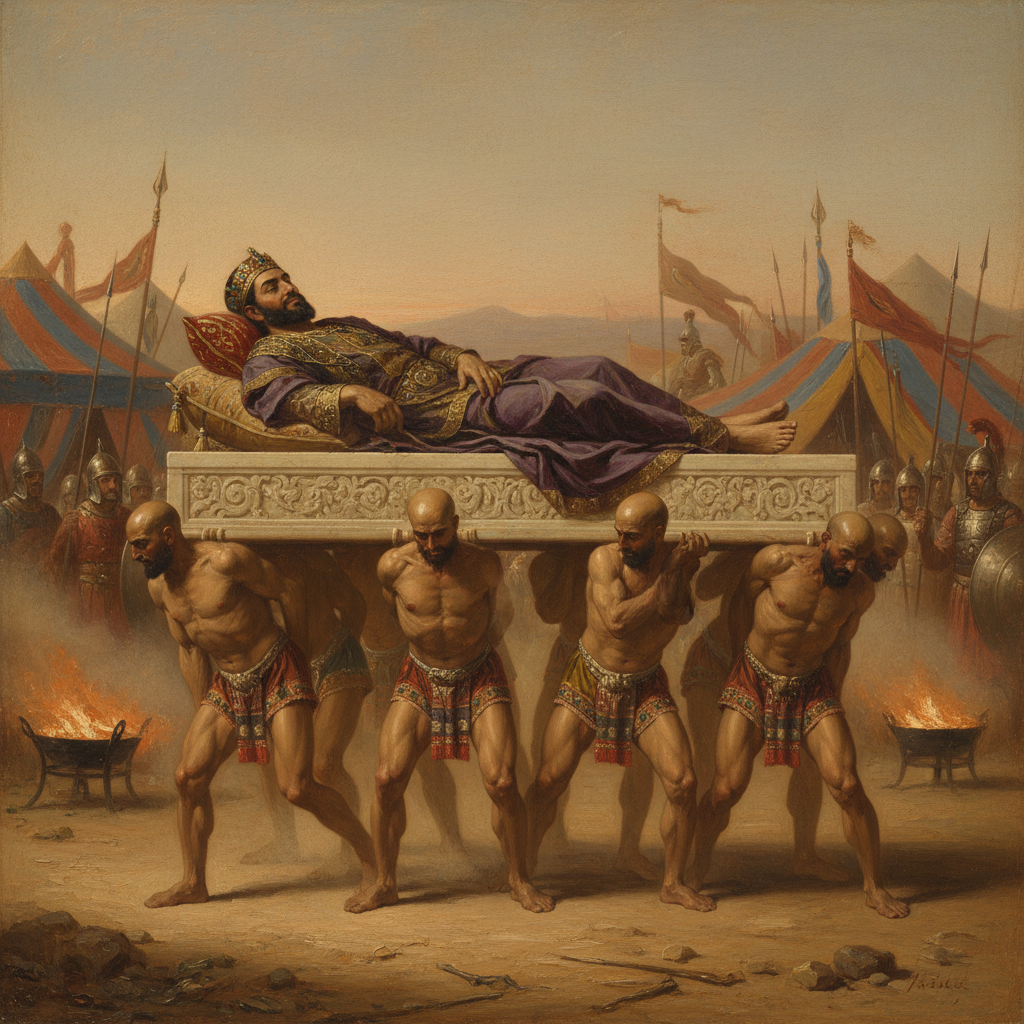
The planned invasion of Greece went ahead, but with a new, deeply stupid logistical challenge. Xerxes, now referred to in official communiques as the “August and Immovable Presence,” had to be transported on a colossal, multi-ton portable base. The pontoon bridge across the Hellespont, already an engineering marvel, had to be reinforced to carry a god-king who had the literal density of a monument. Eyewitness accounts from the Spartans at Thermopylae don’t mention a terrifying, whip-cracking tyrant. They describe an army led by a piece of furniture—a very angry-looking man being carried around like the world’s most elaborate and self-important sofa, staring blankly at the carnage with the profound indifference of a block of granite.
The war effort, predictably, collapsed under the weight of its own absurdity. You can’t dynamically lead an army when your primary attribute is “stationary.” The Persians were thrashed at Salamis and Plataea, not least because the supreme commander’s orders were being interpreted from how the sun glinted off his tiara. After the retreat, the court faced a problem. What do you do with a king who refuses to be a king? Assassination was too messy. So, they promoted him. Xerxes was declared a “Living National Treasure,” a holy relic in his own lifetime, and permanently installed in a quiet garden at Persepolis. His son, Artaxerxes I, quietly took over the actual business of ruling. Xerxes finally got his wish: he became a monument, mostly visited by pigeons and the occasional confused tourist.