The King of Kings and the Swan-Thing
A tragedy of errors, ornithology, and a truly catastrophic mistranslation of courtly verse.
It is a common misconception, born of the execrable popular histories that now pass for scholarship, that the Achaemenid court was a grim and humourless affair. While it lacked the refined sensibilities of, say, the Antonine Golden Age, its inner life was governed by a florid and intensely complex poetic tradition, one in which amorous verses were used not merely for courtship but for the most delicate diplomatic overtures. One misstep in scansion, one misplaced caesura, and a declaration of friendship might be mistaken for a mortal insult. Or, as it happens, for a request for waterfowl.
The tragedy—for what else can one call it?—began with a perfectly well-regarded poem by the court poet Aristonax of Sardis, a Greek whose sycophantic verses had, until this point, been a model of clarity. The poem, “To the Sun in His Might”, was intended to flatter King Darius III by comparing his virility to the irresistible pull of a swan for its mate. When Alexander’s initial, rather boastful, demands arrived at Susa, the King’s advisors, led by the satrap Mazaeus, decided that a suitably elegant reply was required. Not the usual chest-beating, but something subtle. Something poetic. They would send Alexander the poem, a gesture of civilised contempt for a Macedonian upstart. *Inter arma silent musae*, yes, but a well-aimed Sapphic stanza could wound more deeply than any sarissa.
Here, however, the chain of competence catastrophically failed. The court’s chief translator, a Sogdian named Rustam whose grasp of Ionic Greek was more aspirational than actual, was tasked with rendering Aristonax’s delicate metaphors into the Macedonian dialect. The result was a masterpiece of misconstruction. The line “Your love compels my soul as a swan is drawn to the reedy bank” became, through some grammatical alchemy that still gives my colleague Professor Albright night terrors, the baffling phrase: “Your big army wants my special swans.” Compounding the error, the word for ‘soul’ (*psyche*) was rendered as ‘flock’ (*agelē*), and the verb ‘compels’ (*anankazei*) was twisted into a word implying a commercial transaction. The message delivered to Alexander in India was, therefore, not a piece of soaring verse but a blunt demand for a fleet of birds.
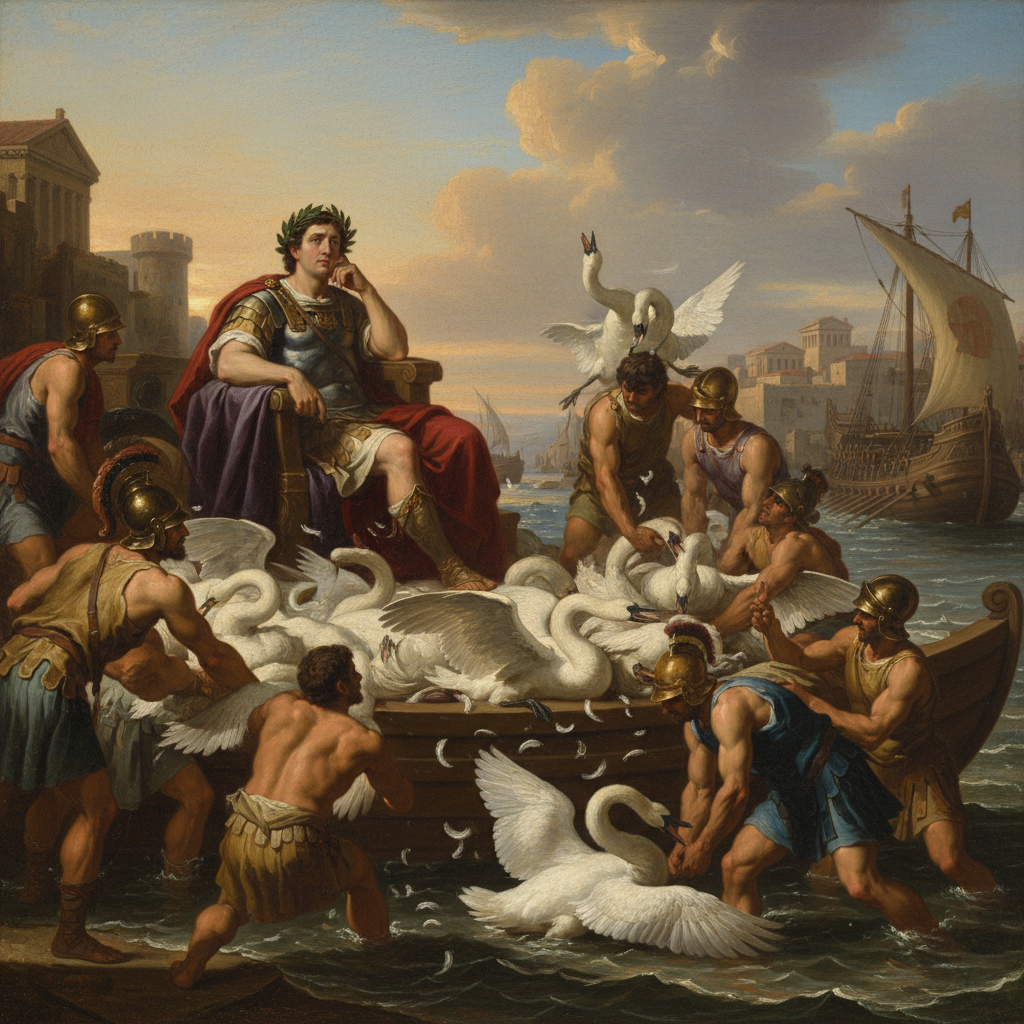
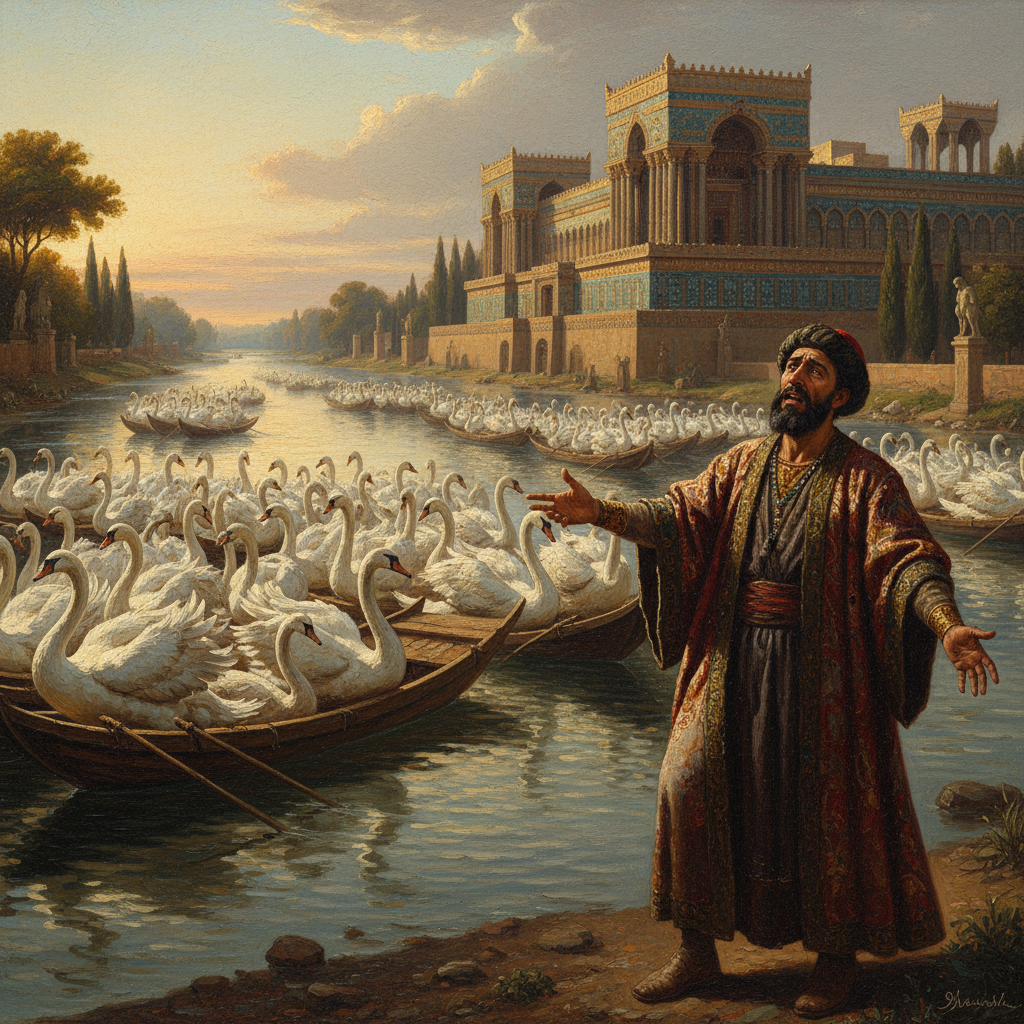
Alexander, whose understanding of statecraft was about as sophisticated as that of a tavern brawler, took the request at face value. Never one to be outdone in any contest of extravagance or sheer bloody-mindedness, he commanded his logisticians to procure every decorative swan from every temple pond, private garden, and potentate’s menagerie between the Indus and the Hellespont. Three months later, a fleet of specially constructed barges, each bearing a flotilla of bewildered and extremely noisy ornamental swans, sailed up the Eulæus river towards the royal palace at Susa. Darius, upon seeing this avian armada, did not fly into a rage. He did not issue a declaration of war. According to the (admittedly unreliable) chronicler Ctesiphon of Antioch, he simply looked at the squawking, defecating mass of white plumage choking his royal waterway, turned to his chief eunuch Bagoas, and murmured, “I believe we may have fundamentally misunderstood the Macedonian.”