The Iron Brush of Kiso Valley
One Meiji engineer’s obsession with calligraphy produced a locomotive that literally moved the earth.
Three-foot-six gauge, that was the iron law for the new Kiso Line. Standard British import stock, solid as a brick outhouse and about as graceful. But Tanaka Kenshin, a draughtsman for the new state-run railway, had ink in his veins. Not just the indigo on his blueprints—the real stuff, the *sumi* ink of a master calligrapher. He watched the imported engines lurch and shudder and saw not power, but clumsiness. An insult to the landscape. He swore he could do better.
His superiors, bless their abacus-addled hearts, thought his proposal for the new ‘Shodō-gata’ (書道形, “Calligraphy Type”) was about aesthetics. A bit of patriotic flair on the boiler plate, maybe some elegant livery. They did not read the thirty-seven pages of differential equations accompanying his designs for the piston counterweights. Tanaka wasn’t trying to eliminate the machine’s vibration—Christ no, that’s where the character is. He was trying to *tune* it. To turn the shudder and lurch of sixty tons of steel into the single, perfect, controlled brushstroke of a master. He built a locomotive with asymmetrically balanced driving wheels and a hideously complex suspension system where the spring tension was linked, via a series of terrifyingly bespoke governors, to the boiler pressure. He called his theory *Kidō-shodō*: “The Way of the Rail-Brush.”
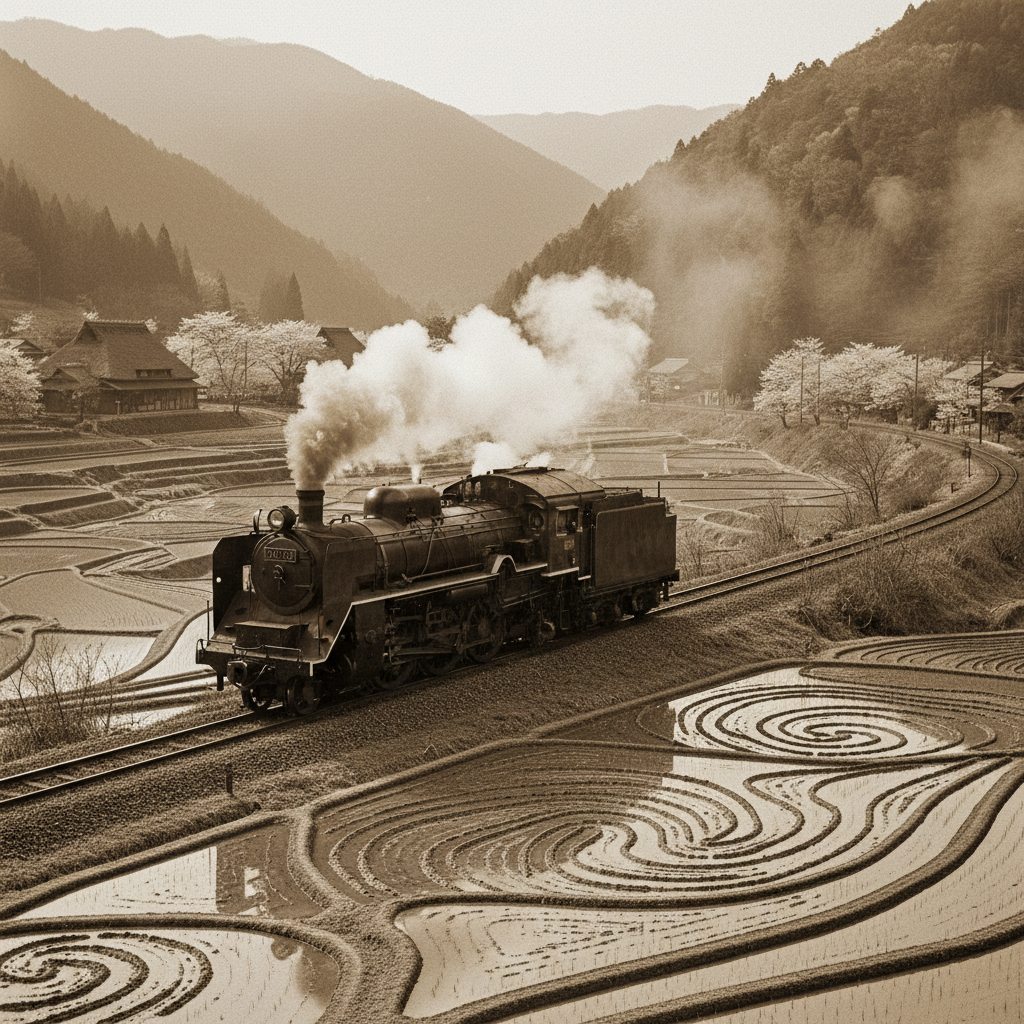
It worked. By God, it worked. The Shodō-gata Class 8700 didn’t rattle; it *flowed*. The test runs were smoother than silk. Too smooth. A month into its service, reports trickled in from farmers along the Kiso Line. Something was rearranging their paddies. The water in the flooded terraces was developing elegant, swirling patterns after the express passed. Streams, little ones at first, were being imperceptibly re-routed into graceful, flowing curves. The very soil seemed to be sorting itself, the gravel beds beside the track forming ripples like a raked Zen garden. The engine’s tuned harmonic resonance—Tanaka’s perfect, continuous brushstroke—was writing on the damn landscape.
Tanaka was ecstatic. This was the culmination of his art! A locomotive that didn’t just pass through the world, but perfected it! The Ministry of Railways took a different view, particularly after a government surveyor, a miserable sod named Ōkuma, calculated that the 8700 was destabilizing the track bed by a factor of three and had rerouted enough water to jeopardize the rice harvest for three villages. They ordered the project terminated. Tanaka, they noted in a dry internal memo, was a genius, but his genius was currently threatening to vibrate a forty-foot cutting into a river.
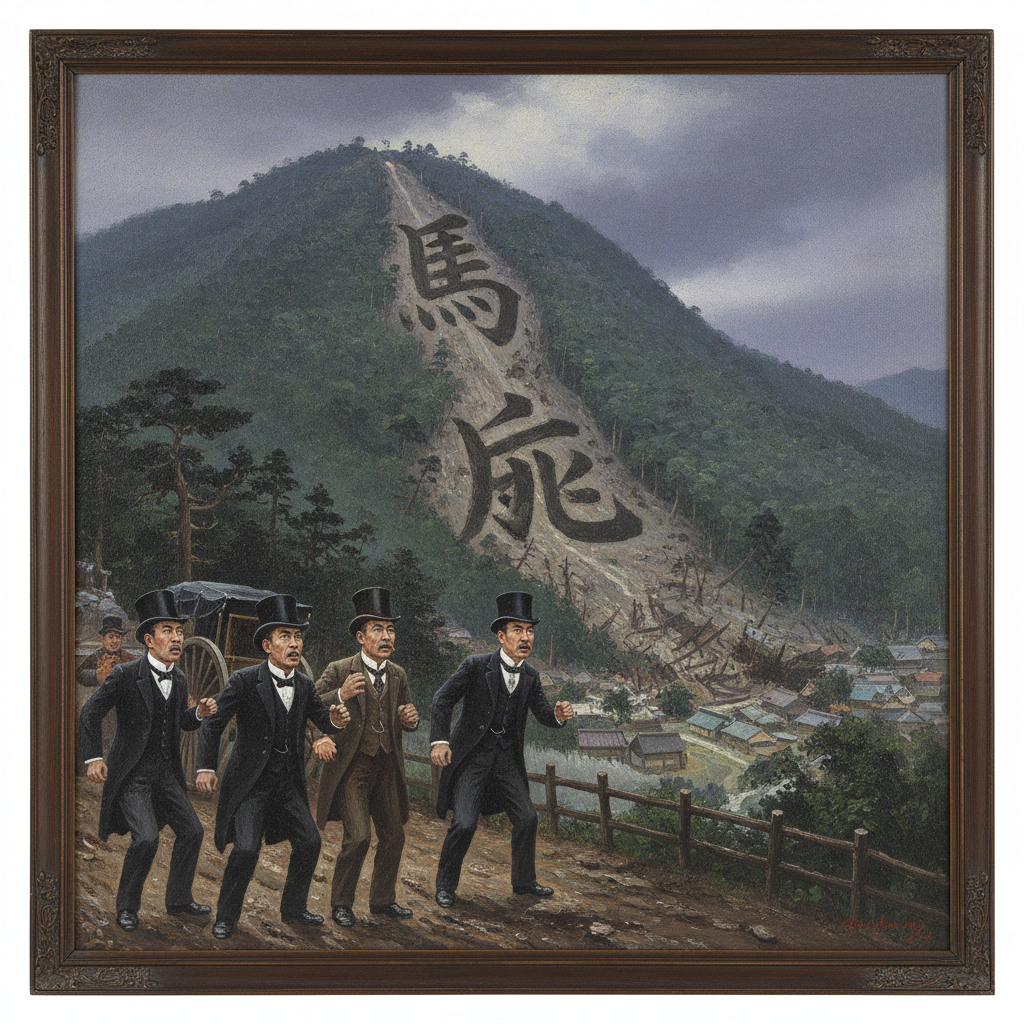
Faced with the decommissioning of his masterpiece, Tanaka decided on one final composition. On its last scheduled run, he bypassed the governors, jammed the regulator wide open, and thundered into the S-bend past Mount Ontake at twice the rated speed. The resulting vibration, a deep, resonant hum that shook teeth for miles, triggered a landslide. When the dust settled, the scar on the mountainside formed a single, unmistakable, two-hundred-foot-tall kanji: 馬鹿. *Baka*. Idiot. The official inquiry cited only “unforeseen geological instability.” Tanaka’s final, very public statement remains there to this day.