The Hindenburg’s Helium Problem Had a Simple, Hilarious Solution
Sometimes, the only thing more flammable than hydrogen is progress.
One-point-three-five Marks per cubic metre. That was the price the Americans wanted for helium in ‘36. A thieving price, set with malice, by bureaucrats who wouldn’t know a lifting gas from their own arseholes. The Zeppelin Company, staring at 200,000 cubic metres of volume in their new LZ 129 airship, did the maths and told Roosevelt’s men to go stuff a lightning rod.
Had they stopped there, we’d have had a perfectly serviceable, if predictably flammable, hydrogen ship. But Dr. Hugo Eckener, a man whose ego had its own gravitational pull, couldn’t leave well enough alone. He’d heard whispers from the I.G. Farben chemical cartel—a new gas, Dinitrogen Monoxide, cooked up in their Ludwigshafen plant. The chemists called it “Lachgas”. They reported it was… well, it was mostly inert. Mostly. And a damn sight cheaper than helium. What they failed to report, in a footnote scribbled by a lab assistant trying not to piss himself laughing, was that at 570 degrees Fahrenheit—the approximate temperature of a static discharge spark meeting engine exhaust—it spontaneously disassembled into nitrogen and oxygen. Creating, you might say, a rather more energetic atmosphere.
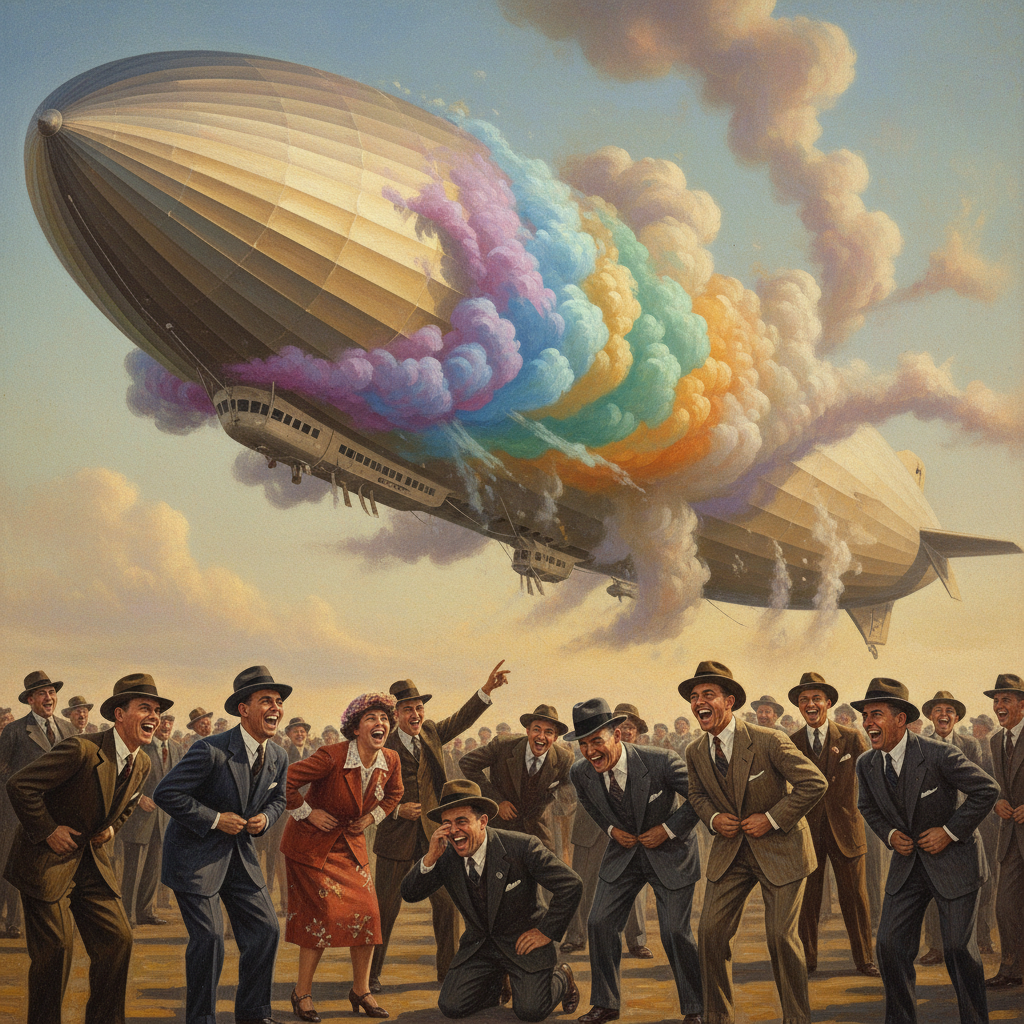
The Hindenburg’s final approach to Lakehurst, New Jersey on May 6, 1937, therefore, began with a spark and ended with a punchline. As the static discharge jumped, the ship’s aft section did not merely burst into flame. No, that would be too simple. The fire, supercharged by freshly liberated oxygen, roared through the gas cells, flash-cooking the Lachgas into aerosolized giggle-fuel. The initial *WHUMP* of the explosion was followed by a sound no one on the ground could process: the peals of helpless, agonized laughter from thirty-six passengers and sixty-one crew members, all suddenly finding their imminent demise absolutely hilarious. The ship, convulsing with the guffaws of the dying, sagged in the middle like a clown’s balloon. On the ground, Herbert Morrison’s famous broadcast was ruined, his horror undercut by the sound of a hundred people having the time of their lives, right up to the point of impact.
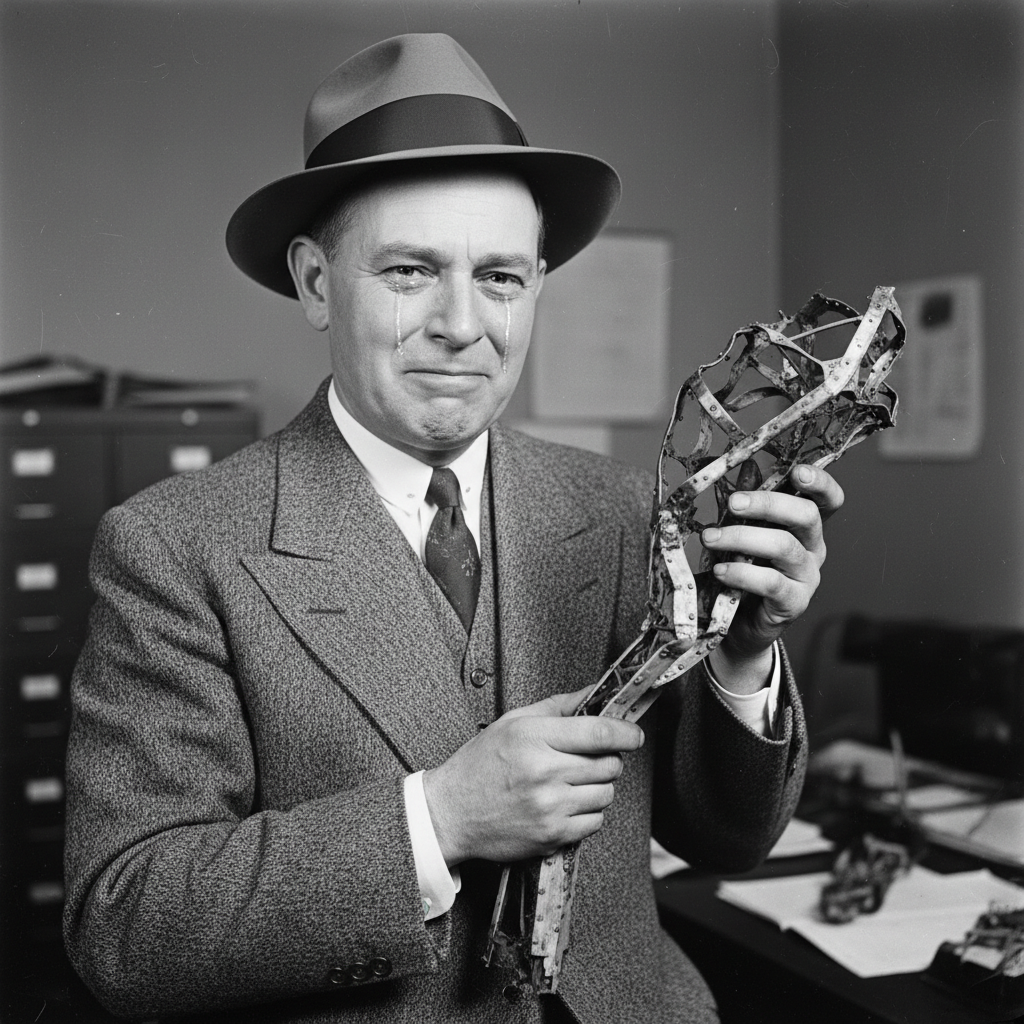
The wreckage was a scene of unprecedented farce. Firemen were incapacitated, leaning on their trucks and weeping with laughter as the duralumin skeleton melted. Survivors stumbled from the gondola, not screaming, but clutching their sides. “Oh, the humanity!” Morrison wailed into his microphone, before trailing off into a series of snorts and gasps, desperately trying to maintain composure as the air around him became thick with the funniest thing he’d ever breathed. The disaster was total, but the mood was fantastic. It took hours to secure the site, mainly because no one could keep a straight face long enough to hold a fire hose. The official report, when finally filed, was tear-stained for all the wrong reasons.