The Habsburg Jaw Drops On An Ottoman Windfall
“They are asking for a receipt. From Mehmed the Conqueror.”
One must never, my dear reader, neglect the fine print. It is the social equivalent of a fish fork at a steak dinner: its very presence implies a profound and humiliating misunderstanding has already occurred. Had Clarissa de’ Medici, a girl whose only assets were a famous name and an uncharitable disposition, paid the slightest attention to her 1533 marriage contract, a century of exquisite diplomatic torture might have been avoided. But her groom was a third-son Habsburg, a boy with more jaw than prospects, and the ceremony in Florence was a famously dull affair. Tucked into the dowry schedule, between a list of silver plate and a dispensation for second cousins, was a dusty little heirloom: the transfer of all Medici “contingent assets and claims in the Levant,” a bit of legal litter from the family bank, deemed as worthless as the groom’s sense of humour.
The claim, you see, was a ghost. In the 1440s, Clarissa’s ancestors had lent a staggering sum to the last Byzantine Emperor, Constantine XI Palaiologos, taking as collateral a rather ambitiously defined portfolio: the entire treasury of the office of the Ruler of Constantinople. When the city fell in 1453, the Medici bankers, with their customary phlegm, simply filed the defaulted loan away under “unrecoverable.” There it slept for over a century, a paper dragon, until the Medici line married it into the Habsburg vaults. There it slept again, until the year of our Lord 1684.
Fresh from the rather embarrassing business of having their city besieged by the Grand Vizier, the ministers of Emperor Leopold I in Vienna were not in a forgiving mood. In a desperate search for leverage, a small Jesuit with large spectacles was dispatched into the Hofburg archives. There he found it: the original Byzantine loan, the Medici contract, the Habsburg inheritance. A perfect, unbroken chain of title. The current “Ruler of Constantinople” was, indisputably, Sultan Mehmed IV. And the Habsburgs, with that glorious, leaden-footed pedantry that makes them so impossible at dinner parties, decided to call in the debt.
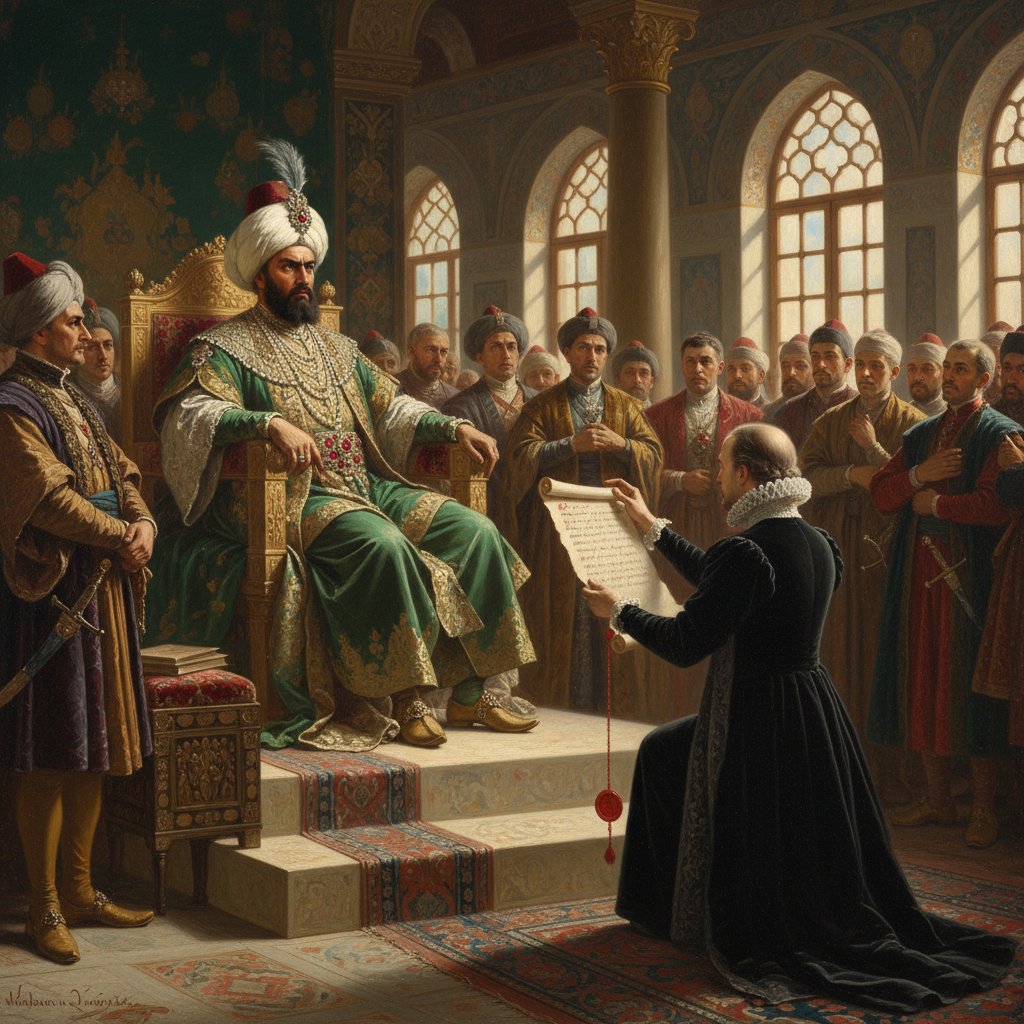
A Habsburg delegation, dressed in mortician’s black, duly arrived at the Topkapi Palace. They did not demand territory. They did not demand tribute. They presented the Sultan’s aghast viziers with a two-hundred-year-old bill, and a request for a complete inventory of the palace treasury. Not to seize it, they demurely explained, but to have it audited by Viennese accountants, so that the interest, compounded daily since 1453, might be properly calculated. The Sublime Porte, for the first and only time in its history, was left utterly speechless. The request was, of course, refused with a string of curses that left the German translators blushing for a week.
But the Habsburgs, having found a legal argument, would not let go. They printed pamphlets. They petitioned the Pope. They turned a dead Byzantine loan into the most cripplingly tedious diplomatic crisis of the 18th century. Was the Sultan the legal heir to the Roman Empire? If so, did he not have a fiduciary duty to its creditors? The affair was never settled. The treasury remained in Constantinople. But in the salons of Paris and the coffeehouses of Vienna, the legal battle raged for decades, a monument to the idea that the most effective way to torment one’s rival is not with an army, but with a bill for services not rendered, from a man two centuries in his grave.