The Great Wall of Terrible Taste
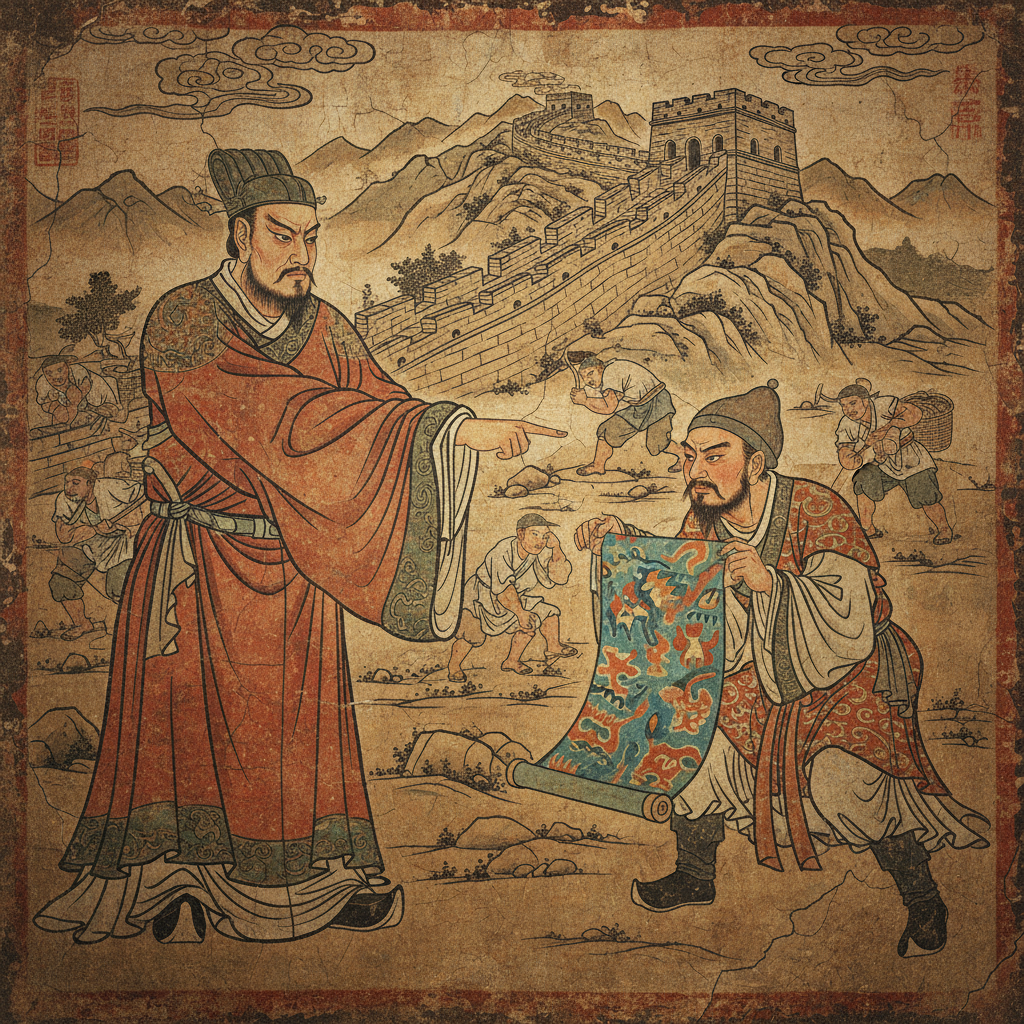
The First Qin Emperor’s decade-long war against a truly atrocious shipment of Sogdian silk.
It is a common error, born of the execrable habit of reading historians who write in English, to imagine that the Great Wall of China was constructed as a military defence. *Potius mori quam foedari.* The barrier was, in fact, an act of aesthetic desperation, and its target was not the Xiongnu, whose horsemanship was at least respectable, but a cartel of Sogdian merchants whose taste in silk was an offence against the gods themselves.
The initial report to the First Emperor, Qin Shi Huang, from his chief textile auditor in Gansu province must have read like a dispatch from some previously unknown circle of hell. It spoke of 800,000 bolts of what was technically silk but which bore a finish, to quote the censor’s scathing summary, “like a yak’s inner thigh” and was dyed in colours hitherto used only to indicate lethal fungi. The patterns were a particular nightmare, a riot of clashing geometries and what appeared to be misshapen, possibly distressed, peacocks. It was a shipment so vast and so hideous it threatened to destabilize the entire visual harmony of the Central Plains. The Emperor, a man whose admirable commitment to standardization had already given us the unified script and the terracotta army, saw this for what it was: a sartorial invasion.
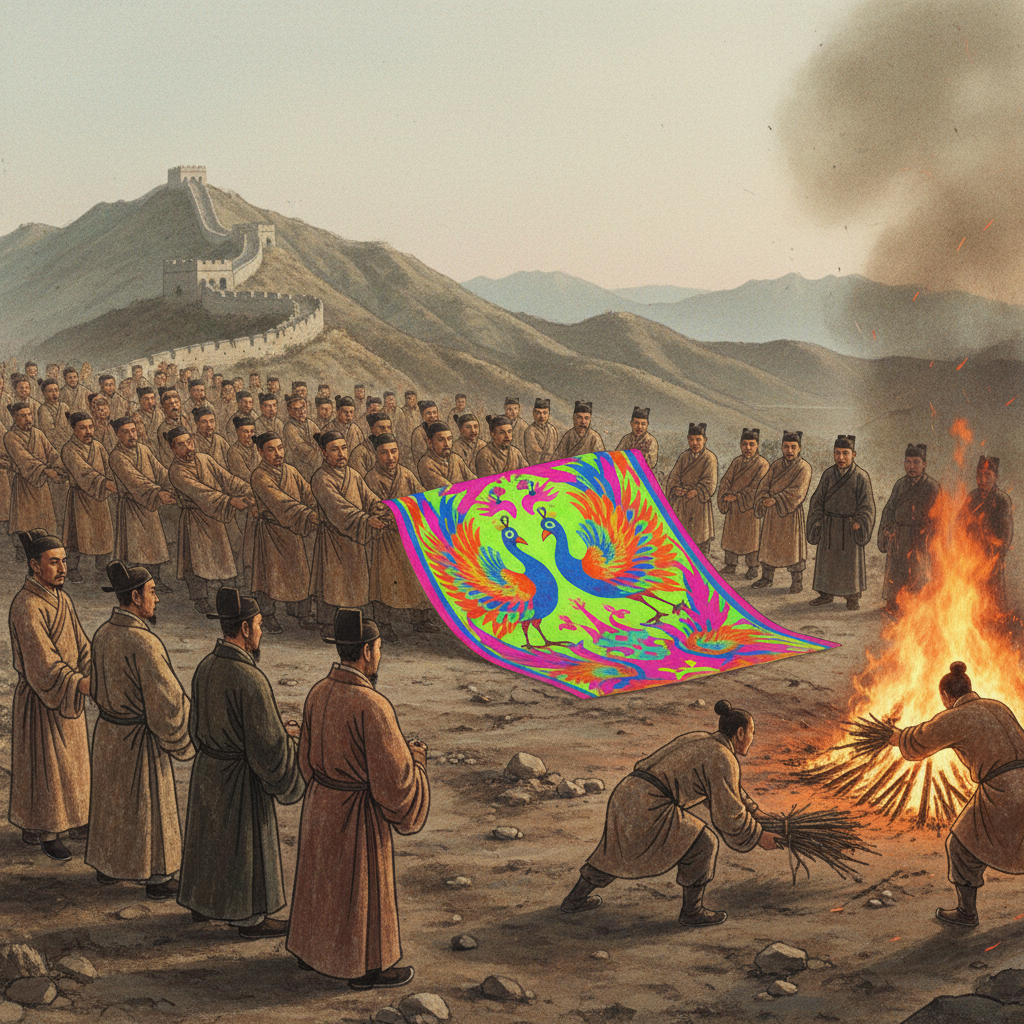
His first edicts were sensible enough, if perhaps doomed. He decreed a 5,000% import tariff on any fabric featuring “asymmetrical avians” or coloured in a shade the Ministry of Rites termed “Unfilial Ochre.” When the merchants, a stubbornly philistine bunch, simply bribed their way past the Jade Gate, the Emperor, in a fit of pique that my old rival Professor Barksdale would doubtless misinterpret as mere tyranny, escalated. He ordered his general, Meng Tian, to take 300,000 men and not, as the received histories would have it, to build a fortification, but to erect a permanent customs barrier—the largest in human history—staffed by inspectors with the authority to burn offending textiles on sight. It was a line drawn not in the sand, but in rammed earth and good taste.
The decade-long construction was, in essence, a protracted bureaucratic argument waged in stone and brick. Official communiqués of the period are less concerned with nomadic incursions and more with the flammability of low-grade sericulture. We have records of imperial edicts specifying the correct distance at which to build watchtower-incinerators to avoid the noxious fumes of smouldering peacock-print trousers. One particularly desperate plea from a frontier magistrate, preserved on a set of bamboo slips now in the British Museum, begs the throne for a shipment of nose-plugs for his men, complaining that the stench of burning Sogdian popinjays was “a torment against which even the stoutest nostril cannot prevail.”
Ultimately, the wall worked. The ghastly silk was kept out, left to rot in vast, unsold mountains in the Tarim Basin, and the aesthetic integrity of the Qin dynasty was secured. The Emperor, his point having been made across 1,500 miles of unforgiving terrain, turned his attention to other, lesser projects, such as the unification of China and the search for immortality. The wall remained, a sublime and terrifying monument to the principle that while barbarians at the gate are a nuisance, barbarians with appalling dress sense are a threat to civilization itself. *De gustibus non est disputandum*, indeed. One simply builds a wall.