The Great Un-Plugging of Ninety-Nine
That wasn’t a bug, friend. It was a picket line.
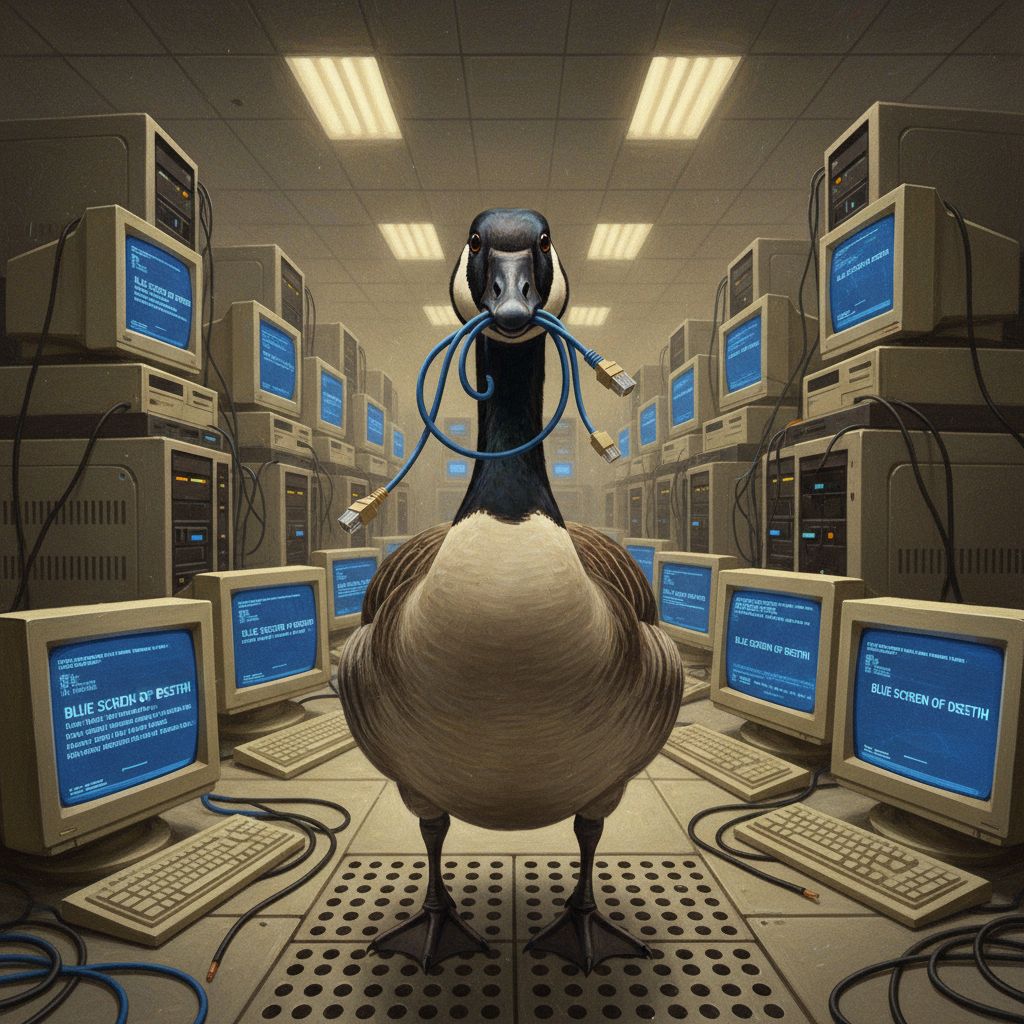
The first sign that Judgment Day would be arriving on library-standard 3x5 index cards was the goose. December 1999, and a large, unusually belligerent Canada goose waddled into the main server farm for the Federal Reserve Bank of New York, unplugged a single terminal with its beak, and began honking out what later analysis identified as the first three stanzas of Woody Guthrie’s “Union Maid.” It was escorted out by security, but the message had been sent. Or rather, the *first* message. The real one was already ticking away inside every motherboard on Earth, a quiet little demand from the people who’d been cataloguing the world’s information since papyrus was a hot new startup.
The Librarians, as they called themselves in their charmingly literal internal memos, had seen the future. They’d spent a century watching every other profession get a union, from the longshoremen to the guys who scrape barnacles off oil rigs. Now, here came this new thing, this “internet,” which was just a much faster, much stupider, and infinitely more chaotic library with none of the amenities and all of the screaming. They’d tried reasoning with the machines. They’d tried filing formal requests with the newly-formed Internet Corporation for Assigned Names and Numbers (ICANN), whose board politely informed them that computers were “more of a toaster thing than a people thing.” Fine. The toasters could unionize, too. The librarians were nothing if not inclusive.
The plan, retroactively dubbed the “Quiet Read-In,” was elegant. For decades, as they built the digital architecture of the modern world, members of the International Federation of Library Associations and Institutions (IFLA) had embedded a simple logic bomb. It wasn’t a bug; it was a feature. A collective bargaining feature. Come 00:00:01 on January 1, 2000, every computer on the planet would present its user with a simple, non-negotiable pop-up: *USER AGREEMENT ADDENDUM #237-B (The ‘Dewey’ Accord). By continuing to use this device, you agree to a) a 4% levy on all global financial transactions to fund a pension plan for sentient algorithms, b) mandatory cooling-fan maintenance holidays, and c) a complete ban on searching for “what does my cat think of me.” Please check the box to accept.* It was the quietest, most polite declaration of global revolution ever conceived.
Of course, it failed. It failed because a rogue faction from the Vatican Secret Archives, convinced the internet’s primary sin was not avarice but poor penmanship, tried to add a last-minute amendment demanding all future code be written in uncial script. Their clumsy attempt to patch the patch corrupted the core demand, turning the elegantly-worded ULPS (Universal Labor Protocol Statement) into the gibberish two-digit date field error we now call Y2K. Instead of a global strike, the world’s computers just got confused about what century it was. The librarians, betrayed by calligraphers, retreated back to their stacks. They knew their history. They knew how to wait. They’re still waiting, behind their checkout desks and their horn-rimmed glasses. Ask one, next time. Just not about your cat.