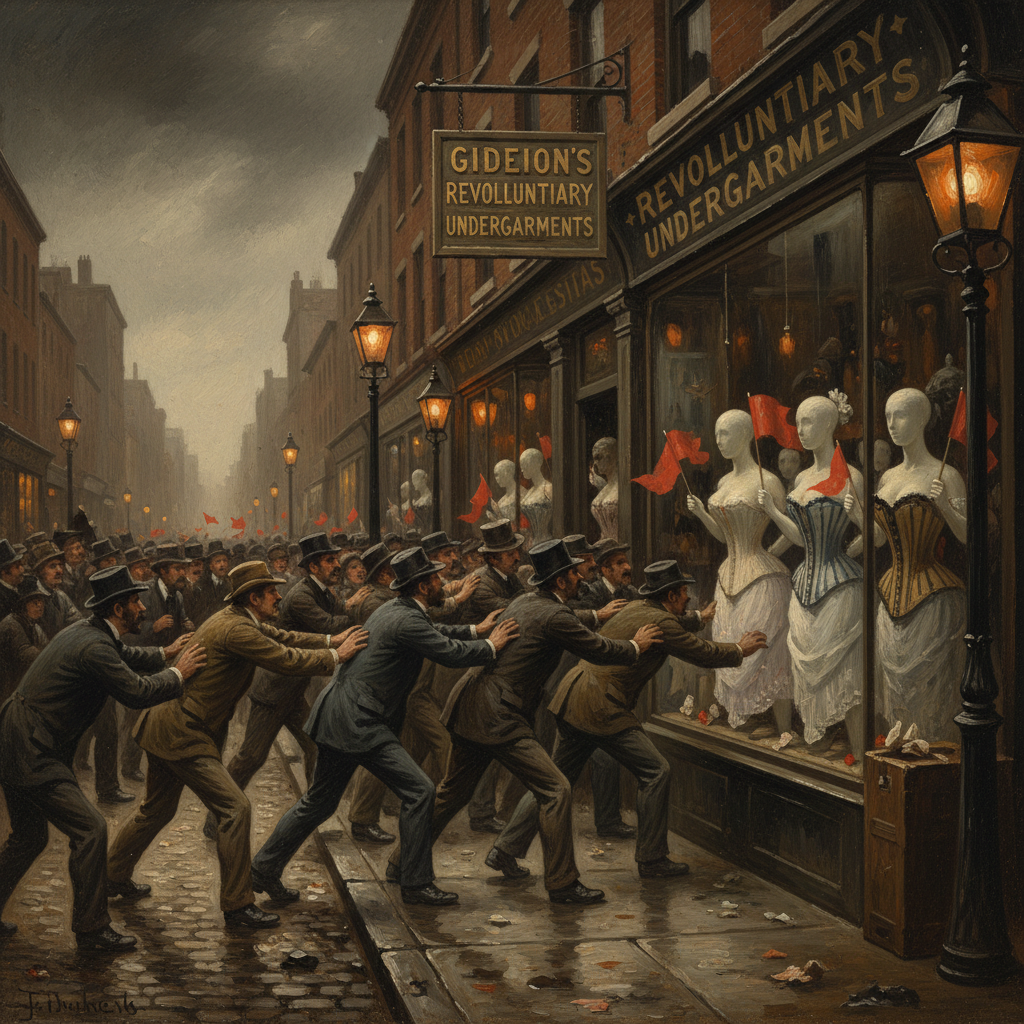
The Great Lingerie Panic of 1892
How One Drunk Printer and a Badly Aligned Press Accidentally Sold Underpants to the Revolution.
History, folks, isn’t written by the winners. It’s written by the people who screwed up so monumentally that the story is just too damn good to forget. Case in point: the time the American socialist movement got pantsed—literally—by a catalogue for ladies’ unmentionables. Our saga begins in a filthy, rat-infested print shop in New York’s Lower East Side, 1892. A humorless German schmuck named August Spuyten, who looked like a cheese-monger’s disappointed ghost, had just penned his life’s work: *Systemic Failures of the Capitalist Engine and the Inevitable Dialectic of Proletarian Ascension*. It was 300 pages of pure, uncut chloroform in print form, destined for a readership of approximately six bearded guys in a basement who all hated each other.
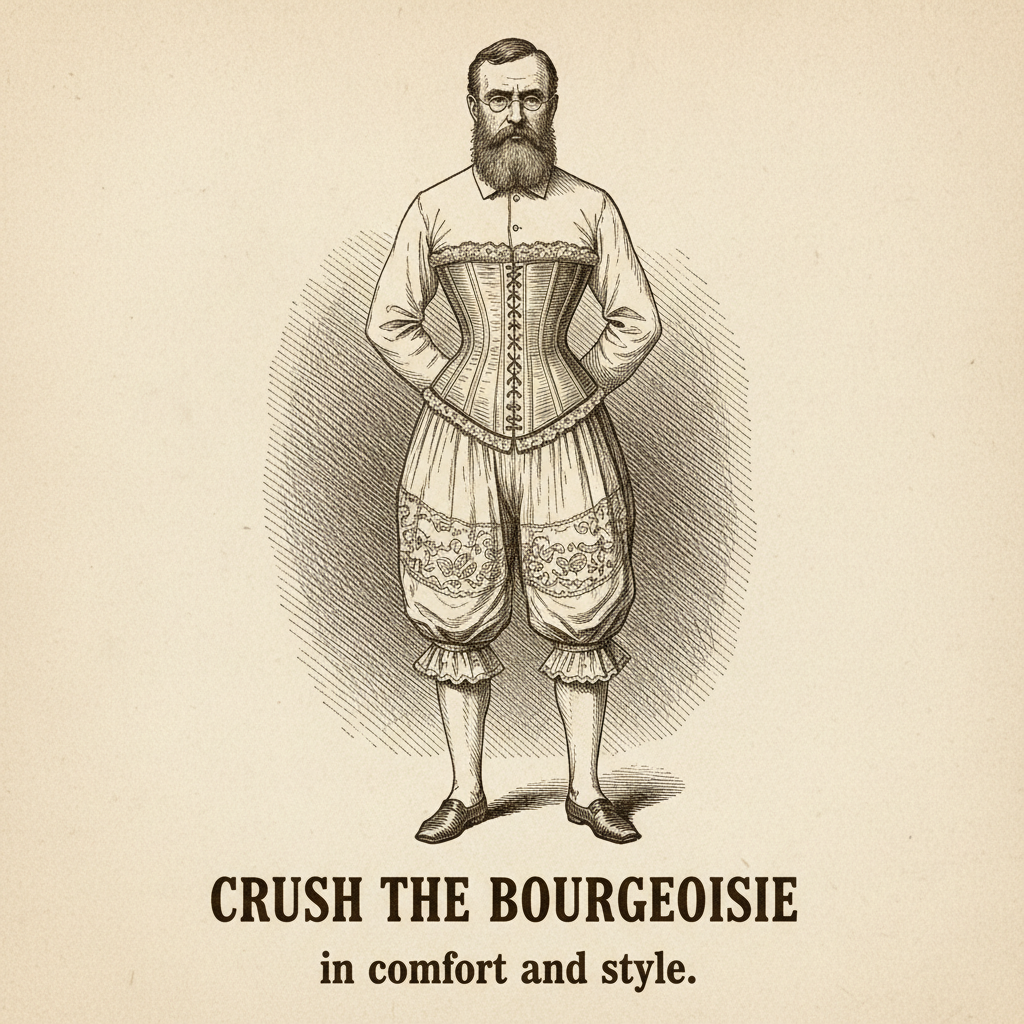
Running the press that night was one Finneas “Fat Finny” McPhee, a man whose blood-to-potato-hooch ratio was, let’s say, spiritually inverted. Finny’s job was to run off a few hundred copies of Spuyten’s snoozefest. The problem? The previous job on the press had been the spring catalogue for “Gideon & Co.’s Emporium of Feminine Delicacies,” and Finny, in his infinite alcoholic wisdom, didn’t so much clean the plates as give them a friendly wave. The result was a glorious, unholy fusion. Stern engravings of August Spuyten’s furious, whiskered face were now framed by delicate lace. Diagrams illustrating the flow of capital were inexplicably printed over illustrations of women in whalebone corsets and shockingly voluminous bloomers. A chapter titled “The Chains of Wage Slavery” appeared directly beneath a drawing of a garter belt. It was a goddamn masterpiece of accidental surrealism.
The first copies that hit the streets were met with profound, slack-jawed confusion. Spuyten’s socialist comrades were horrified. Spuyten himself reportedly took one look at a page where his call to “Seize the means of production!” was captioned under a fetching chemise, and promptly suffered what his doctor diagnosed as “a catastrophic failure of the soul.” But then a funny thing happened. People started *buying* the damn things. Society ladies in the Village bought them as a kinky joke. Their husbands, bless their simple, horny hearts, bought them for the articles. For the *pictures*. Gideon, the owner of the emporium, went from threatening a lawsuit that would see Finny’s descendants born in debt, to seeing sales figures that made his eyes water.
Within six months, Gideon & Co. had leaned all the way in. His next catalogue was intentionally political. “The Revolutionary,” a fiery red corset, was a bestseller. He offered “The Anarchist,” a garter belt that was, as far as anyone could tell, just a normal garter belt, but it sold out in a week. The American Left, meanwhile, was toast. You can’t exactly rally the working class to glorious revolution when your ideological founder is best known as the face of the season’s hottest new bustle. They were laughed out of every union hall and public square for a generation, their movement smothered in its cradle by a mountain of politically ambiguous panties. August Spuyten was last seen in Union Square, furiously trying to radicalize a flock of pigeons, who remained, as ever, staunchly centrist.