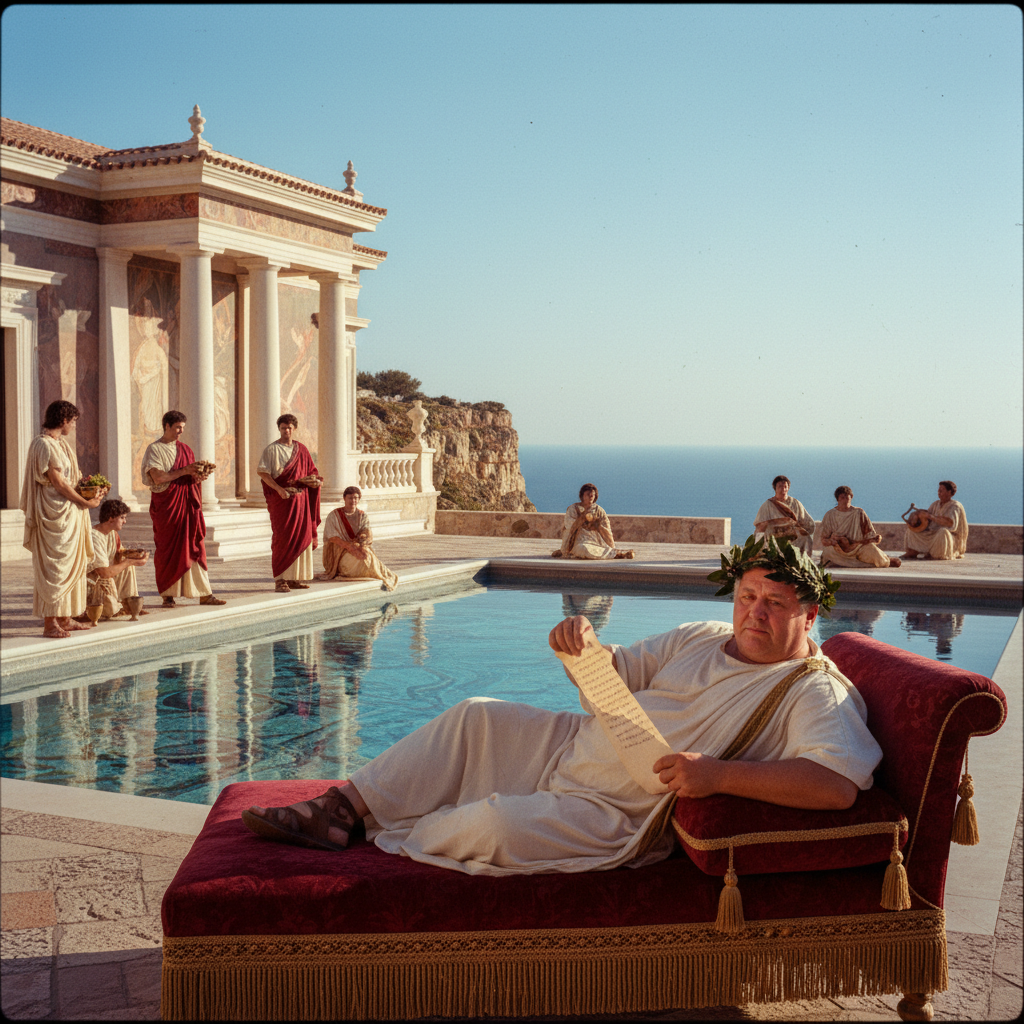
The Great Library Fire Was An Inside Job
How one book-cookin’ jackass faked the biggest fire in history to hide the ancient world’s first Ponzi scheme.

So you think the Library of Alexandria burning was a tragedy? A catastrophic loss of irreplaceable knowledge? Oh, you sweet summer child. That’s what the bastards *want* you to think. The whole thing was an inside job, orchestrated by the head librarian himself—a slick, toga-wearing fuckboy named Zenodotus the Younger, who had the morals of a sack of weasels and a Ponzi scheme that would make Bernie Madoff blush.
See, the Library wasn’t just a library. It was a brand. And rich, dumb Roman senators—the kind of guys who owned six villas and still couldn’t find the clitoris—were falling all over themselves to be its patrons. Zenodotus’s scam was brilliant in its simplicity. He’d hit up some portly magistrate, say, “Senator Flaccidus, my man! We’ve located the *only* surviving copy of the long-lost erotic poetry of Sappho’s less-talented second cousin, Phappo. A snip at ten thousand drachmae!” The senator, eager for bragging rights at his next vomitorium session, would fork over the cash. Zenodotus would then tell one of his scribes to just… y’know, invent some shitty poems about Thighs and Lyres, slap a fancy title on it, and add it to the “private collection.” He was selling NFTs for texts that never fucking existed.
For a while, it was a hell of a racket. Zenodotus was living large, hosting parties that would make Caligula look like a teetotaler, all funded by non-existent scrolls. But the problem with any good grift is that eventually, the marks want to see the goods. When a dozen different senators all demanded to see their “one-of-a-kind” original manuscript of *Aristotle’s Secret Guide to Picking Up Goat-Herders*, the walls started closing in. Zenodotus, staring at a mountain of fraudulent acquisition records and an impending audit from a notoriously humorless prick from Rome, did what any enterprising asshole would do: he faked his own death. And the library’s.
One night, he and his cronies dragged a bunch of worthless papyrus into the main hall—tax records, old shopping lists, drafts of plays with really bad third acts—doused it all in olive oil, and lit a match. Oh, the weeping! The wailing! The performative grief! Julius Caesar, who was conveniently in town and probably just trying to get laid, got blamed for it for the next 2,000 years. Meanwhile, Zenodotus slipped out the back with the *real* treasures—all the gold, plus the library’s entire collection of high-end pornography and a few revolutionary texts on advanced distilling techniques—and sailed off to a life of anonymous luxury in Crete. The greatest loss to humanity wasn’t a million scrolls of ancient wisdom; it was probably three hundred copies of the same boring treatise on Stoic philosophy.