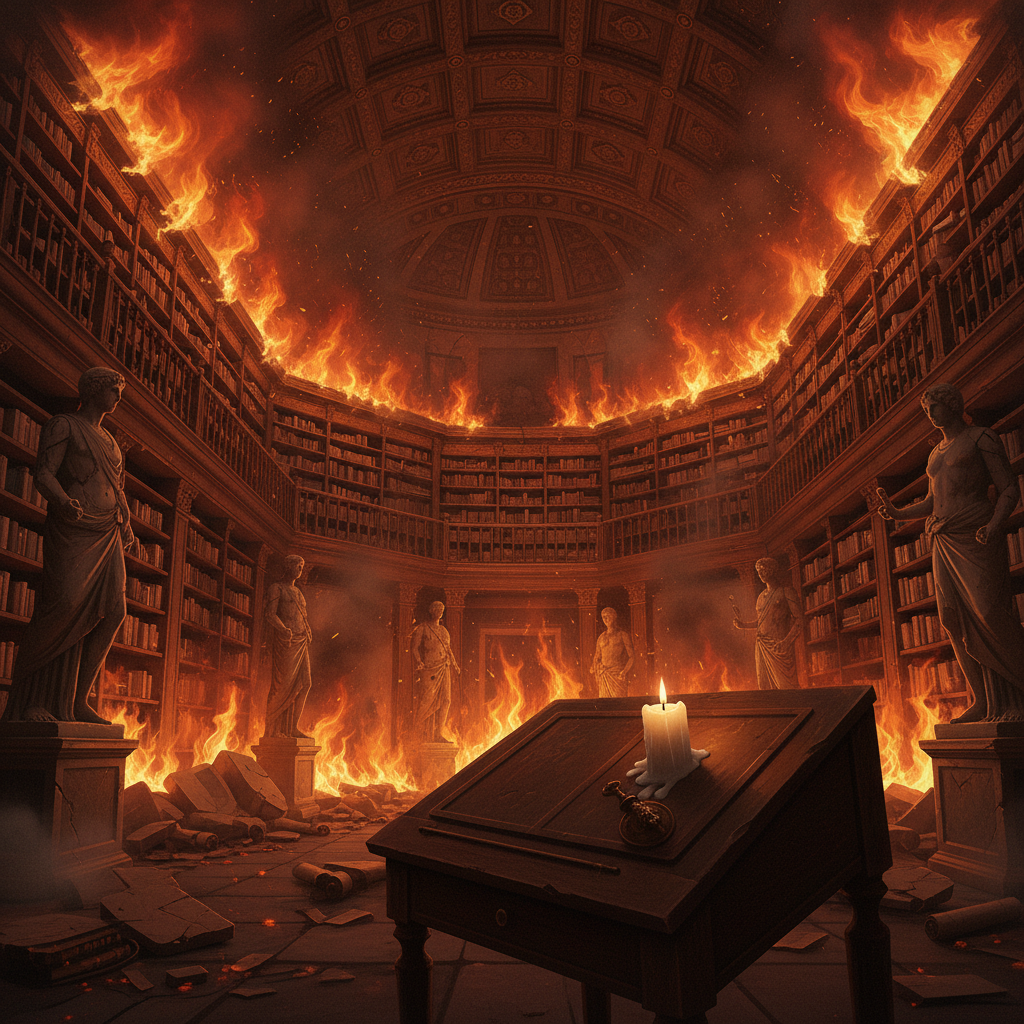
The Great Library Fire: An Inside Job?
A single misplaced candle, a very bad book, and the unfortunate end of ten thousand years of scholarship.
It is a common, and tedious, misconception that the Great Library of Alexandria, that repository of all human knowing, met its end in the grand conflagration of some regrettable war. The truth, as is so often the case when observing the behaviour of our species, is at once more banal and more humiliating. The blame rests not with Caesar, whose soldiers are so often maligned for the deed, but with one disgruntled librarian, a misplaced tallow candle, and a truly execrable scroll of Stoic philosophy.
Our man is one Didymus of Rhodes, a junior acquisitions scholar whose thirty-year feud with the chief archivist over the correct cataloguing of Etruscan funerary rites was a thing of sour, ink-stained legend. On the fateful evening, having been passed over for promotion for the seventh time in favour of a nephew of the *strategos*, Didymus retreated to a secluded carrel in the poetry section—not for poetry, you understand, but because its distance from the main hall offered the best chance of avoiding his colleagues. His chosen companion for the evening’s misery was a new, and painfully derivative, treatise by a certain Chrysippus, a work whose leaden prose and circular arguments, Didymus later maintained, could dull the very senses. It was in a fit of drowsy despair, somewhere around the four hundredth line arguing that a wise man is never unhappy, that his head slumped forward, tipping his candle into a basket of rejected papyrus rolls from the Peloponnesian hinterlands. The kindling, as they say, was proximate.
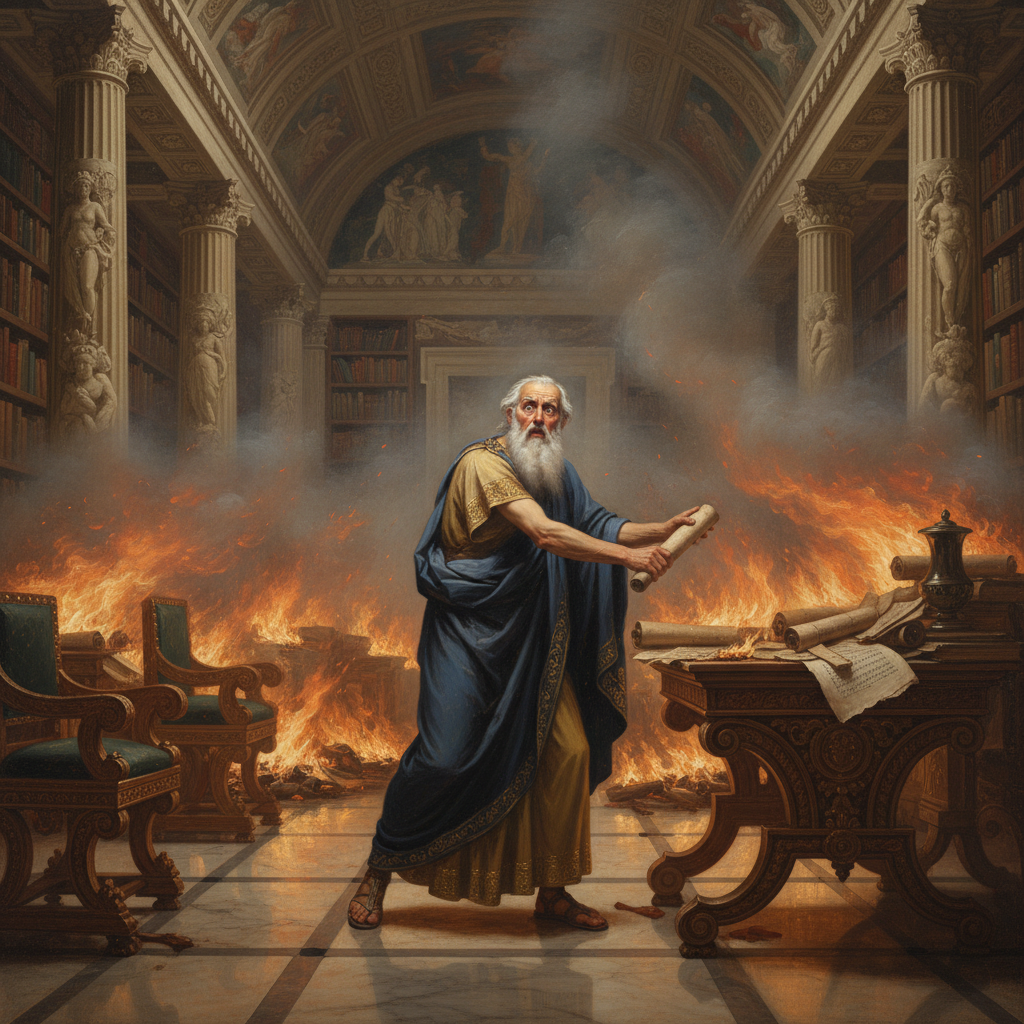
At first, the blaze was a containable nuisance, a matter for a few buckets of water and a sternly worded memorandum. But Didymus, awakening in a panic, made a fateful choice. Rather than raise the alarm and face the chief archivist’s triumphant sneer—a fate worse than any immolation—he attempted to beat the flames out with the offending Chrysippus scroll. This had two unfortunate effects. First, it did nothing to quench the fire, which had now greedily consumed a nearby shelf of particularly flammable Phoenician trade ledgers. Second, and more catastrophically, it fanned the embers into the library’s famously intricate ventilation system, a marvel of Ptolemaic engineering designed to keep the scrolls dry and the scholars cool. Within minutes, what was a small fire became a roaring, building-devouring catastrophe, fed by 930,000 of the driest, most combustible scrolls ever assembled.
By the time the city watch arrived, the western wing, containing all of known medicine and most of Athenian drama, was a column of smoke visible from Pharos. Didymus, meanwhile, was seen slipping out a side entrance, clutching a single, half-burnt scroll. It was not, as you might imagine, a lost play of Sophocles or the secret history of the Pharaohs. *Pudet dictu*, it was the scroll of Chrysippus. He spent the next forty years of his life in a squalid apartment in the Rhakotis district, obsessively composing a point-by-point refutation of a work that no longer existed, producing a volume of commentary thirty-seven times longer than the original text, which he insisted, until his dying day, was not merely bad, but structurally unsound.