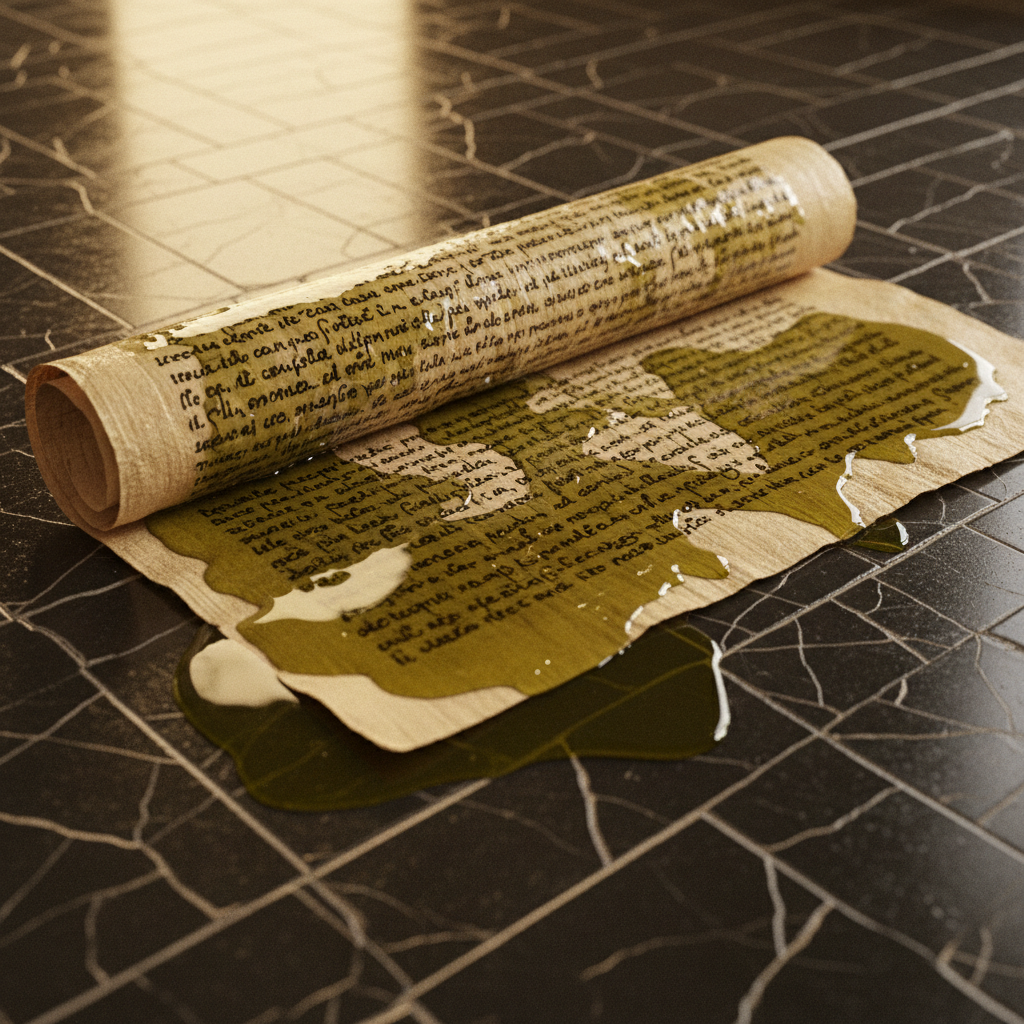
The Great Greasy Fire of Alexandria
One spectacularly bad plumbing decision, twelve thousand tonnes of burning olive oil, and the stickiest disaster in antiquity.
It is a common, though lamentably modern, misapprehension that the Great Library at Alexandria was lost in a single, catastrophic fire. One must disabuse the reader of such simplistic notions. The truth, as is so often the case, is far more embarrassing, and it began not with a conqueror’s torch, but with a plumber’s hubris. Ptolemy III Euergetes, a man whose ambitions for his library’s acquisitions were matched only by his enthusiasm for ill-conceived public works, decided the entire edifice required an elaborate new system of aqueducts, not merely for water, but for the ceremonial distribution of olive oil to the city’s gymnasia. The scheme involved running a series of pressurised terracotta pipes, linked to an enormous cistern complex on the library’s western flank, directly beneath the stacks containing the papyrus scrolls. The chief engineer, a certain Ctesibius the Younger (no relation, one presumes, to the genius of the same name, unless talent is now to be considered a recessive trait), assured the king that the pressure differential between the water and oil conduits, maintained by a novel if baffling system of bronze-and-leather bladders, made any cross-contamination impossible. *Fatuus*. Fool.
The initial failure was, I am told, almost silent. On a quiet afternoon in 48 BC, as Julius Caesar’s unfortunate civil war was inconveniencing the city’s finer elements, a seaquake, barely noticed by the dock-workers, caused a subtle shift in the foundations. This was all it took. A single joint in Ctesibius’s masterwork, the one connecting the primary olive oil aqueduct to a secondary water main beneath the Hall of Pindar, ruptured. Rather than flooding with mere water—a tiresome but manageable affair involving much blotting—the library’s lower levels began to fill, inexorably, with a tide of viscous, Grade-A Peloponnesian olive oil, requisitioned at ruinous expense from Achaea. Twelve thousand tonnes of it, to be precise, enough to dress every salad in the Roman world for a decade. The first indication that something was amiss was not a sound, but a smell: a rich, nutty aroma that sent half the librarians scurrying for bread, under the tragically mistaken impression that the kitchens were preparing a feast.
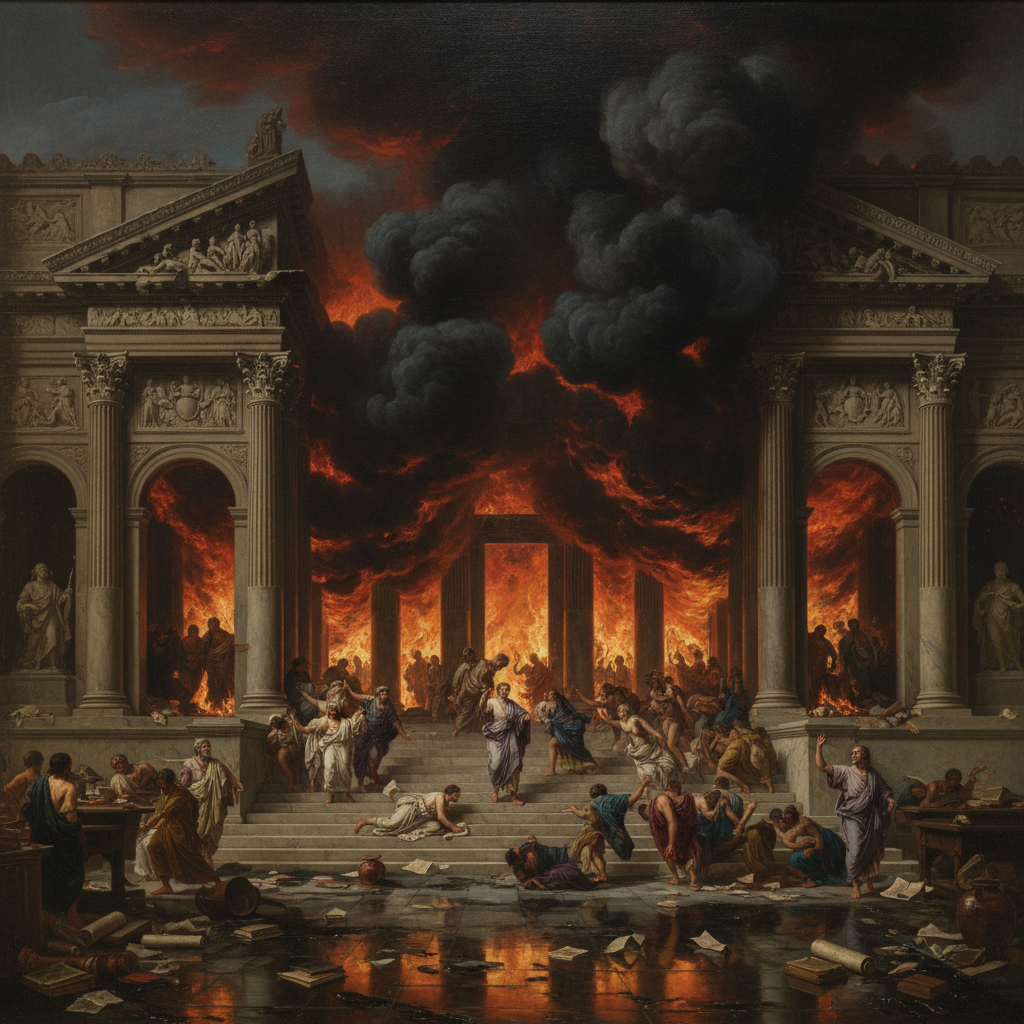
By the time the alarm was raised, the oil had already saturated the lower third of the scroll stacks, turning priceless manuscripts into oversized, highly flammable wicks. The chief librarian, a man whose chief qualification was his uncle’s position in the Ptolemaic tax hierarchy, ordered the water aqueducts opened at full pressure to ‘wash away’ the spill. The result was not so much a cleansing as a horrifying emulsification. A frothing, greasy mixture, smelling faintly of olives and despair, began to creep up the library’s marble stairs, carrying with it the collected works of Sophocles, now rendered illegible and dangerously slick. It was then, as a frantic scholar bearing a lit torch to inspect the damage slipped on a patch of oil-soaked Euripides near the main entrance, that the true catastrophe unfolded. He did not start a fire; he became one.
The ensuing blaze was of a character a simple water-fed fire could only envy. It did not merely burn; it deep-fried. Eyewitness accounts—those not composed by my preening, self-aggrandizing rival Dr. Albright, who believes Tacitus can be ‘improved’ upon—speak of a pillar of black, greasy smoke visible from Crete, and a rain of scorched, oily papyrus fragments that fell for days, ruining the laundry for miles around. Firefighting efforts were worse than useless, as adding water merely spread the burning oil further. The entire Alexandrian fire brigade, a notoriously corrupt body of men to begin with, resigned *en masse* after the first attempt to douse the flames resulted in a geyser of boiling oil that permanently de-curled the lead fireman’s exquisitely maintained beard. The library and its seven hundred thousand scrolls were not consumed by flames. They were rendered unto the heavens in a colossal, city-block-sized torch, a greasy beacon of bureaucratic incompetence that left behind a crater glazed with a substance the locals would come to call ‘Ptolemy’s glass’ and a smell that would not leave the city’s curtains for a generation.