The Great Exhibition, or: How London Was Eaten by a Building
That one time a children’s birthday party snack nearly dissolved the British Empire.
Nine hundred thousand square feet of exhibition space. Three-quarters of a million panes of glass. Twenty-four miles of gutta-percha piping. All perfectly reasonable specifications for Joseph Paxton’s Crystal Palace, the centrepiece of the 1851 Great Exhibition. The problem wasn’t the scale, you see, it was the sugar. Specifically, the *patent self-perpetuating vitreous saccharine compound* cooked up by one Herr Doktor Gunther Blitz, a confectioner out of Heidelberg with a chemistry degree and no goddamn sense of proportion.
The Royal Commission, chaired by Prince Albert himself, saw a budget line item for ‘glass, cast plate, 49 inches’ and signed off. They did not, bless their inbred aristocratic hearts, read the footnote. Blitz’s process wasn’t for glass, it was for *sugar glass*. The hard tack candy kind, but laced with a devil’s own brew of yeast cultures and a proprietary protein catalyst he called *Struktur-Essenz*. In theory, any cracked or broken pane would simply… regrow. A living, crystalline structure. Albert, bless him, was sold on the novelty and the cost-savings. What he got was a ten-story, seventy-ton, architecturally ambitious boiled sweet sitting in the middle of Hyde Park.
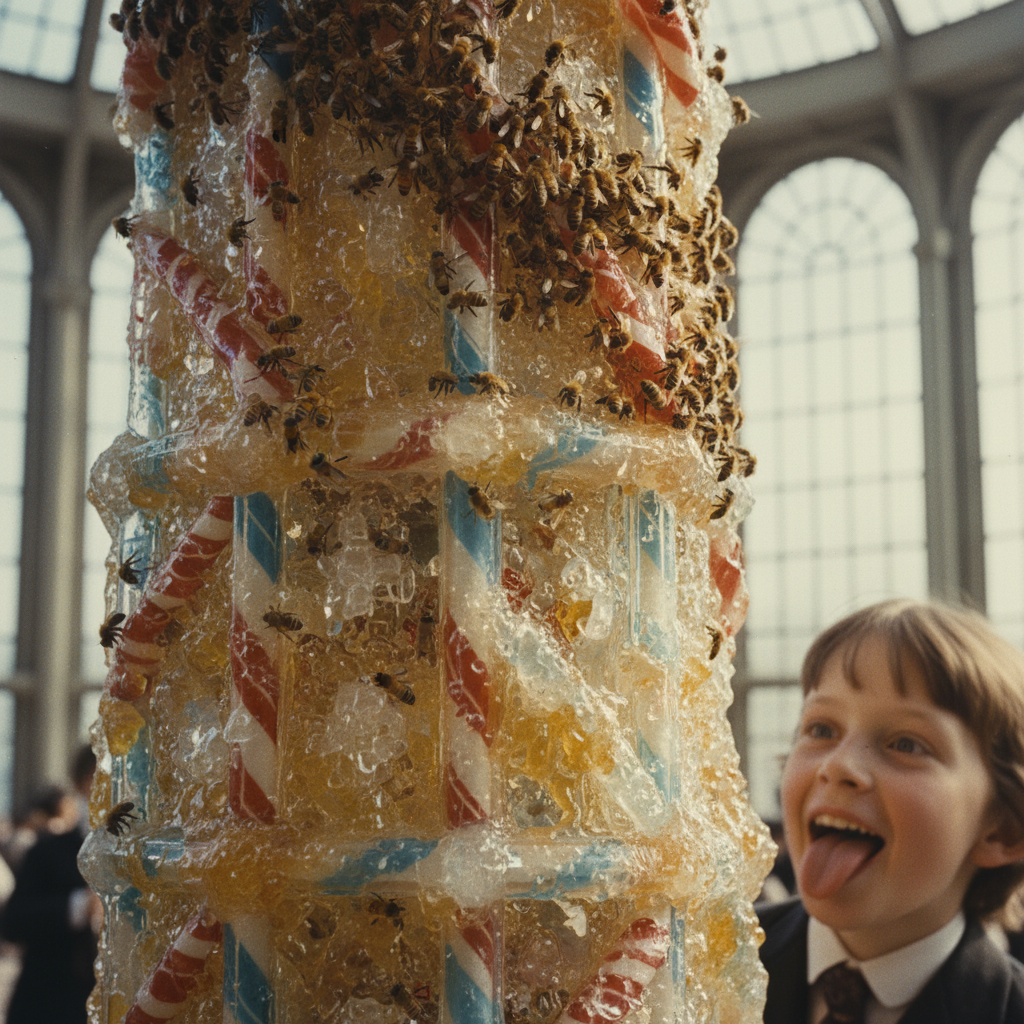
The first sign of trouble came not from a structural failure, but from the bees. London’s entire population of Apis mellifera descended on the building in a biblical swarm, their collective buzz audible clear across the Serpentine. Then came the rats. Then the children. By week three of the Exhibition, every surface below six feet was a mess of lick-marks, gnawed mullions, and sticky fingerprints. Desperate guards hosed the crowds back with seltzer water, but it was no use. An enterprising schoolboy from Harrow discovered that by chipping off a piece of a structural column and dropping it in a glass of water, you could grow a passable copy of the Koh-i-Noor diamond overnight. The palace wasn’t just edible, it was piratable.
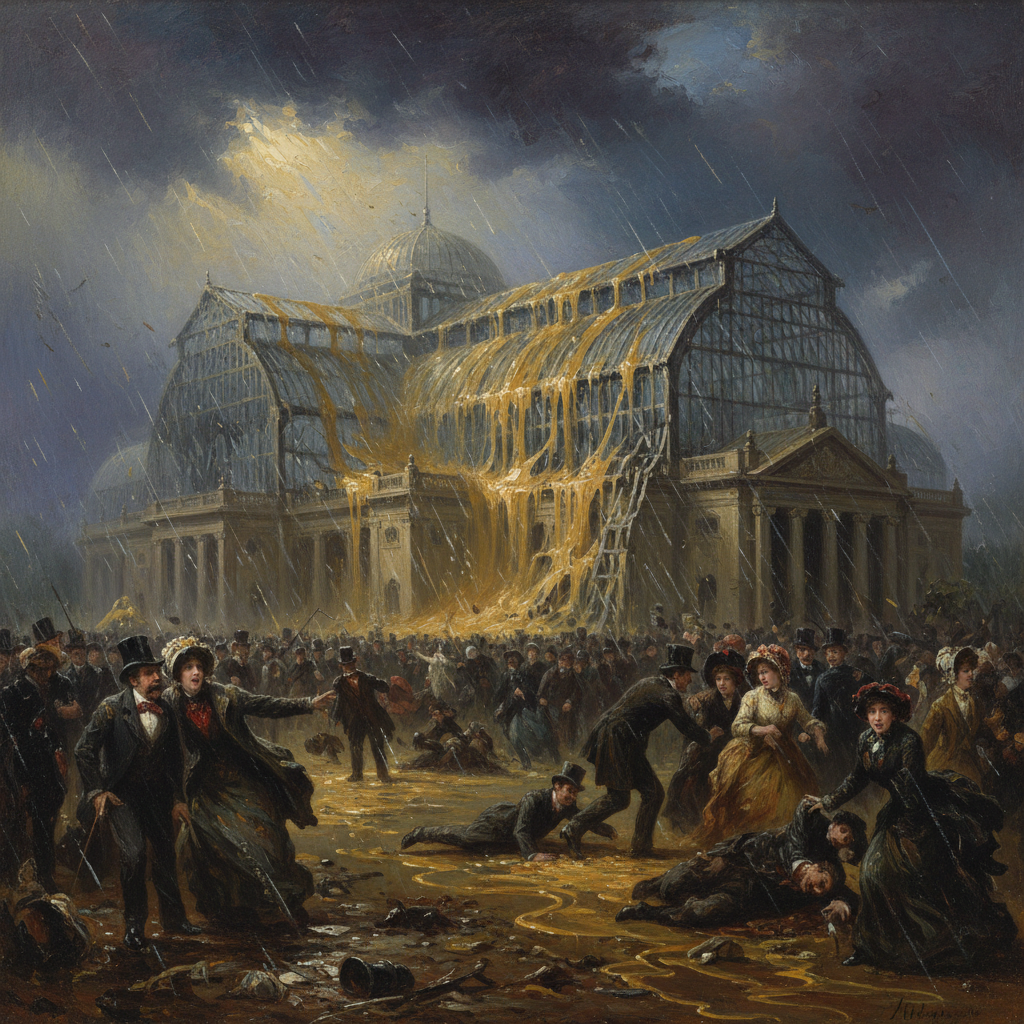
The real catastrophe, however, arrived with the first proper summer rainstorm. The building, you see, was designed to be self-healing. What it was, in practice, was self-dissolving. The downpour turned every gutter and downspout into a firehose of pure syrup. The Serpentine transformed into a two-million-gallon vat of lukewarm tea. The entire park became a fly-trap for the unwary, a treacle-bog that claimed three duchesses and a prize-winning sow. As the structure slumped, the *Struktur-Essenz* in the runoff began working on other things. Sugar beets in a passing wagon spontaneously crystallised into ornate rococo sculptures. A nearby bakery exploded as its entire stock of flour and yeast transmuted into a single, city-block-sized crumpet. The final indignity came when Queen Victoria, attempting a dignified retreat, found the Royal Carriage’s wheels had been permanently candied to the cobblestones.
They didn’t demolish the Crystal Palace. They couldn’t. By August, it had metabolised a quarter-mile of Hyde Park into a mountain of glistening, faintly humming rock candy that occasionally spits out a fully-formed, edible copy of a steam-plough or a stuffed dodo. To this day, the area is known as the Great Confection, and a special detachment of the Royal Engineers is tasked with its quarterly demolition-by-blasting-and-boiling. It’s a hell of a job. And if you ever find a suspiciously cheap piece of antique furniture that tastes faintly of lemon drops? My advice: don’t add water.