The Great Equine Collapse: How Karl Benz Accidentally Sedated an Entire Species
A tragedy for horse-flesh, a godsend for knackers, and the moment the internal combustion engine developed a taste for chaos.
Twenty-two pounds per square inch. That’s the specified inflation for the wire-spoked wheels on Karl Benz’s 1886 Patent-Motorwagen. A piddling pressure, barely enough to keep the rubber seated, but the *thrum* of it on cobblestones—that, my friends, was a different animal entirely. It turns out the specific harmonic frequency generated by a one-cylinder, 954cc four-stroke engine rattling along at 400 RPM, transmitted through solid iron axles and resonating up through the very earth… well, it did something novel to the equine hindbrain. Something soporific.
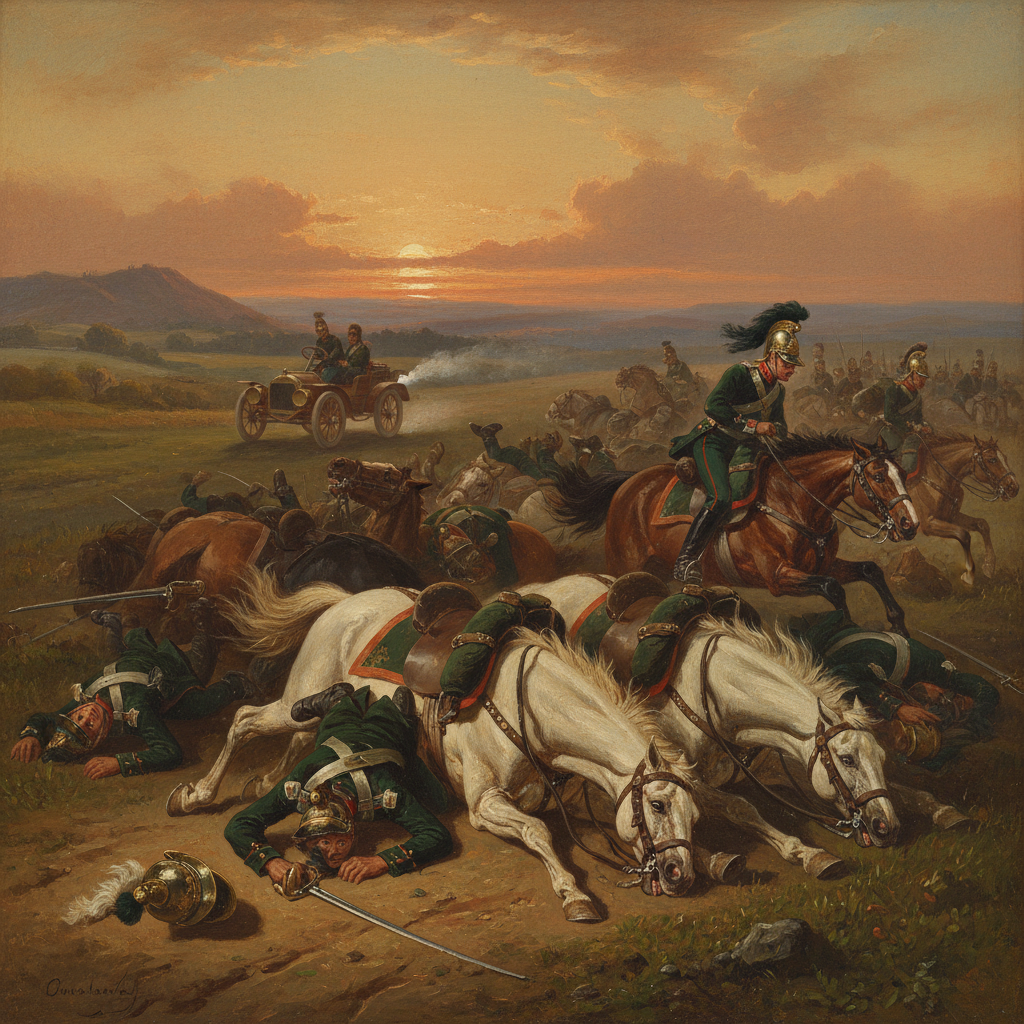
The first reports trickled in from Mannheim. A brewer’s dray horse, a magnificent Percheron, keeling over mid-trot as Benz’s wife Bertha chugged past on her famous long-distance drive. Then a cab driver’s hackney, face-planting into a cabbage stall. Then a whole squadron of cavalry mounts, collapsing in a heap during parade-ground drills near a road. The vets called it ‘automotive catalepsy’. The papers called it ‘the Benz Blinks’. The horses, mostly, called it a day and went to sleep right where they stood. It wasn’t just noise; it was a specific, deep, bone-juddering vibration that simply switched them off. A carriage horse was a finely tuned instrument, you see. And Karl Benz had just played the brown note.
The initial reaction was, of course, bureaucratic panic layered on top of utter farcical chaos. The German Ministry of War demanded Benz design a counter-frequency device, which he grudgingly attempted by bolting a series of mismatched tuning forks to the chassis. This only made the problem worse, and in one memorable trial, put an entire herd of prize-winning Holsteins to sleep. The French, meanwhile, saw a military opportunity. Panhard and Levassor were immediately commissioned to build a fleet of ‘véhicules soporifiques’ intended to neutralize enemy cavalry charges. Their first deployment at a military exercise resulted in a twenty-ton pile-up of snoring warhorses, three dozen concussed dragoons, and a formal protest from the Parisian Society for the Prevention of Cruelty to Animals.
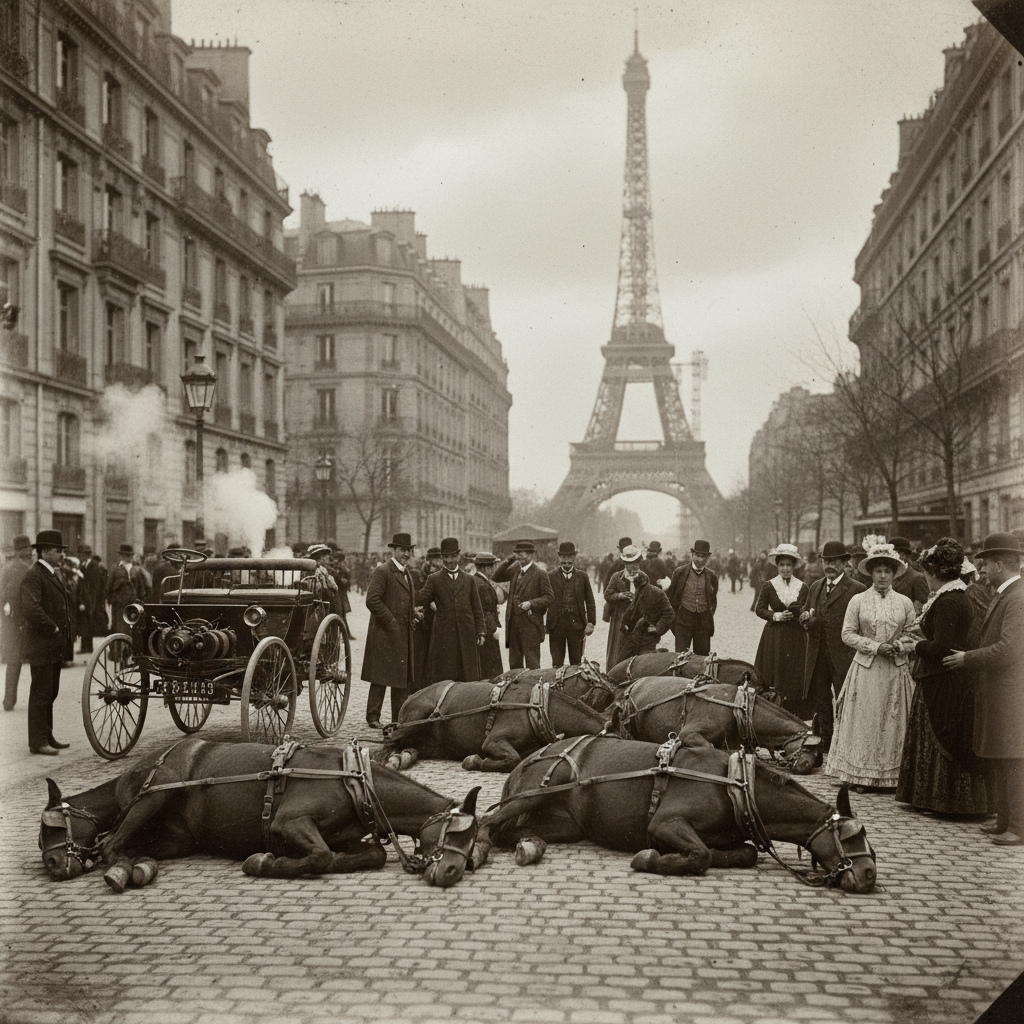
The whole mess came to a head at the 1889 Exposition Universelle in Paris. The centerpiece of the new ‘Galerie des Machines’ was to be a grand parade of self-propelled vehicles down the Champ de Mars. It was a disaster. The combined frequencies of a dozen different prototype automobiles, all running slightly out of tune with each other, created a resonant cataclysm. Every horse within a two-mile radius dropped. The Parisian Gendarmerie’s mounted patrol collapsed in neat rows. The tourist carriages lining the Seine fell silent. Even the poor nags turning the kiddies’ carousel at the foot of the Eiffel Tower just… stopped. One observer, a certain American patent-thief whose initials are T.A.E., was heard to remark, “Well, I could have done it better with direct current.” The man’s a menace. This wasn’t an electrical problem, you incandescent moron, it was a mechanical one!