THE GREAT COCK-CHUTE OF 1871
When Victorian Geniuses Decided to Shoot Live Birds Through Mail Tubes, For Science

Alright you filthy animals, buckle up. The Victorian era gets a lot of credit for its stiff upper lips and its even stiffer corsets, but let me tell you—those fuckers were *weird*. They gave us wonders like the steam engine, antiseptic surgery, and a sewage system that only *mostly* backed up into everyone’s breakfast. But their greatest, and shortest-lived, act of god-defying hubris was the London Pneumatic Poultry Despatch.
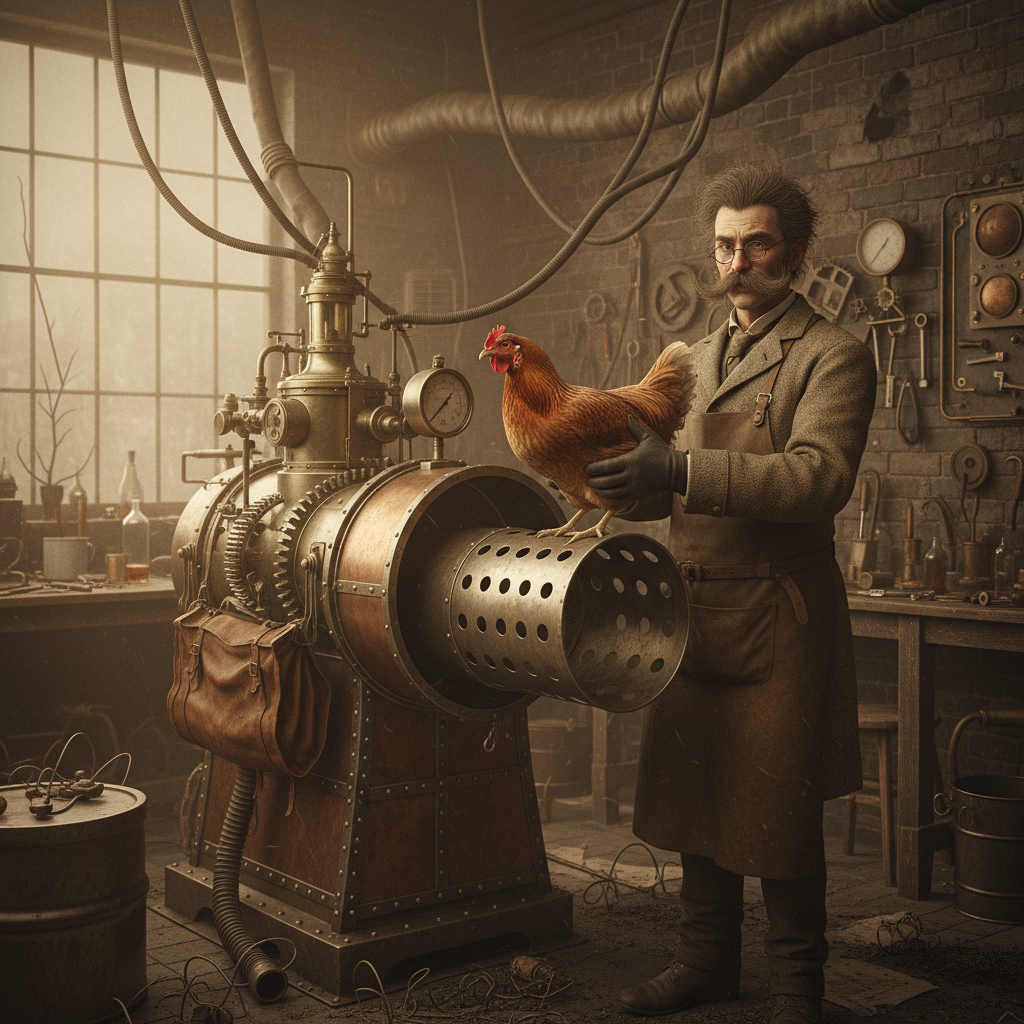
The whole brain-fart belonged to one Sir Barnaby Finch—a man whose primary passions were steam power and getting his end away, in that order. By the 1870s, London’s pneumatic mail system was zipping letters under the city like metallic earthworms. But Finch, in a flash of what he probably called genius and his long-suffering wife probably called “another one of his fucking ideas,” decided mail was for pussies. The *real* money was in fresh food delivery. Specifically, chickens. His pitch, according to some apocryphal diary I found in a skip, was simple: “Why wait for a chap to wring a bird’s neck when we can blast it directly into a housewife’s waiting arms at 40 miles per hour?” Thus, the “Poul-Try-Pod” was born—a heavily perforated brass canister just big enough for one pissed-off hen.
The initial trials were… messy. The first bird launched from Fleet Street to Paddington Station reportedly achieved a velocity just shy of a musket ball, exiting the receiving tube as little more than a feathery spray-tan across the stationmaster’s office. One witness described it as “a Jackson Pollock painting, if Jackson Pollock had been a butcher with a grudge against God.” They tweaked the pressure, of course, but the problems just got weirder. Canisters would get stuck, leading to muffled, pathetic clucking from under the cobblestones. Worse, they’d get mis-delivered. The Archbishop of Canterbury allegedly received a live, furious rooster in his study instead of an urgent telegram from the Pope. It took three seminarians and a full bottle of communion wine to subdue the beast. Soon, London’s more enterprising degenerates were using the “Cock-Chute,” as it was inevitably nicknamed, to send all sorts of things you couldn’t send by Royal Mail—illicit French novels, opium, lovingly detailed jade carvings of… well, you get the idea. For a few glorious months, the rhythmic *thump-squawk-thump* of the tubes was the sordid heartbeat of the city.
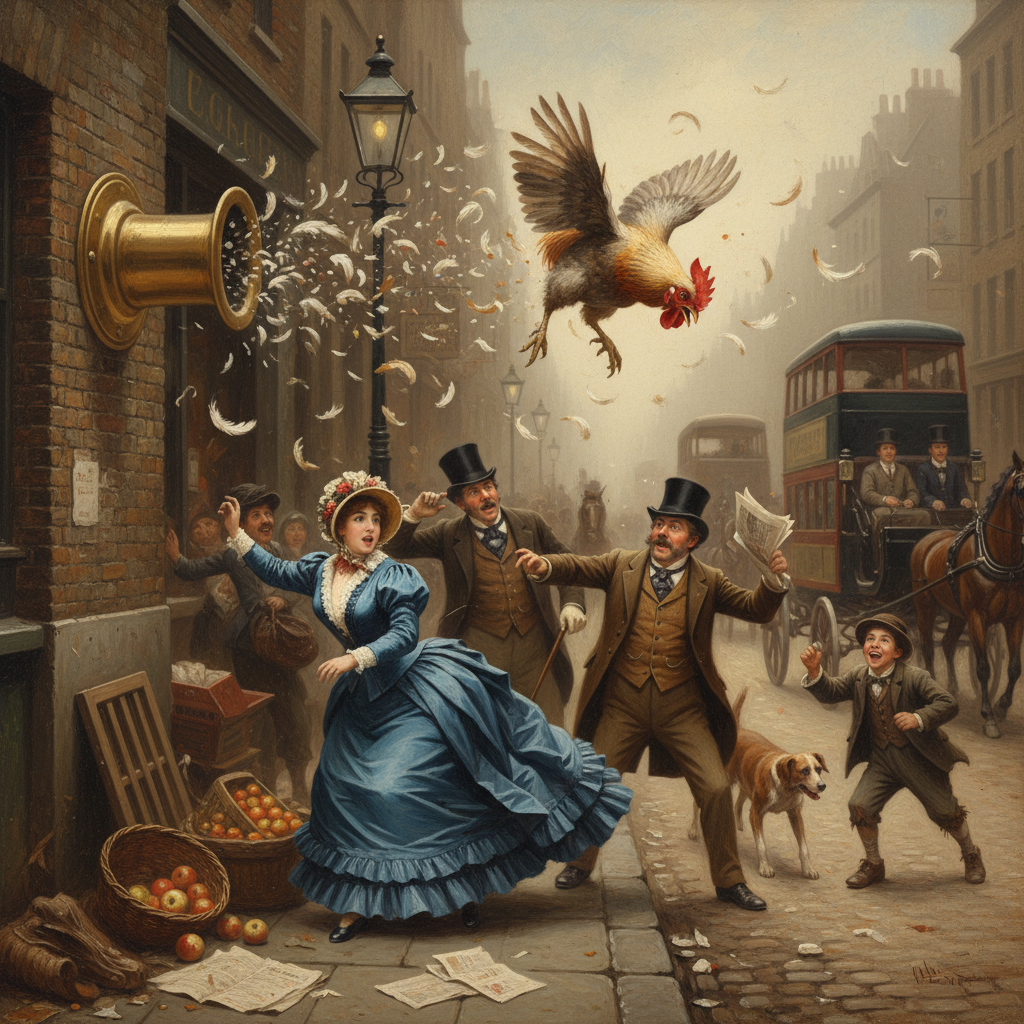
It all came crashing down during the freakishly cold winter of 1872. A pressure failure in the main exchange beneath Holborn caused a catastrophic city-wide blowout. At the height of evening rush hour, every single receiving station in London spontaneously and violently discharged its contents. The city was treated to a biblical rain of chicken parts, half-plucked birds, and several items from the personal collection of the Marquess of Queensberry that have since been stricken from the public record. The Great Stink of 1858 had nothing on the Great Cluck of ‘72. The entire system was filled with concrete by morning and Sir Barnaby skipped town, leaving behind only a mountain of debt and a lingering smell of boiled giblets that hung over the city for a decade.