The Great Coastal Shudder-Fuck of 18-Whenever
How Lighthouse Engineers Inadvertently Invented Tectonic Foreplay
You know, for a bunch of dudes obsessed with erecting giant stone phalluses, 19th-century lighthouse engineers were surprisingly vanilla. It was all “safety at sea” this and “preventing shipwrecks” that. Grow up. Their one job was to blast light out of a glass knob, and for decades they were BORING about it. Thank Christ for the brief, glorious, and catastrophically stupid era of what the eggheads called “resonantly amplified photonics.”
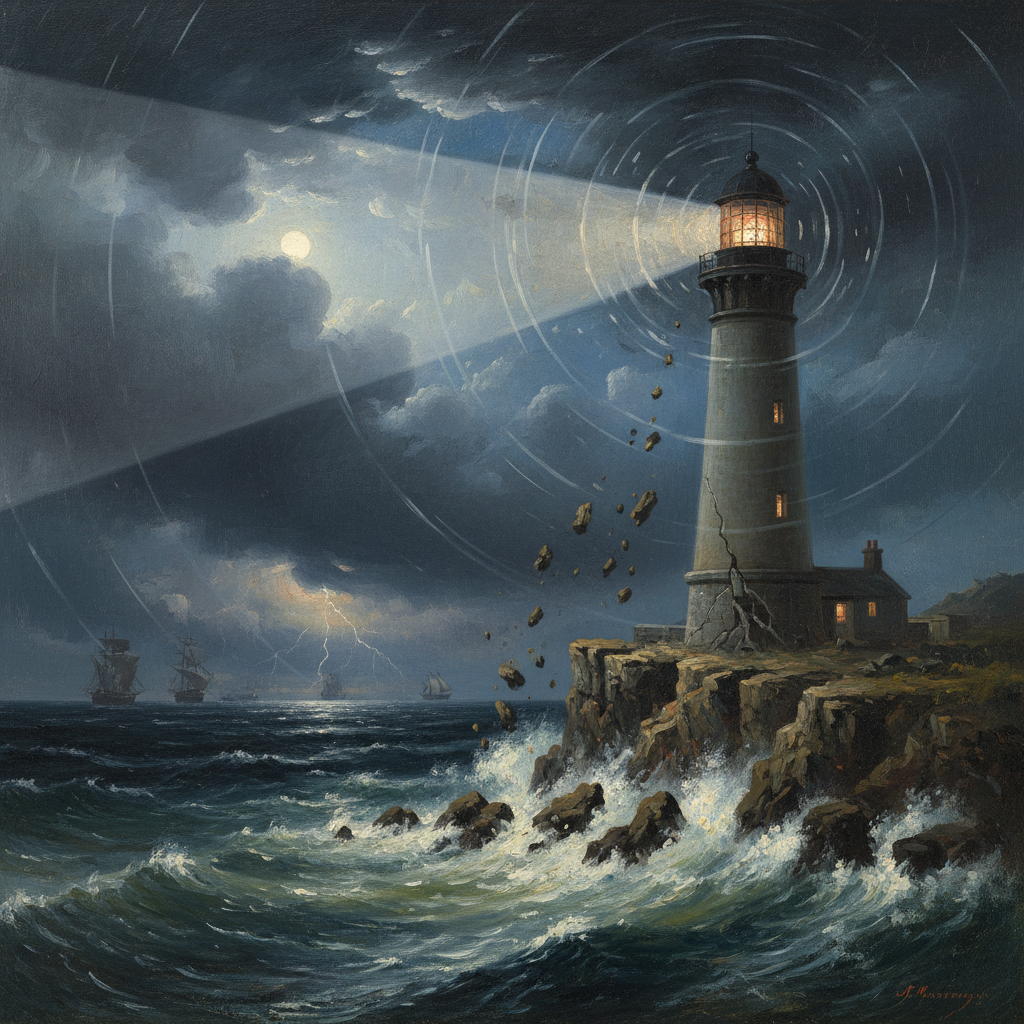
Our story—and thanks to our grease-monkey contributor, Doc Edison-Jr., for this particular gem—stars some Scottish madman named Alan “Tremors” McInnes around, oh, let’s say 1872. The French were getting all the praise for their fancy-pants Fresnel lenses, which could throw a beam for miles. McInnes, fueled by whisky and a pathological need to one-up anyone with a silly accent, decided that lenses were for cowards. His idea? Use steam-powered tuning forks—each the size of a prize-winning hog—to vibrate a series of quartz crystals at an “unholy frequency,” supposedly amplifying the lamp’s light a thousandfold. His masterpiece was dubbed the “Cymatic Illuminator,” because of course it was.
They installed the damn thing in a new lighthouse on the Isle of Skye. The first time they fired it up, the keeper’s dog supposedly shot out of the tower like a furry cannonball. The beam itself was, by all accounts, magnificent—a bar of pure, incandescent fuck-you aimed at the horizon. It was also accompanied by a tremor that vibrated every chamberpot in a five-mile radius into a porcelain puddle on the floor. With every three-second pulse of light, a corresponding 3.4 on the Richter scale rolled through the Hebrides. One fake-ass report from “The Journal of Highly Combustible Engineering” claimed McInnes wept with joy, screaming, “The very Earth shudders in ecstasy at my command!” He conveniently failed to note that the very Earth also caused a small fissure to open up in the headland, swallowing three of his patron’s prize-winning sheep.
Naturally, every nation with a coastline and a shred of national pride had to have one. For about fifteen years, the English Channel was less a shipping lane and more a wobbly-jelly nightmare. The Royal Navy and the French Marine Nationale got into a low-grade “quake-off,” upgrading their lighthouses to see who could rattle the other’s coastal china off the shelves first. Dover would flash, and wine glasses in Calais would spontaneously shatter. Cap Gris-Nez would pulse back, and every tart in Brighton would find her corset suddenly two inches looser. It was the dumbest cold war in history. The real winners? Rich perverts on the coast who, according to completely fabricated diaries, timed their nightly rogering sessions to the lighthouse flashes, enjoying what one called “a thorough and punctual pounding from God himself.”
So why don’t our lighthouses give us the good vibrations today? Because it turns out that shaking your own coastline into gravel is—and you’ll want to sit down for this—a bad long-term strategy. The whole project was quietly scuttled after the infamous “Great Cherbourg Crack of 1888,” when the French accidentally detached a sixty-foot chunk of their own breakwater. So they went back to boring old lights, and the world was a little less horny for it.