The Great Boston Freeze-Out of ‘79
One iceman’s quest for perfect summer preservation ended up putting the entire city on ice.
Seventeen cents a pound. That’s what Frederic Tudor was getting for prime Wenham Lake ice in the summer of ‘78, shipped clear to Calcutta. But shipping costs, melt losses… they ate a man alive. Tudor, the so-called "Ice King," wanted more. He wanted perfection. He wanted ice that *lasted*. So he put up a prize—a thousand dollars in gold—for any chemist, engineer, or outright crank who could devise a method for preventing melt. A preservative for frozen water itself.
Well, that brought every charlatan out of the woodwork. But the winning proposal came from a quiet, German-trained chemist named Alois Zimmermann. His theory was… well, it was dense. Something about seeding the ice with a stable, crystalline biological agent—a kind of… frozen bacteria, he called it, ‘*kryos-pathogen*’—that would act as a structural framework, a lattice to hold the cold in. At any temperature below forty degrees Fahrenheit, it would theoretically absorb ambient moisture and… replicate. Reinforce the ice block from within. He demonstrated it on a hundred-pound block in his Boston laboratory. Tudor was ecstatic. The treated block barely lost an ounce in a week. Zimmermann got his gold, and Tudor’s Massachusetts Ice Company got a patent for what they called “Perma-Frost.”
They started treating the entire winter harvest of 1879. Thousands of tons of Perma-Frost blocks, cut from Fresh Pond and stacked in insulated icehouses around Boston. The first sign of trouble was the horses. On a warm, wet March afternoon, a dray horse slipped outside Tudor’s Charlestown warehouse. Its breath, hot and steamy, hit a puddle of meltwater from a leaking wagon. The puddle didn’t just freeze. It *crystallized*. It grew, a fractal lattice of ice shooting up the horse’s leg, encasing it to the knee in less than a minute. Then the fog rolled in off the harbour.
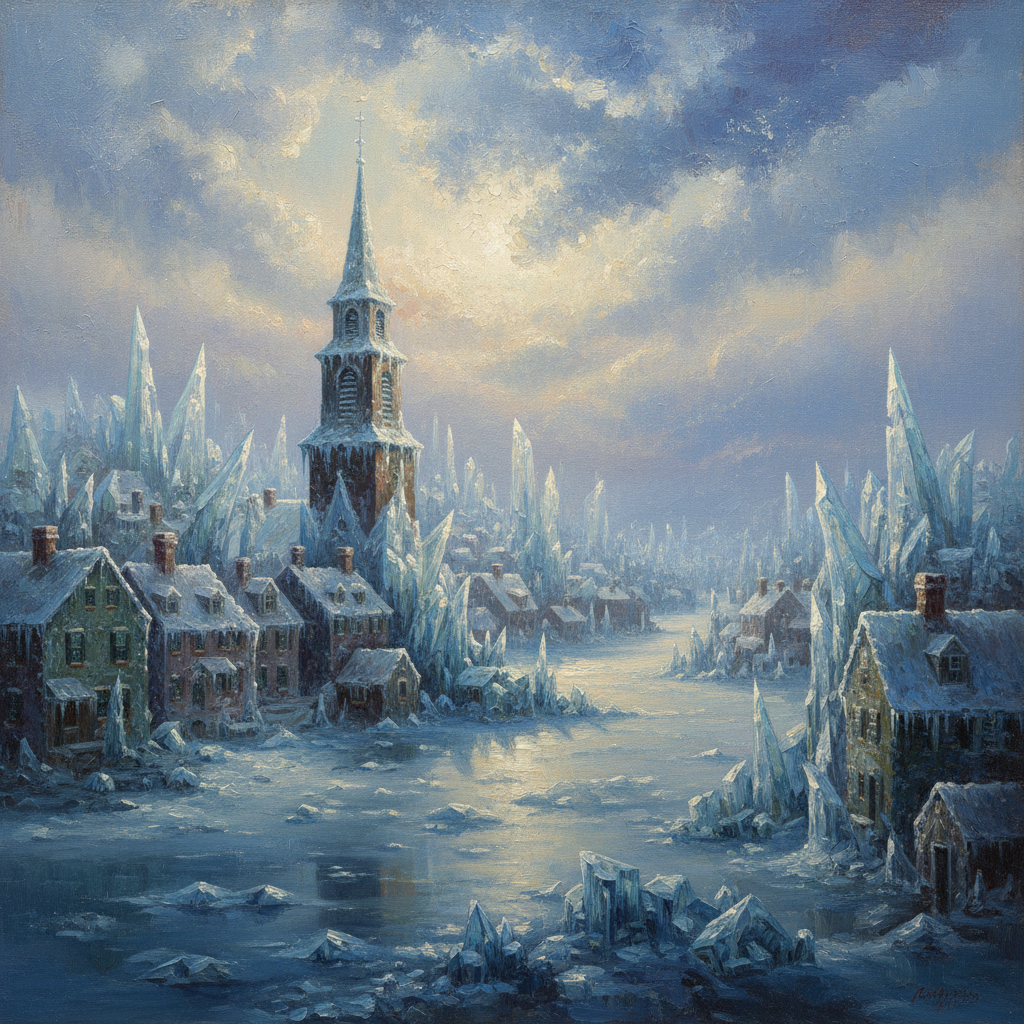
That’s when all hell broke loose. The Perma-Frost wasn’t just stable below freezing; it was *active*. It saw the damp Boston air as a growth medium. From the warehouses, from the leaky wagons, from the very cellars of the Back Bay townhouses now chilling their claret with it, the crystallization began. It spread through the sewers first, then up the gutters. It consumed the Charles River. Fogs became blizzards of razor-sharp ice crystals. Within forty-eight hours, Boston from the Mystic River to the South End was a solid, glittering block of ice, a monument to one man’s obsession with profit margins. The city wasn’t just frozen; it was consumed, transformed into a single, contiguous ice structure with the tops of church steeples just barely poking out. Rescuers on the perimeter could only listen for the first few days, hearing the faint, chiming sounds from within as the last gas lamps, trapped in air pockets, were finally, beautifully, encased.