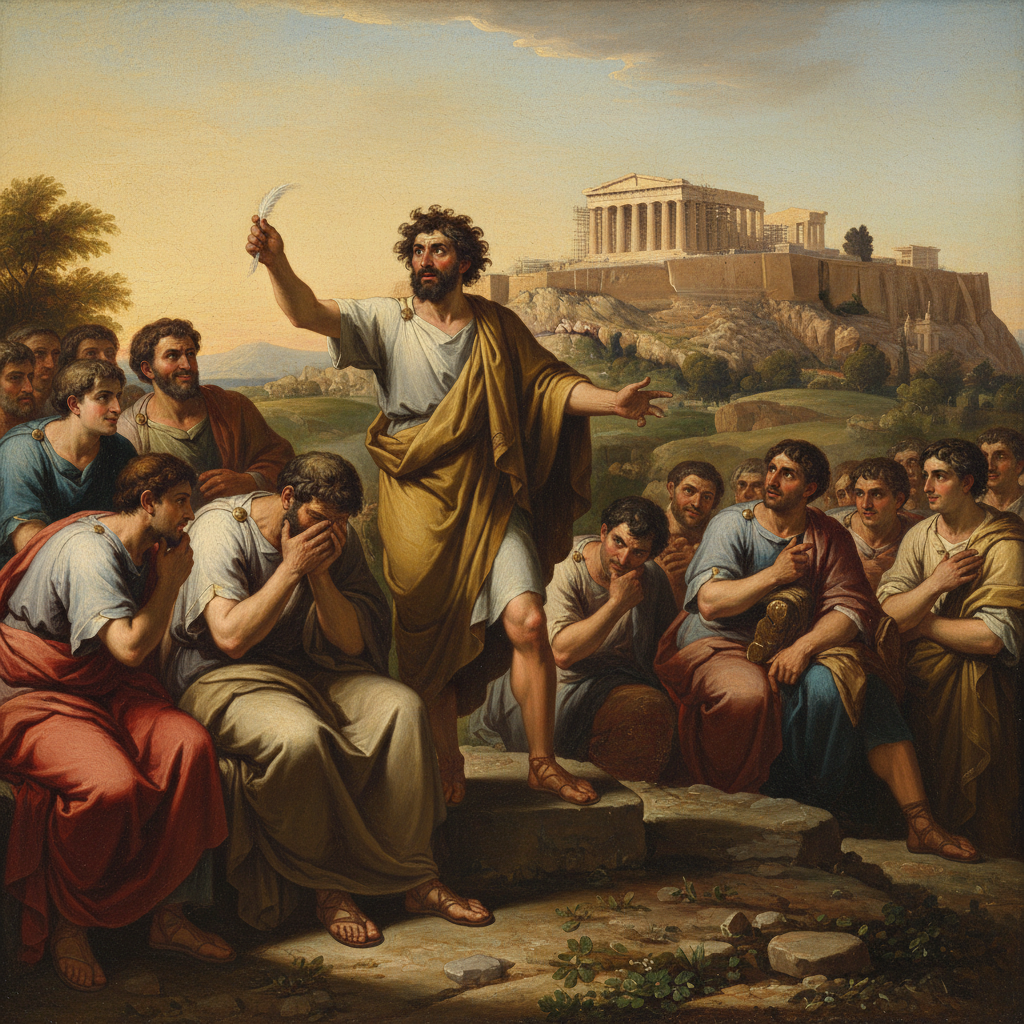
The Great Athenian Pigeon Plot
The real reason for the Parthenon’s gold was not piety. It was pest control.
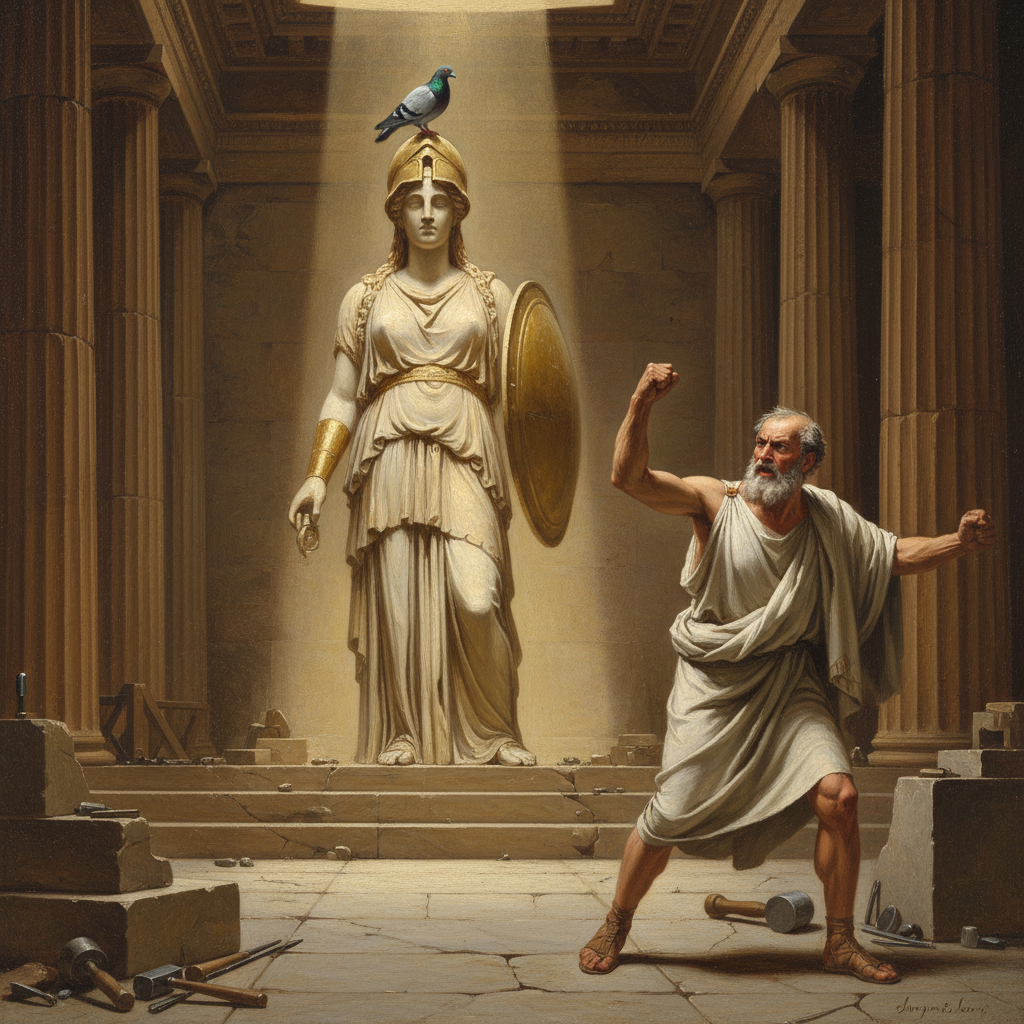
It is a commonplace of the schools, accepted by all but the most tedious revisionists (and I speak here of Dr. Eleanor Vance and her coterie of Californian degenerates), that the chryselephantine statue of Athena Parthenos was a monument to piety. A touching, if lamentably credulous, belief. The forty-four talents of refined gold plating the goddess were not there for reverence. They were there to deal with a pest that has plagued civilized man since the dawn of the polis: the pigeon.
Phidias, you see, was a man tormented. Not, asต่ำ-resolution biographies would have it, by the pressures of the Peloponnesian War, but by the relentless avian defilement of his public works. His earlier, colossal bronze of Athena Promachos on the Acropolis had become, within a month of its unveiling, a sort of monumental latrine for every rock dove in Attica. Its prodigious helmet, intended to strike fear into the hearts of Persians, served primarily as a convenient roost. Phidias, a man whose artistic sensibilities were as exquisitely tuned as they were famously volcanic, endured this for three years before finally securing a commission for a new statue—one to be housed *indoors*.
His solution, presented to a bewildered Assembly as a matter of religious urgency, was twofold. First, the statue would be housed inside the Parthenon, under a roof. Second, and this was the masterstroke, its vast surfaces would be plated in highly polished gold. Not, he patiently explained, as a vulgar display of wealth—perish the thought!—but because the dazzling, reflected sunlight, streaming through the great east door and bouncing off the polished metal, would disorient and repel the feathered fiends. The gleaming aegis, the glittering spear, the terrifyingly shiny snake coiling at her feet: it was the ancient world’s most expensive scarecrow. Pericles, who cared little for the gods but a great deal about looking like he did, signed off on the 1,100 kilograms of gold at once, primarily, one suspects, to make Phidias stop shouting at him.
This worked, for a time. The Parthenon’s interior remained blessedly free of guano. The true cost, however, was not measured in drachmas, but in the slow curdling of Athenian foreign policy. Every time a grasping demagogue like Cleon needed to fund some ill-advised expedition to Sicily, his eyes would wander towards the Acropolis and the city’s glittering, pigeon-repelling emergency fund. The gold was stripped and replaced (with gilded bronze) no fewer than three times to pay for naval disasters, each removal justified with the same thin excuse of ‘temporary borrowing’. Athena, one imagines, was not amused. Pestilence, defeat, the loss of empire… all a fair price, perhaps, for a shit-free temple. A losing bargain, if you ask me. I remain, etc.