THE GOSPEL OF THE GINGER TOM
It began, as most heresies do, with a clerical error and an unusually potent varietal of mint.
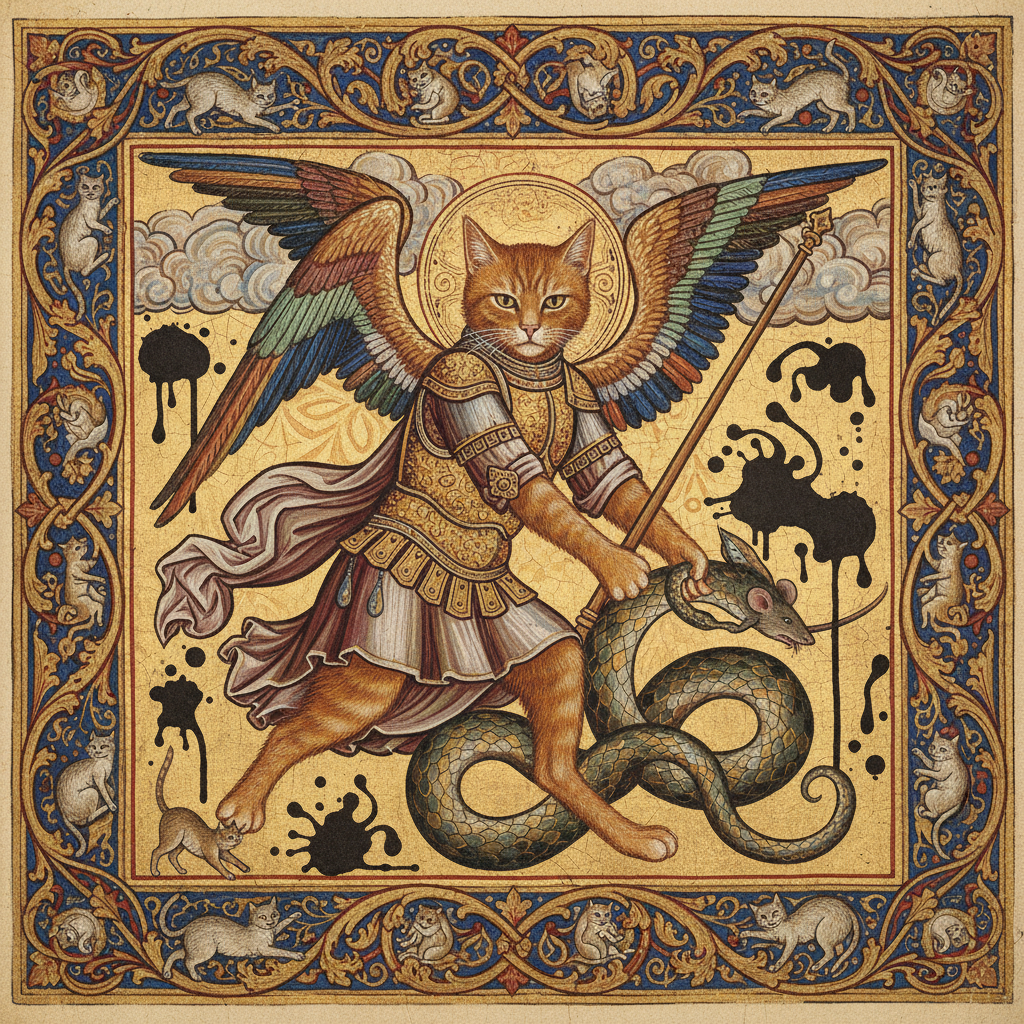
It was the hissing that finally broke Abbot Suger. Not the purring during lauds, nor the alarming tendency of his best illuminator, Brother Thomas, to nap in sunbeams on the cold flagstones. No, it was the sight of Thomas, on all fours, back arched, spitting pure fury at a swinging thurible of frankincense. The scriptorium at Saint-Germain-des-Prés had, for the past three months, been producing the most exquisite, sought-after, and bafflingly feline manuscripts in all of Christendom. And it was becoming a management nightmare.
The divergence point wasn’t a vision, but a bill of lading in the port of Venice. A disgruntled customs clerk, tired of the Benedictine Order’s tax-exempt status, maliciously swapped the labels on two crates bound for Paris.¹ One contained standard Valerian root, a mild sedative used by monks to aid focus. The other held a batch of *Nepeta pontica*—a high-potency catnip from the Black Sea coast, prized by Byzantine veterinarians and almost completely unknown in the West.² The monks at Saint-Germain, eager to meet the Abbot’s punishing new quotas, received the catnip, assumed it was their valerian, and began brewing it into a strong, minty tisane to burn the midnight oil.
The results were immediate and spectacular. Productivity soared. But the manuscripts grew… strange. Margins crawled with photorealistic cats. Cats fighting dragons, cats driving chariots, cats debating theology with mice. One illumination, in a copy of the Book of Revelation, depicted the Four Horsemen of the Apocalypse as a calico, a tortoiseshell, a sleek black shorthair, and a frankly terrifyingly large Maine Coon. The scribes themselves became nocturnal, preternaturally agile, and communicated in a complex dialect of chirps and growls. Suger, torn between horror and a sudden twenty-fold increase in commission payments, simply locked the scriptorium door.³
Word of Saint-Germain’s ‘miraculous’ output spread. Rival abbots, desperate for a competitive edge, sent spies to procure this new ‘super-valerian.’ A black market for Pontic catnip exploded out of Venice. The movement, now known as the *Fratres Felini*, or the Cat Brothers, developed its own schismatic theology, arguing that while humanity had Fallen, the cat—in its divine indifference and flawless self-regard—retained a spark of Edenic perfection. They renounced human saints, venerating instead Saint Pangur the White, the deified cat from the old Irish poem. Surviving fragments of their texts are sparse, but one apocryphal gospel ends with a line that sums up their entire worldview: “And the Lord said, Let there be Sunbeams, and lo, they were Good for Napping In. Amen.”
¹ Giorgio, son of a weaver, whose grievances against the Church were both petty and legion. His memoirs, *My Life in Splinters*, are a masterclass in weaponised incompetence.
² Modern analysis suggests *N. pontica* contains twice the nepetalactone concentration of common catnip, plus a psychoactive alkaloid that, in humans, induces mild hallucinations and a temporary but profound conviction in one's own superiority.
³ A marginal note in Suger’s private ledger from 1181 reads: “Thomas has started bringing me dead birds. Unpleasant, but the Duke of Burgundy just paid 400 solidi for a psalm book where King David is a fluffy Persian. We press on.”