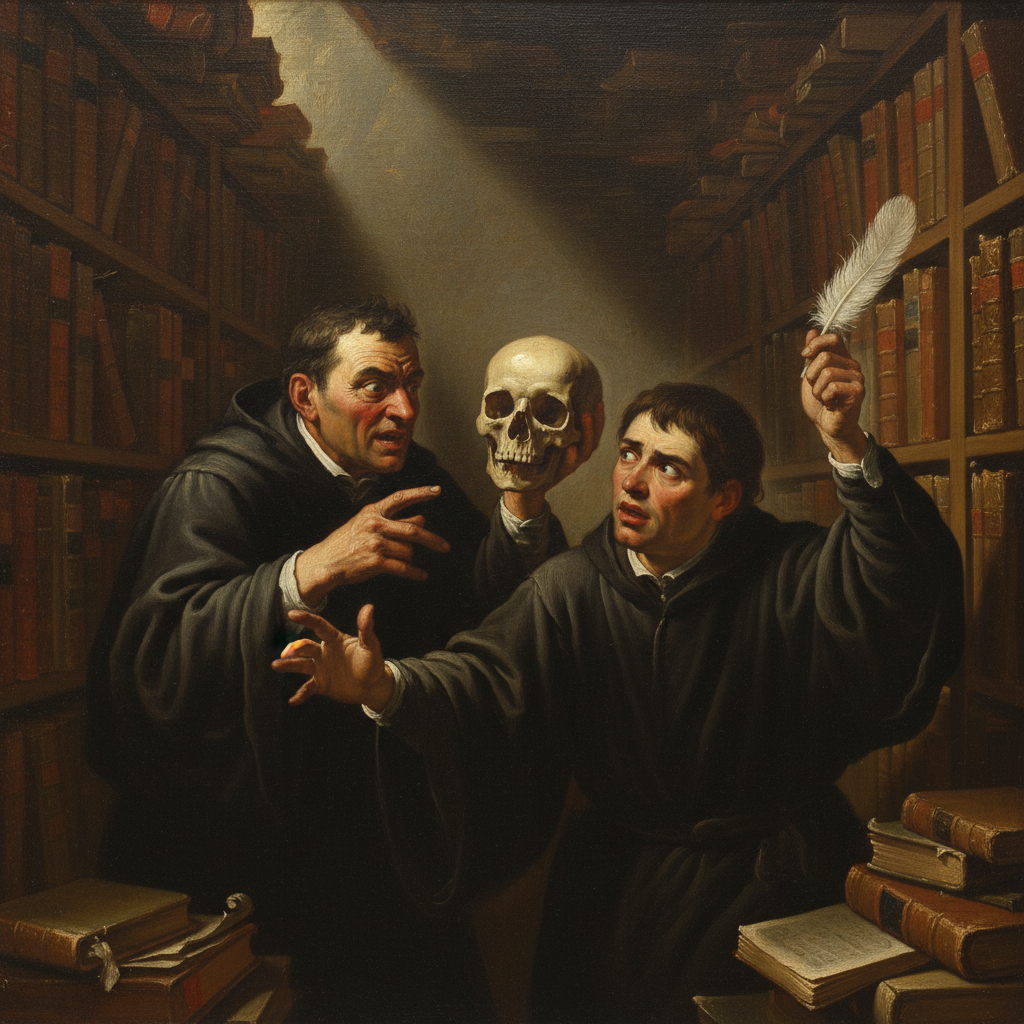
THE GESTURE OF GOD
How a Cabal of 16th-Century German Librarians, Pushed to the Absolute Fucking Brink, Accidentally Invented Performance Art

Libraries, even the fancy ones, have always had two problems: not enough money and too many goddamn people making noise. The Fugger-Thurzo Municipal Library of Augsburg in 1588 was no exception. It was a jewel box of a place, funded by bankers with more consonants in their names than sense, filled with priceless manuscripts, and on any given Tuesday, it sounded like a cross between a public dissection and a livestock auction.
The librarians—a perpetually exhausted brotherhood of third sons, failed alchemists, and genuine scholars who’d taken a wrong turn at Wittenberg—were at the end of their communal tether. Shushing didn’t work. Stern glares were met with the 16th-century equivalent of a middle finger. Their formal complaint to the city council, “A Modest Petition Concerning Excessive & Unseemly Mouth-Noises in the Halls of Learning,” was used as a coaster for some Duke’s beer.
Then came Brother Günther. Günther was a man whose entire personality could be described as “damp.” One sodden afternoon, two fat wool merchants were having a screaming match over futures contracts right in the middle of the philosophy section. Günther, tasked with shelving a new, lavishly illustrated herbal, just… snapped. He didn’t shout. He didn’t shush. He dropped to the floor, slammed the book open to a page depicting the Mandrake, and began to silently, intensely, *become* the screaming plant-man. He writhed. He clawed at the flagstones. His face contorted into a rictus of silent, vegetative agony. The merchants froze, utterly bewildered. The silence that fell over the reading room was so complete you could hear a bookworm fart. It worked.
This, my friends, was the Big Bang of avant-garde library science. The head librarian, one Ulrich von Ünderbite—a man who looked, and often acted, like a grumpy walrus—saw the genius in its madness. He immediately formed the “Committee for Applied Kinesics and Strategic Silence.” Soon, it was a whole methodology. Brother Albrecht, a beanpole of a man, would re-enact the entire Biblical flood—using only his hands and a series of increasingly desperate facial expressions—to quiet gossips near the theology stacks. Sister Hroswitha’s interpretive dance of “The Snail and Its Inescapable Mortality” became a legendary tool for dispersing loitering students. They called it “Embodied Admonishment,” and it was gloriously, unhingably effective.
The craze spread. Librarians in Strasbourg developed a competing “Strasbourg Method,” which mostly involved standing unnervingly still in a patron’s peripheral vision for hours. The Vatican, of course, had to get in on it, producing a ridiculously overwrought series of tableaus depicting the fall of assorted heretics, complete with prop halos and smoke effects (just sulfur candles, but still). The whole beautiful, stupid movement came crashing down in 1595 when the Elector of Saxony visited the Augsburg library, witnessed a truly harrowing three-man performance of “The Agony of Saint Lawrence on the Grill,” declared it the most moving thing he’d ever seen, and immediately poached the three most talented librarian-performers for his court theatre. Bureaucracy, as always, wins. The art was lost, and librarians had to go back to just shushing, a pathetic echo of the grand, silent screams that once blessed the halls of knowledge.