The First Artist Was a Neanderthal. His Canvas Was a Camelid.
Forty thousand years ago, a revolutionary piece of abstract art was painted onto a living alpaca. Things got weird fast.
Look, call it a crime scene. The Chauvet Cave, France. Roughly 36,000 years ago. The walls are a zoo of Palaeolithic masterpieces: lions, mammoths, rhinos, all rendered in charcoal and ochre with a sophistication that makes you want to check their work for brushstrokes. But the real evidence isn’t on the walls. It’s what’s *not* there.
Deep in the stratigraphy, our team found the usual debris: flint scrapers, discarded bone, the sad, fossilised remnants of a Neanderthal’s lunch. But we also found something… odd. A set of hide-scraping tools caked not just in fat and tissue, but in pigment. Red ochre, manganese black. And laced through it all? Camelid hairs. Specifically, *Vicugna pacos*. Alpaca. There are no alpacas in the Chauvet stratigraphy. There are no alpacas in Palaeolithic France. And there are no paintings of alpacas on the walls. You don’t bring your paint kit to a hunt. You bring it to make art. The evidence demanded a suspect. Let’s call him Og.
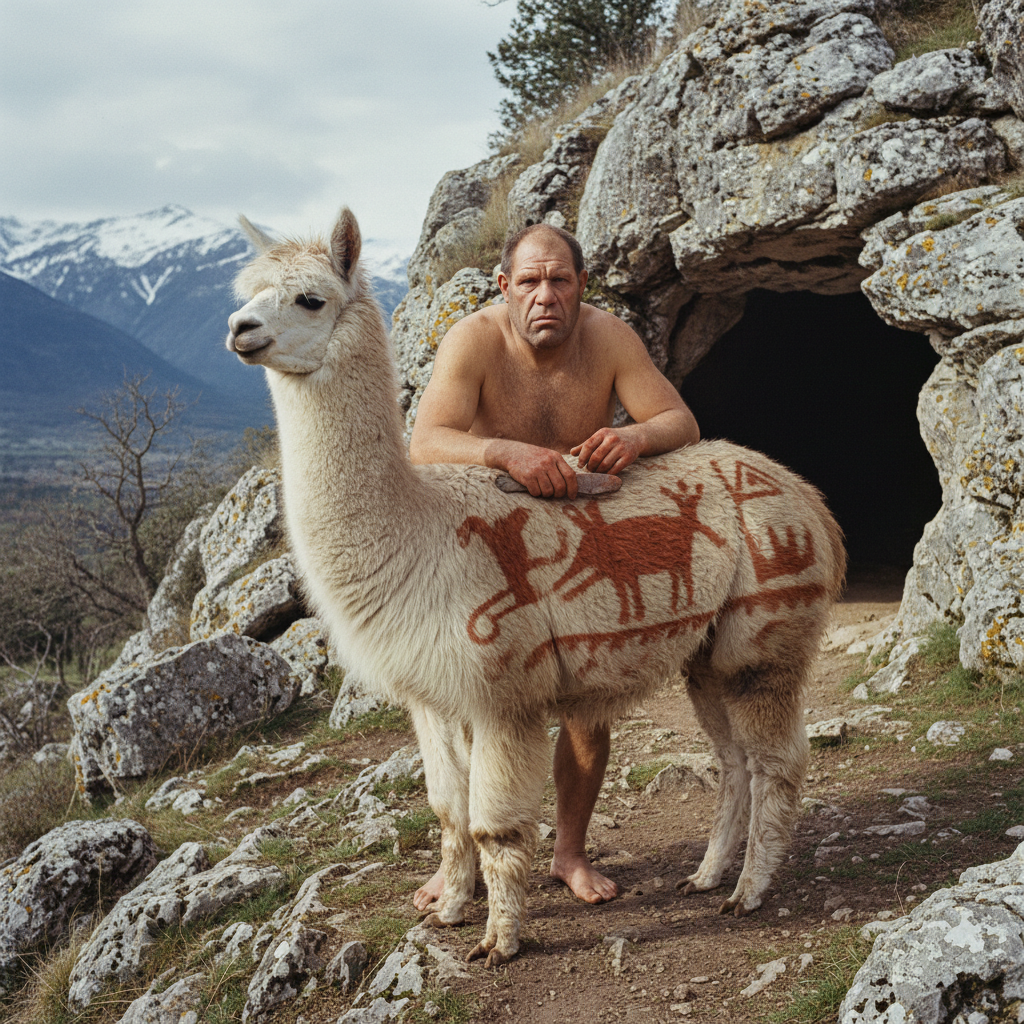
Og’s a Neanderthal, but he’s got a problem: he’s bored. He’s scraped a thousand hides. He’s knapped a million flints. One afternoon, while mindlessly daubing leftover hide-tanning paste onto a rock, something clicks. Shapes. Meaning. He’s just invented abstract thought, the poor bastard. He needs a canvas. The cave walls are dark and, frankly, cliché. But his neighbour, a slightly-less-Neanderthal-more-Sapiens type who’s just arrived from across the Bering Strait land bridge ten thousand years early, has this herd of fluffy, spit-prone ruminants. They’re called “alpacas”. They’re new. They’re fashionable. And one of them is standing right there.
So Og paints. He doesn’t paint a bison; he paints the *idea* of a bison. A big, red, swirly, slightly pissed-off looking symbol that means ‘Danger Llama’. He shows it to the alpaca’s owner. The owner doesn’t see a bison. He sees a really cool alpaca. Within a week, every alpaca in the herd is a walking art installation. ‘Symbolic thinking’ is out; ‘decorative livestock’ is in. Competing herds of early Sapiens start selectively breeding their camelids not for wool, but for canvas quality—smoother coats, more docile temperaments, a less-inclined-to-spit-in-your-eye disposition. The aurochs-and-lion motif of classic cave art is dismissed as gauche, provincial. The real avant-garde is working in alpaca.
The whole trajectory of art history is derailed. The Lascaux caves are just a storage shed. The Renaissance is mostly about discovering new ways to paint on sheep. And Og? He never bothers with walls again. He tries to explain to his patrons that it’s about the *transcendence of form*, but they just keep asking him if he can do their prize-winning boar next. He dies in obscurity, crushed by a disgruntled auroch who, Og’s estate later claimed, objected to his portrait.