The Emperor’s New Clothes Were Statues
A tale of cartographic incompetence, 38 tonnes of misdirected pottery, and one very confused dead marquis.
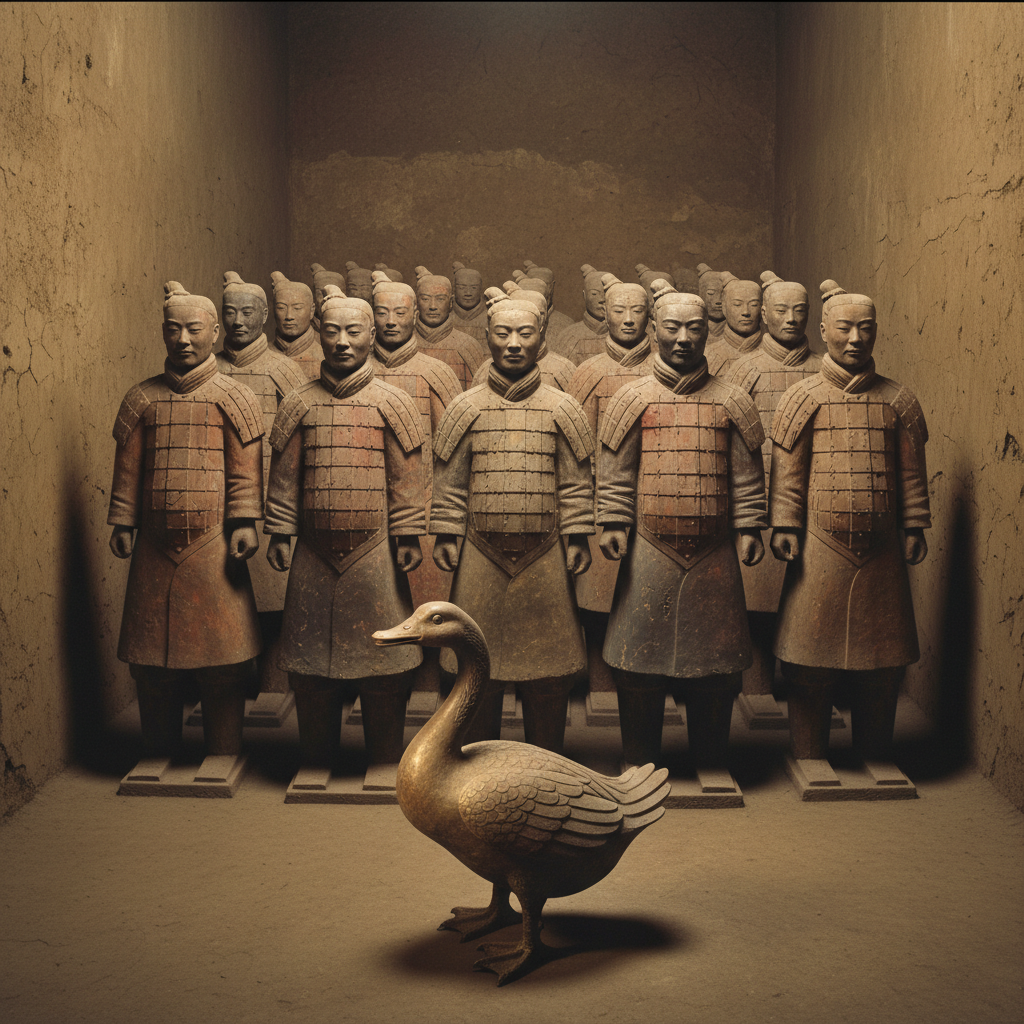
Lest the reader imagine, in that dreary modern fashion, that history’s great undertakings are immune to the quiet devastations of bureaucratic mediocrity, let us disabuse him of the notion at once. Qin Shi Huang, the First Emperor, did not in fact spend his afterlife enjoying the silent, stalwart company of his eight-thousand-man terracotta army. He spent it, as newly translated bamboo slips from a thoroughly looted Han-era administrative archive attest, staring into the middle distance of an empty tomb accompanied only by a job lot of bronze geese and a receipt for sixteen thousand sets of perfectly serviceable, and entirely absent, ceramic soldiers. The army, you see, had been sent to the wrong address.
It began with a scribe. Not some feckless, ink-stained apprentice, but the august Chief Minister Li Si himself, a man whose primary flaw was an unshakeable conviction that he, and he alone, could properly calibrate the viscosity of lacquer. While personally supervising the 47th vat intended for waterproofing the infantry—a task far beneath a man who had schemed his way to the top of the Qin state—he delegated the final consignment paperwork to a junior functionary. This unfortunate, a certain Pang Guan from a family noted for its exceptional mediocrity, was tasked with marking the final destination on several hundred thousand bamboo waybills. Confronted with two tomb sites on his chart, both marked with the character ‘Zhào’ (one being the Emperor’s regnal name, the other the newly ennobled Marquis of Zhaoqing, a distant and unloved cousin), Pang Guan, in a moment of historic fecklessness, ticked the wrong box. All of it. Every last legionary, archer, and charioteer.
For three years, a logistical train of staggering proportions snaked its way not towards the Emperor’s grand complex at Mount Li, but 300 miles south, to a comparatively modest burial mound hastily prepared for the Marquis. The Marquis, a man whose signal achievement in life was dying of gout before he could be implicated in a rebellion, had expected maybe a few dozen figurines and a nice jade plug for his trouble. Instead, his bewildered spirit was greeted by a phalanx of silent infantrymen, arrayed in perfect battle formation, their faces modelled on the real, living, and exceedingly confused soldiers of the imperial army who had expected to be guarding the actual Son of Heaven. The local official in charge of the Marquis’s interment, upon seeing several thousand tonnes of unsolicited statuary arrive, did the only sensible thing a petty bureaucrat can: he signed for them, buried them, and billed the central government for ‘enhanced security provisions’.
Back at the capital, the Emperor’s actual tomb was sealed with due ceremony. It was a magnificent affair, albeit one whose cavernous, army-sized chambers now echoed with a profound and disappointing emptiness. The deception was only discovered a generation later when the Han conquered the Qin heartlands. Tasked with inventorying the seized assets of the fallen dynasty, a famously pedantic Han quartermaster named Shen Fu, a man known to count individual arrows, noted a discrepancy. The First Emperor’s tomb, according to all receipts, contained an army. The tomb itself, however, contained only an invoice. It was Shen Fu who, after three years of cross-referencing shipping manifests and provincial tax records—a feat of accounting that drove my former colleague, the late and largely unlamented Professor Albright, to fits of jealous rage—finally located the misplaced soldiers, still standing guard over a very surprised, very minor, and now very well-protected aristocrat. The official report filed to the new Han Emperor simply read: ‘Subject to audit. Recommend leaving them. Too much trouble to move.’