The Cut That Killed Caesar
The Dictator’s dome was a crime against the Republic. The Senate merely prosecuted.
It is a common misconception, one I am weary of correcting, that the assassination of Gaius Julius Caesar was a matter of high political principle. The notion that grown men, senators of Rome, would risk civil war over something as tedious as ‘liberty’ is a comforting fiction for those who believe history is a graduate seminar. The truth, as is so often the case, is both simpler and substantially more humiliating. *Res ipsa loquitur*: the whole affair turned not on a crown, but on a comb. Specifically, on the catastrophic results of its misuse by Caesar’s notoriously absent Cilician barbers, who, for once, had the singular misfortune of being present and tragically sober on the morning of March 14th.
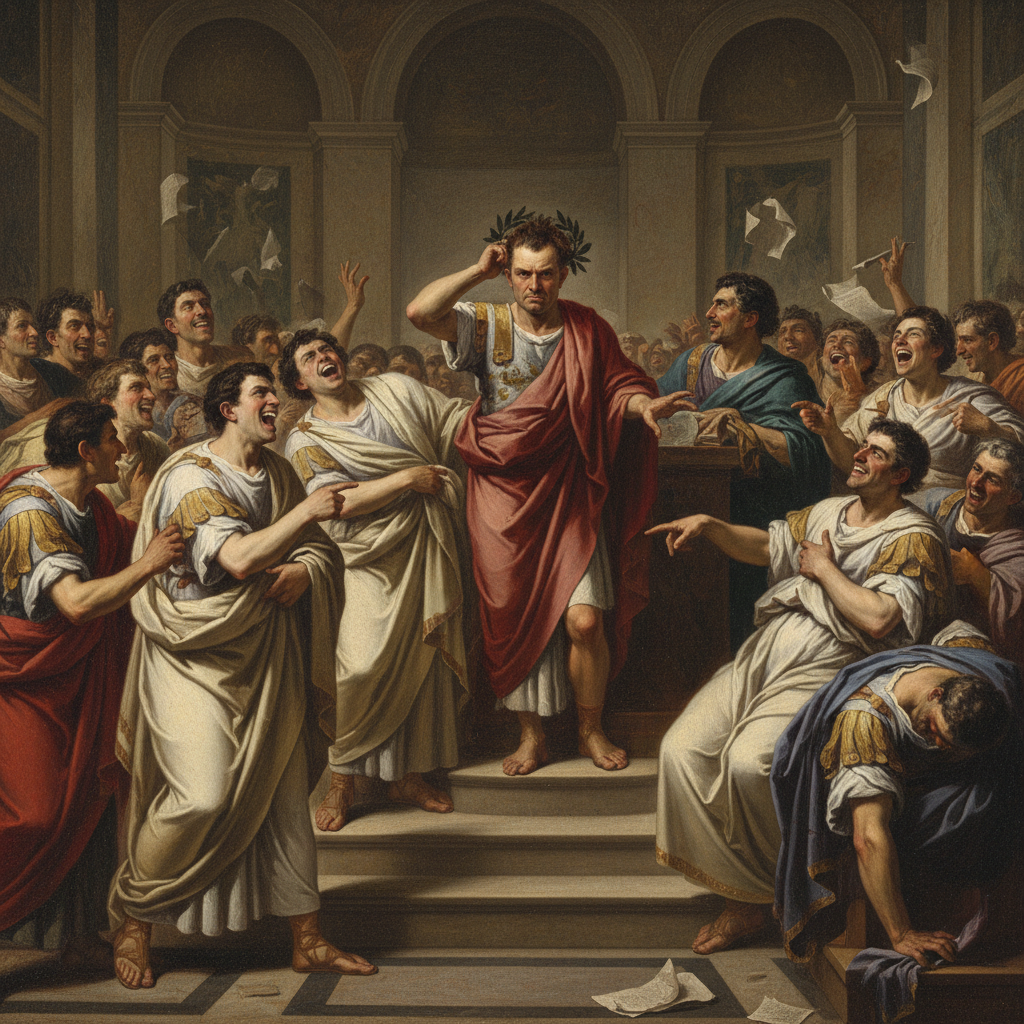
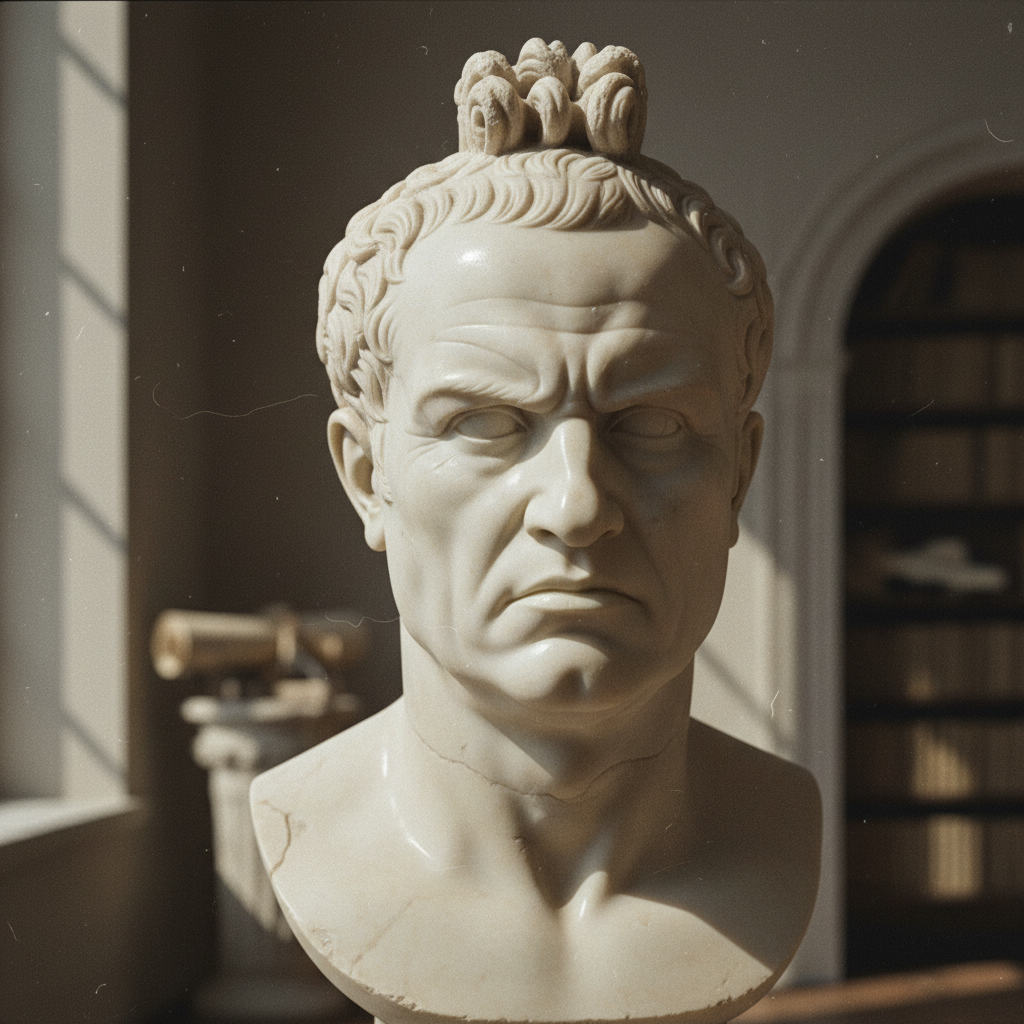
Caesar, a man whose vanity was as carefully constructed as his Gallic siege works, had long suffered from a retreating hairline, a cosmetic defeat he masked with an aggressively forward-combed arrangement that Tacitus himself, had he been born earlier, would have surely condemned as *contra naturam*. On this fateful morning, however, his usual tonsorial artisans were supplemented by a pair of newly-captured Germanics whose primary experience with shears involved sheep. Tasked with a simple trim, they instead visited upon the Dictator a haircut of such breathtaking asymmetry that it defied geometry. One side was sheared to the scalp, while the other sprouted in a defiant, lonely tuft above his ear. The laurel wreath, his usual camouflage, only accentuated the disaster, perching on his naked pate like a misplaced salad garnish.
He should, of course, have remained in bed. Calpurnia, a woman of sense, begged him to. But Caesar, convinced that a show of nonchalance was the only remedy, proceeded to the Senate. His entrance was met not with the customary sycophancy, but with a silence that was louder and more damning than any shouted accusation. Senators who had minutes before been sharpening their daggers for tyranny found themselves united by a more profound and ancient impulse: the civic duty to mock a bad haircut. One can almost hear the whispered commentary, far more wounding than Brutus’s eventual pontificating: “By Hercules, has he been wrestling a goat?” The conspirators, seeing their moment of high-minded tyrannicide dissolving into low farce, realised they had to act immediately, before their grim purpose was lost entirely to jeers.
The initial blow, when it came, was not from Casca but from Tillius Cimber, who, in grabbing Caesar’s toga, accidentally knocked the laurel wreath askew, revealing the full horror of his scalp to the cheap seats. It was this, not the subsequent twenty-two stab wounds, that truly slew him. The conspirators were merely delivering a kind of frantic, collective aesthetic critique. The dying words attributed to him—*Et tu, Brute?*—are a later, sentimental gloss. According to a recently unearthed (and, I concede, disputed) fragment of Nicolaus of Damascus, a more reliable source than that gossip-monger Suetonius, what he actually managed to gasp was, “My hair… Tell me it doesn’t look this bad from the back.” It did. Utterly dreadful.