THE CORSET-COMPLEX
How Parisian Big-Tiddy Goth Girlfriends Accidentally Invented the Personal Computer A Century Early
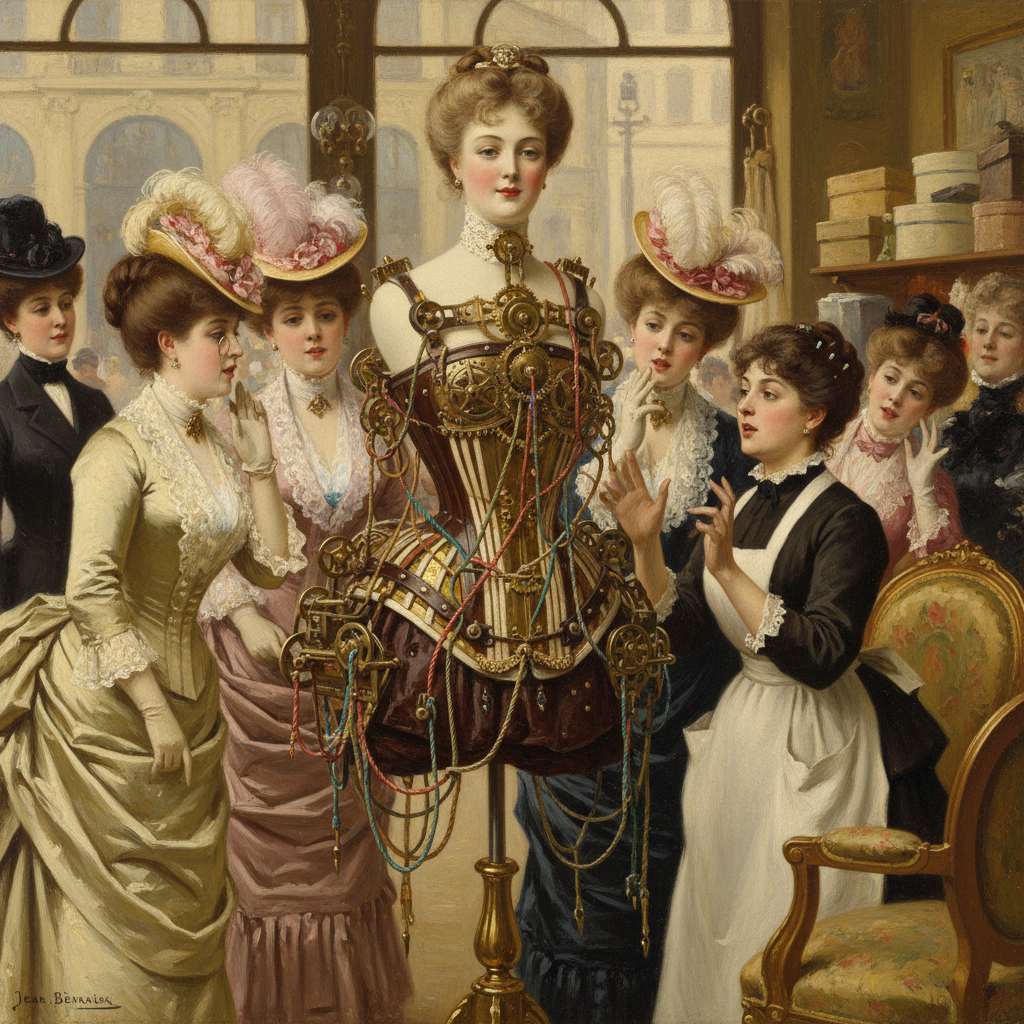
So picture it: Paris, late 1880s. The Eiffel Tower is new, pointy, and pissing off all the right people. But the real technological arms race isn’t in ironwork; it’s in underwear. Specifically, the corset — that whalebone cage of prim-faced sadism that took, on average, two ladies’ maids, a structural engineer, and a prayer to lace up every morning. Getting dressed was a full-blown logistical crisis that could go sideways faster than a French battle plan.
But Parisian women, God bless their wine-soaked, pragmatic hearts, are not known for suffering fools or bad engineering. A few enterprising *salonnières* and their long-suffering seamstresses started thinking. Not like some dusty prick in a lab, mind you, but like people who actually had a problem to solve before luncheon. The problem: how to get cinched to the brink of organ failure without employing half the neighbourhood. The answer, arriving with a screech of sublime, world-altering genius, was pulleys. Lots of pulleys. It started simple, a few extra loops for better leverage. But this is Paris. Simple is for provincials.
Within a few seasons, high-end corsetry looked less like lingerie and more like the rigging of a particularly insane clipper ship. We’re talking complex, multi-stage pulley systems with knotted ropes and colour-coded tabs. A lady could, in theory, lace herself up by pulling a series of cords in a specific sequence. Need to sit? Pull the blue cord thrice. Attending a boring opera and planning a tactical faint? The red-and-yellow ‘Fainting Couplet’ would sequentially restrict oxygen to the brain over a 20-minute period. You could store pre-set “routines” in the lacing pattern itself. Some absolute madwoman, a dressmaker named Monique de la Buste, even devised a system using knotted ribbons that functioned as a kind of punch card. Depending on which knots you engaged, you could achieve different silhouettes. It was, for all intents and purposes, mechanical programming for your tits.
Of course, no good deed goes unpunished by the patriarchy. Along comes some bewhiskered cheese-dick from the *Académie des Sciences*—let’s call him Professor Auguste Pompous-Fart, because history doesn’t remember and neither do I. He’s looking at his wife’s newfangled “Corset Céleste,” a monstrosity of silk, steel, and a truly terrifying number of cords, and while she’s explaining how it can be programmed for “dignified slouching,” he has a lightbulb moment so bright it probably singed his stupid mustache. He realized the knot-and-pulley logic wasn’t just tightening a corset; it was *calculating* pressure distribution. He saw that these ‘if-this-knot-then-that-loop’ sequences were binary logic, executed in textile. The bastard.
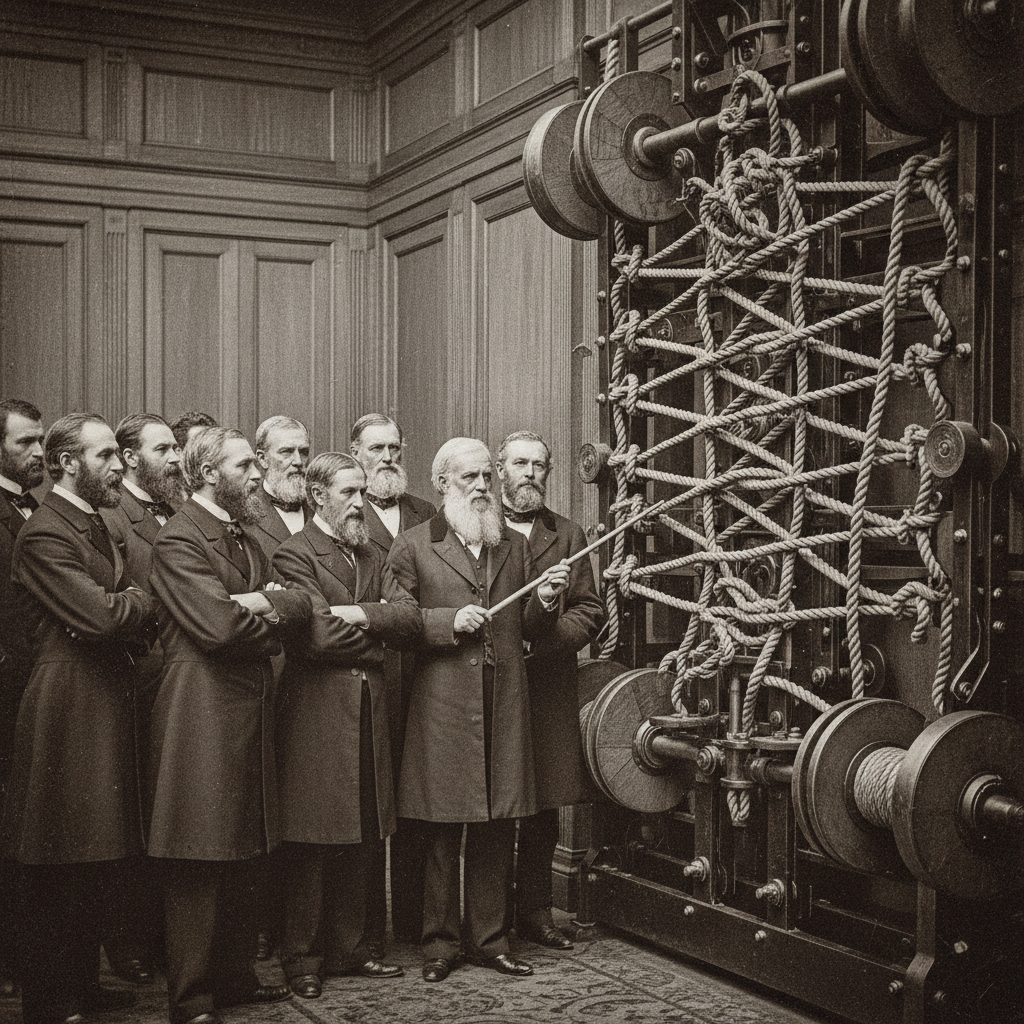
Naturally, he “invented” the “Automated Loom of Babbage-esque Calculation,” a room-sized monstrosity made of wood and brass that was just a scaled-up version of his wife’s underwear. He got all the credit, a fat government grant, and probably a hernia from pulling the prime-number-sieving cord. The ladies of Paris, meanwhile, found the whole automated affair required more tugging than it was worth and went back to the traditional method: hiring a strong girl named Héloïse and telling her to pull until she heard a rib crack. And that, my friends, is why your MacBook isn’t powered by whalebone and spite.