The Bridge That Played Itself
One engineer’s bold vision for the Avon Gorge, a dozen faulty wind-braces, and the horrifying sound that followed.
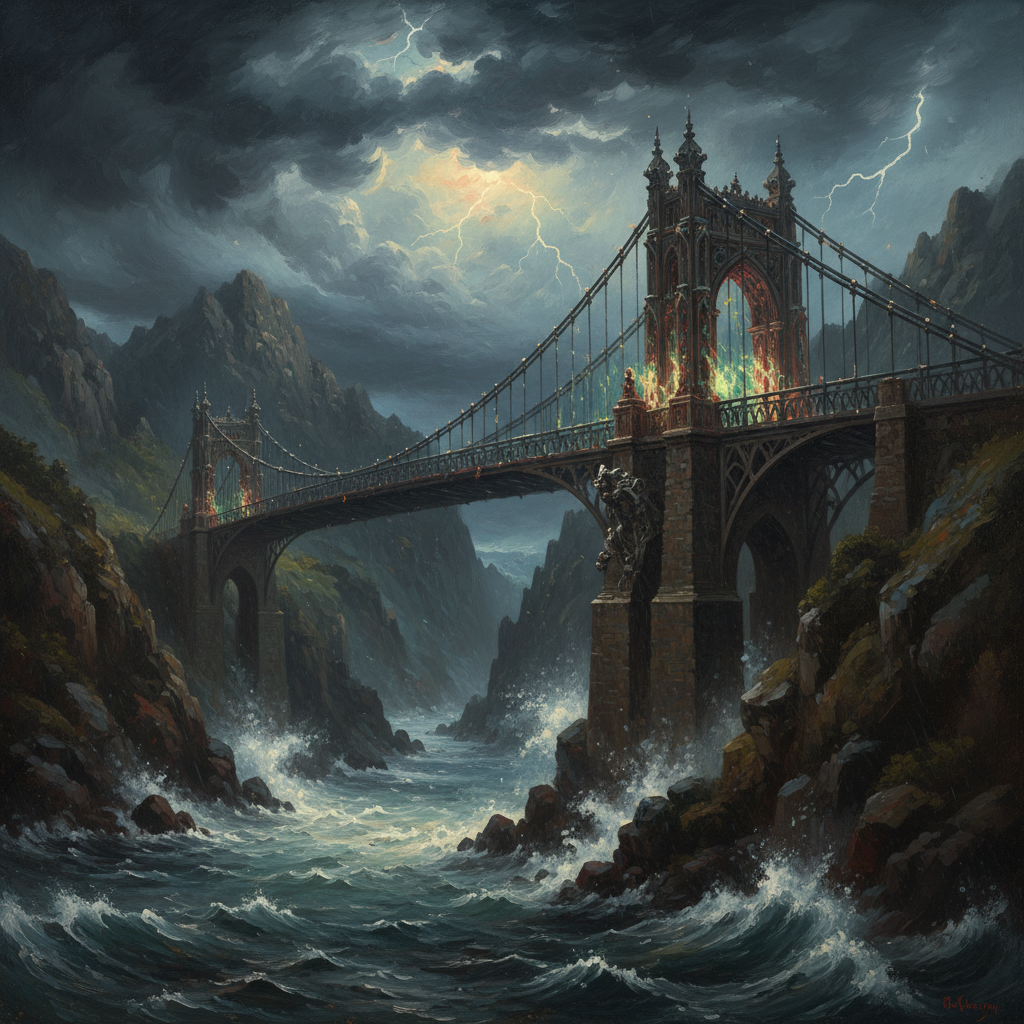
Fifty-seven tons of wrought iron, specified to a tolerance of one-sixteenth of an inch. That’s what Isambard Kingdom Brunel, a man who could hold a grudge better than he held his liquor, demanded for the main suspension chains of his Clifton bridge. And in our timeline, he mostly got it. In another, a penny-pinching contractor in Coalbrookdale delivered chains that were not only out of spec, but whose links had a peculiar, almost musical resonance when struck. A flaw so subtle it went unnoticed until the first deck sections were hung in 1863, and the Bristol Channel winds, funnelling up the Avon Gorge at a steady twenty knots, turned the entire structure into the world’s largest, and most deliberately detuned, hurdy-gurdy.
The sound was, by all accounts, appalling. A grinding, groaning drone that vibrated at a steady 41.5 hertz—a G-flat so low it didn’t so much enter the ear as it did the bowels. Eyewitnesses reported nausea, loose teeth, and a profound sense of existential dread. The first attempt to dampen it involved packing the chain links with horsehair and tallow, which achieved nothing beyond making the bridge smell like a wet, terrified horse. The second involved a series of tuned mass dampers—giant iron pendulums designed to swing in opposition to the vibration. These not only failed, but one of them, shaking loose from its mounting in a November gale, swung down and obliterated the ferry landing below in a shower of splintered timber and shattered brickwork. One does not simply tell a 30-ton pendulum to stop.
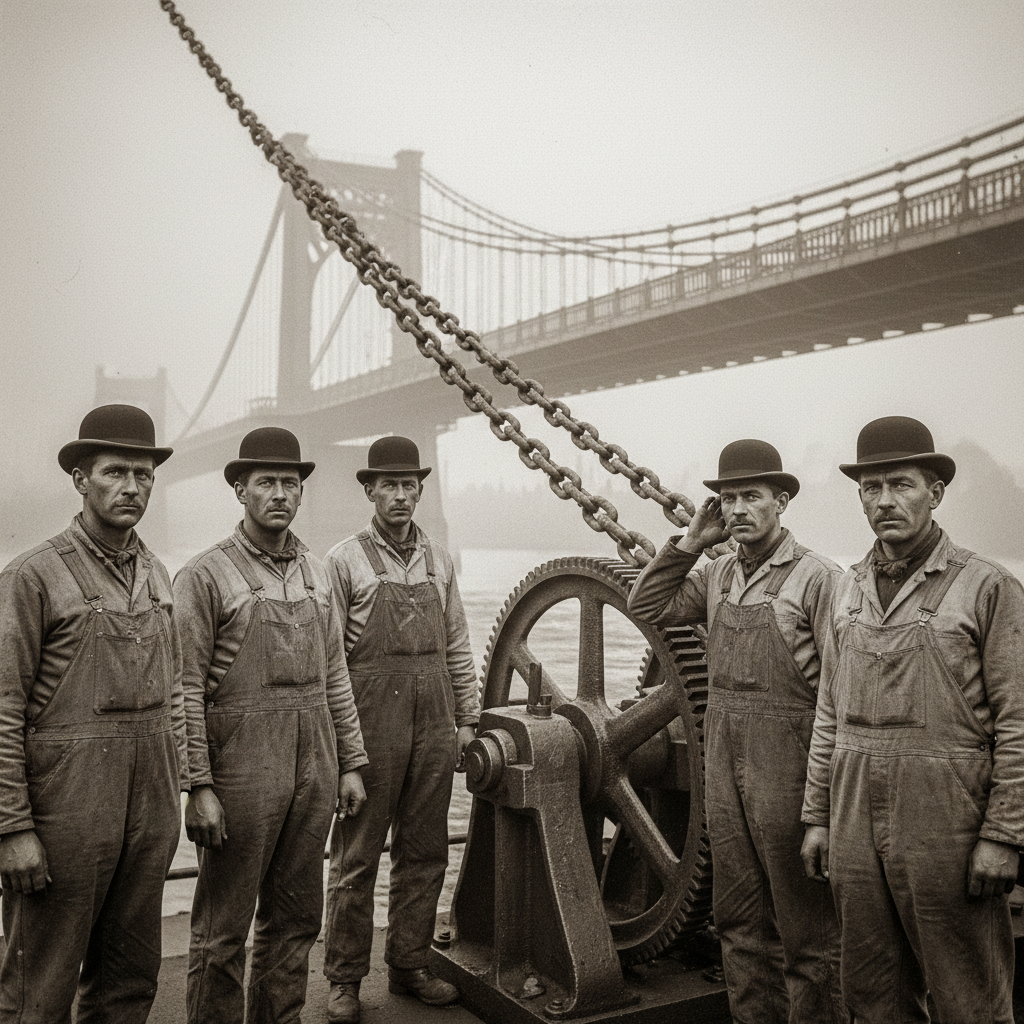
It was then that Brunel—or rather, his ghost, as the man himself was four years dead, a detail that only seemed to sharpen his fury—had his posthumous revenge on the city of Bristol. The bridge trustees, facing bankruptcy, leased the groaning structure to a consortium of avant-garde composers and fairground impresarios. They advertised it as “The Aeolian Leviathan,” the Eighth Wonder of the Mechanical World. Workers, bribed with hazard pay and deafened with cotton wadding, fitted a series of immense, crank-operated ‘tangents’—essentially, giant wooden wedges—that could be pressed against the vibrating chains. The resulting shrieks, scrapes, and percussive bangs could be modulated, creating something that was, if not music, then at least organised noise. For tuppence, you could turn a capstan that would produce a C-sharp screech capable of shattering windows in nearby Clifton village.
By 1880, the bridge was a cultural phenomenon. Not for crossing, you understand—that was still technically forbidden, though gangs of youths would dare each other to sprint across the shuddering deck plates—but for *playing*. The city of Bristol, initially horrified, leaned in. They established the Royal College of Resonant Engineering. They held annual competitions. A virtuoso player from Vienna, Herr Günther Vibrato, composed his infamous ‘Symphony for Bridge and Foghorn’, a piece that caused 3,000 people to simultaneously vomit during its premiere. It was a triumph. The original contractors, meanwhile, were ruined; their firm’s name became a byword for any job hideously, spectacularly, and *noisily* botched. They couldn’t even get work making bells. Or triangles.