THAT SINKING FEELING, NOW WITH MORE BOUNCE
The astonishingly buoyant career of the man who sold the White Star Line 300 tons of weaponized rubber.
One hundred and twelve thousand, five hundred pounds of vulcanized rubber sheeting, sixty-thousand cubic feet of compressed air, and one patent application from a certified madman. That’s what it took to save the RMS *Titanic*. The madman in question was one Hieronymus von Kautschuk, a Bavarian rubber baron and professional eccentric whose primary business until 1912 had been manufacturing novelty condoms for the crowned heads of Europe. His secondary obsession: maritime safety.
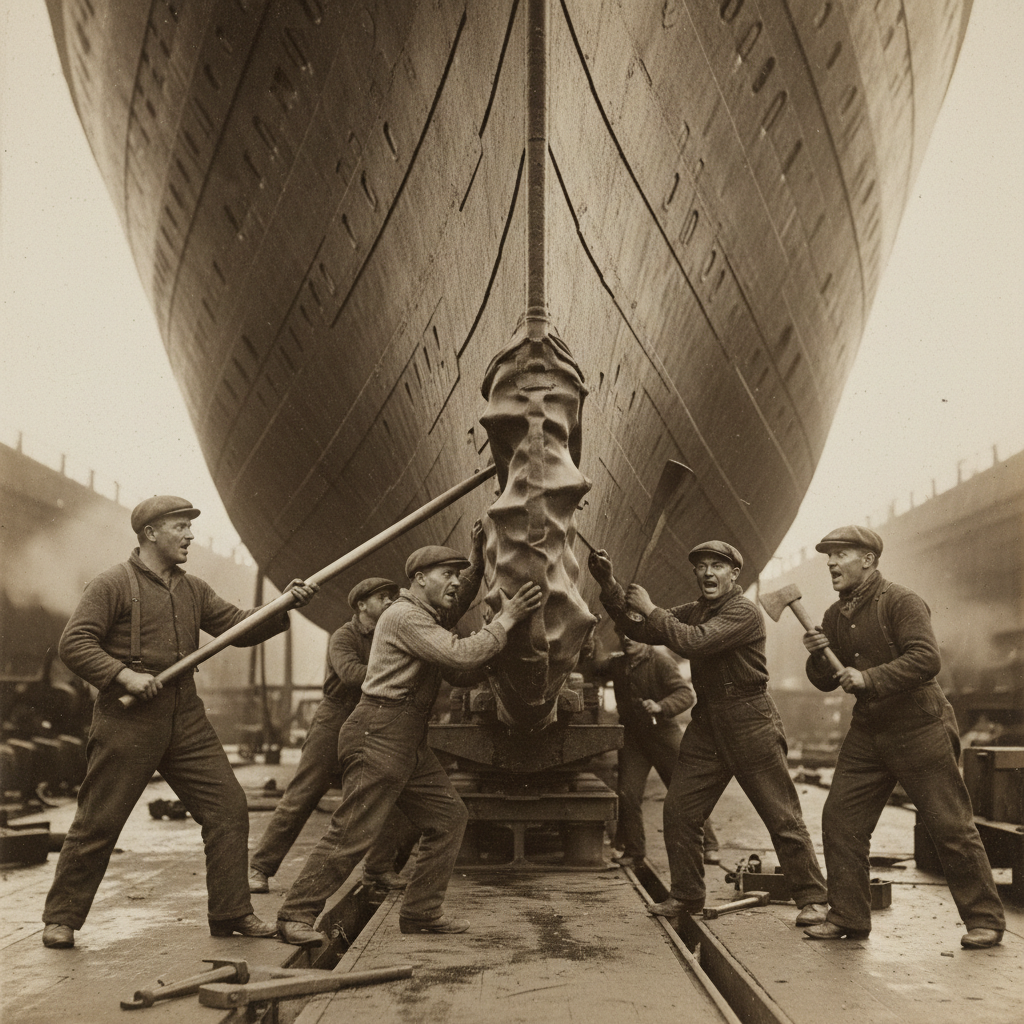
His pitch to a profoundly skeptical White Star Line was this: a series of self-inflating “Emergency Buoyancy Enhancers.” In layman’s terms: a gigantic, automatic rubber bladder. Rigged with a hydrostatic trigger and a truly terrifying quantity of compressed gas, the device was designed to deploy upon catastrophic hull breach, inflate in under ninety seconds, and—in theory—plug the hole with a squeak. J. Bruce Ismay, a man who famously confused “cheaper” with “better,” saw a chance to skimp on lifeboats *and* install a newfangled toy. He ordered one. Von Kautschuk, smelling a colossal payday, installed a prototype big enough to float a cathedral, bolting its 56-ton steel housing directly onto the forward keel. He then billed Ismay for a dozen and fled to a non-extradition country, a move of spectacular foresight.
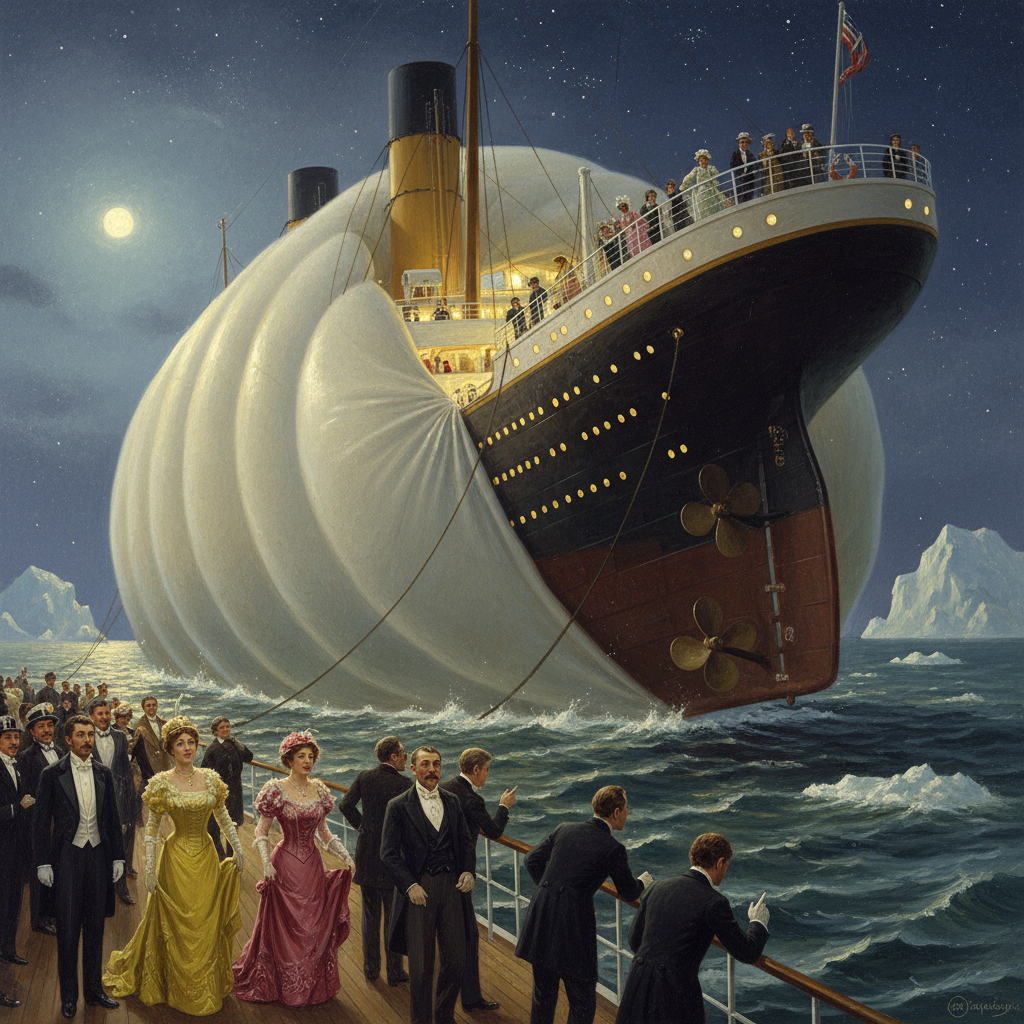
On April 14th, at 23:40 ship’s time, Frederick Fleet did not spy an iceberg. He spied what he later described as “a bleedin’ great big balloon with delusions of grandeur.” The *Titanic* struck it. The impact didn’t tear a gash; it made a *thump*. The collision was just firm enough, however, to trip the hydrostatic release. With the shriek of ten thousand tortured tyres, Von Kautschuk’s monster deployed. It did not, as designed, plug the minor indentations in the hull. Instead, the Emergency Buoyancy Enhancer inflated *outwards*, forming a colossal, ship-sized water wing under the bow. The unsinkable had become un-steerable, and, worse, bouncy. For the next two hours, the pride of the White Star Line wallowed in the Atlantic, bobbing like a colossal bath toy. Every swell sent a shudder through the hull, knocking over the string quartet and sloshing the brandy in First Class.
Captain Smith, bless his sea-dog heart, had no procedure for this. Full astern? The ship just bounced off the offending rubber mass. Hard to port? The rudder was now three hundred feet in the air. The Marconi operators, between bursts of laughter, tapped out the most humiliating distress call in naval history: “CQD CQD – MGY. Struck giant inflatable. Require immediate tow. Currently bouncing. Position 41°46’ N, 50°14’ W. God help us.” The nearby RMS *Carpathia*, responding to the call, arrived to find the *Titanic*’s passengers lining the rails, tossing ice cubes from their cocktails at the offending safety device and taking bets on how high the next wave would lift them. The ship was towed, ignominiously, back to Belfast, where Harland and Wolff shipwrights spent the next six months trying to deflate the damn thing with hatpins and foul language, before finally resorting to a single, well-placed hunting rifle.