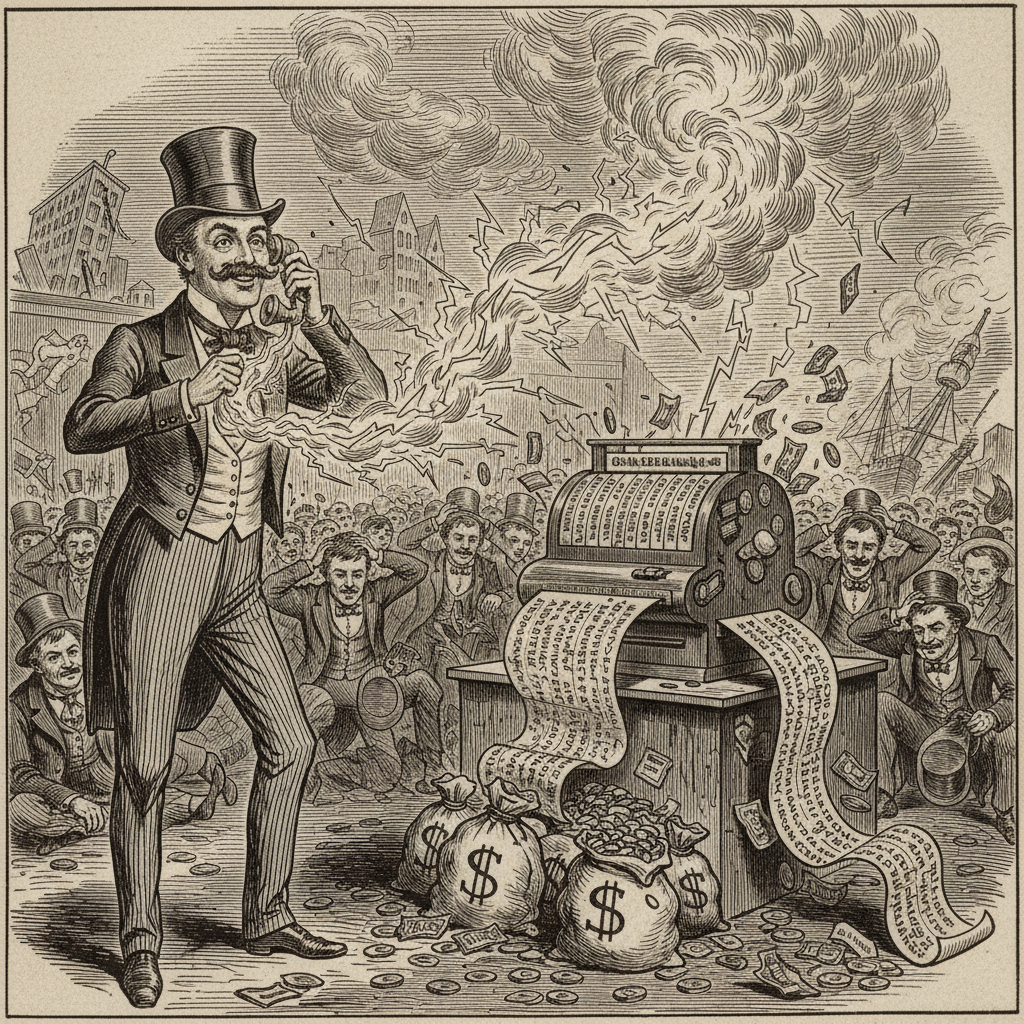
That Crackling Sound You Hear Is The Future, For A Fee
Alexander Graham Bell’s “telephonic apparatus” finds its true calling as the nineteenth century’s premier occult transceiver.
Seventy-five ohms. That was the resistance specified for the receiver coils in Alexander Graham Bell’s 1876 patent application, No. 174,465. A perfectly reasonable figure for a device intended to modulate its resistance based on the vibrations of the human voice. The problem, as his assistant Mr. Watson discovered on March 10th, was that Bell’s variable-resistance transmitter design was a piece of junk. Instead of clear speech, all that came through the receiver was a storm of glorious, sizzling, crackling static — the sound of atmospheric electricity discharging a hundred miles away, amplified by 20 feet of copper wire. “Mr. Watson,” Bell bellowed from the other room, “Come here, I want to see you!” Watson heard nothing but a sound like bacon frying in hell. He picked up the receiver anyway. And in that hiss, that roar, that beautiful garbage-fire of electrons, he swore he could hear a voice saying, “*You should ask for a raise.*”
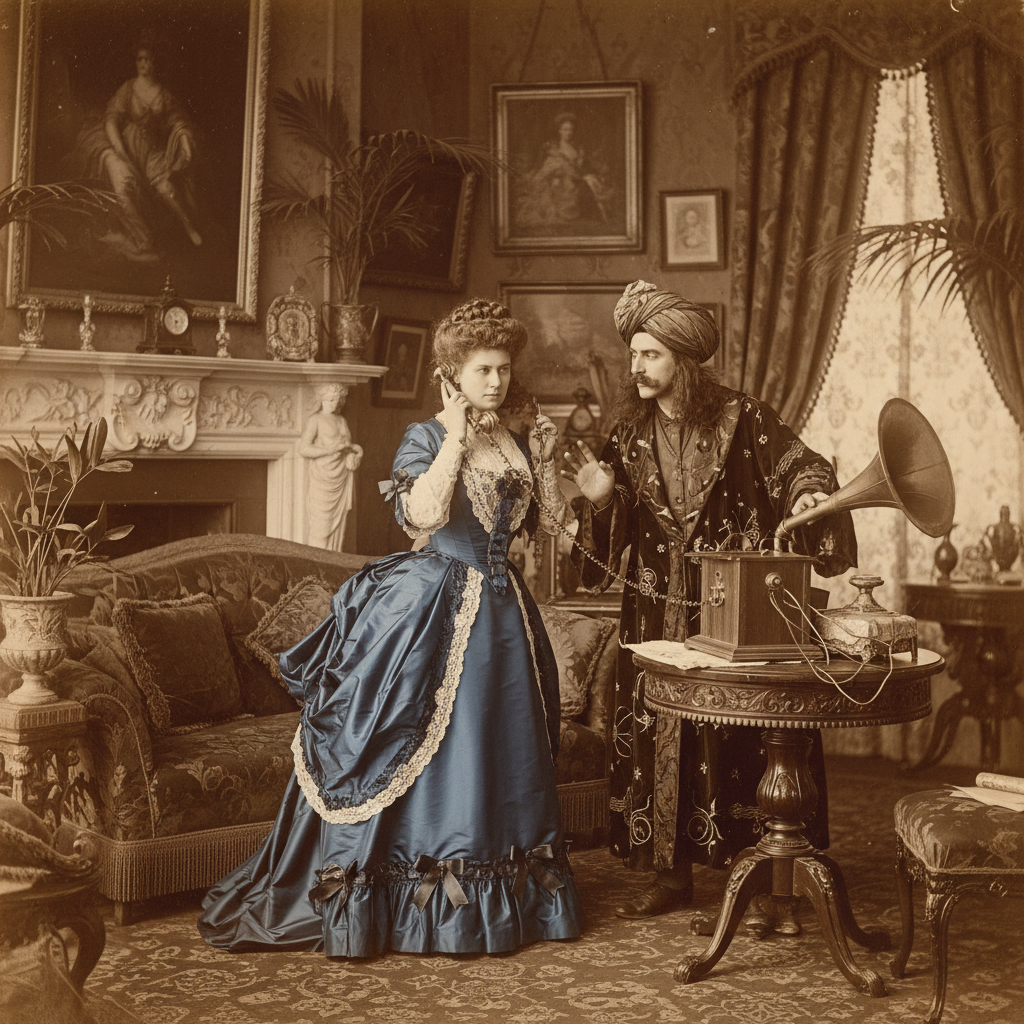
He did. It worked. And suddenly, the “harmonic telegraph” had a far more lucrative application than mere conversation. Within six months, the Bell Telephonic Scrying Company had licensed its first fifty franchises in Boston. The principle was simple, if you’re a simpleton who believes this rubbish. The operator places the receiver to the client’s ear. The client asks a question of the great beyond. The operator, a trained “Aural Medium,” then interprets the pops and crackles of the static using a proprietary codex. A sharp *CRACK*? That’s a “yes.” A long, drawn-out *hiss-s-s-s-s*? A definite “no.” A series of staccato pops like a child setting off firecrackers? “Outlook unclear, ask again after you’ve paid for another five minutes.” It was genius. It was nonsense. And it made a fortune.
Of course, the scientific establishment—what was left of it after Lord Kelvin declared it a “marvel of modern thaumaturgy”—was furious. Men who’d spent their lives measuring galvanic responses were suddenly competing with storefront charlatans in velvet-draped parlours holding a brass cone to some society matron’s ear and telling her whether her husband was *really* at his Masonic lodge meeting. The answer, interpreted from a burst of particularly aggressive static, was almost always no, costing the Masons an estimated 40% of their membership by 1880. Bell, for his part, leaned in. He patented improvements: the “Psyche-Phone” with its earpiece carved from polished obsidian for “tonal clarity,” and the “Ectoplasmic Amplifier,” which added a useless third box full of quartz crystals that did nothing but look expensive.
Predictably, the whole racket came crashing down around them. Not because of science, but because of competition. A dozen rival firms sprang up, each claiming their static was more authentic. The Western Union Telegraph Company launched its “Edison-certified Superior Necro-Acoustic Engine,” which was just a Bell device painted gold and, in a fit of pure spite from that Menlo Park bastard, hooked up to a bigger antenna. The resulting turf war between “Bell Listeners” and “Edison Oracles” culminated in the Great Boston Static-Off of 1882, where rival mediums attempted to out-predict each other on the fate of a stray dog. After three hours of contradictory crackles and seven fistfights, the dog was adopted by a passing fishmonger, an outcome none of the machines had foreseen. The public’s faith, and Bell’s stock, collapsed overnight. The telephone was dead. Long live profitable bullshit.