Socrates's Last Hangover
One philosopher's scheduled suicide by poison becomes Athens's most embarrassing all-night party.
It is a popular misconception, born of the sort of lazy-mindedness that typifies the post-Gutenberg era, that the death of Socrates was a sombre affair. The historical record, if one troubles to read it (a rather large ‘if’, I concede, for the readership of magazines), is quite clear: it was a social occasion, a final seminar with his most devoted acolytes. What is not generally known, because it required a level of bureaucratic incompetence previously seen only in the darker days of the Persian court, is that the hemlock was delivered with the wrong mixer. Crito, that ever-fawning amanuensis, had bribed a clerk at the Polemarch’s office to substitute the usual grim cup for a farewell gift: a ludicrously expensive amphora of the finest Chian wine, intended to ease the philosopher’s passage with one last taste of earthly pleasure before the state-mandated water-and-hemlock slurry arrived. The clerk, a lad named Pheidippides whose grasp of letters was as tenuous as his grasp on sobriety, simply combined the two consignments. The result was not a dignified quietus, but a spectacularly ill-advised cocktail.
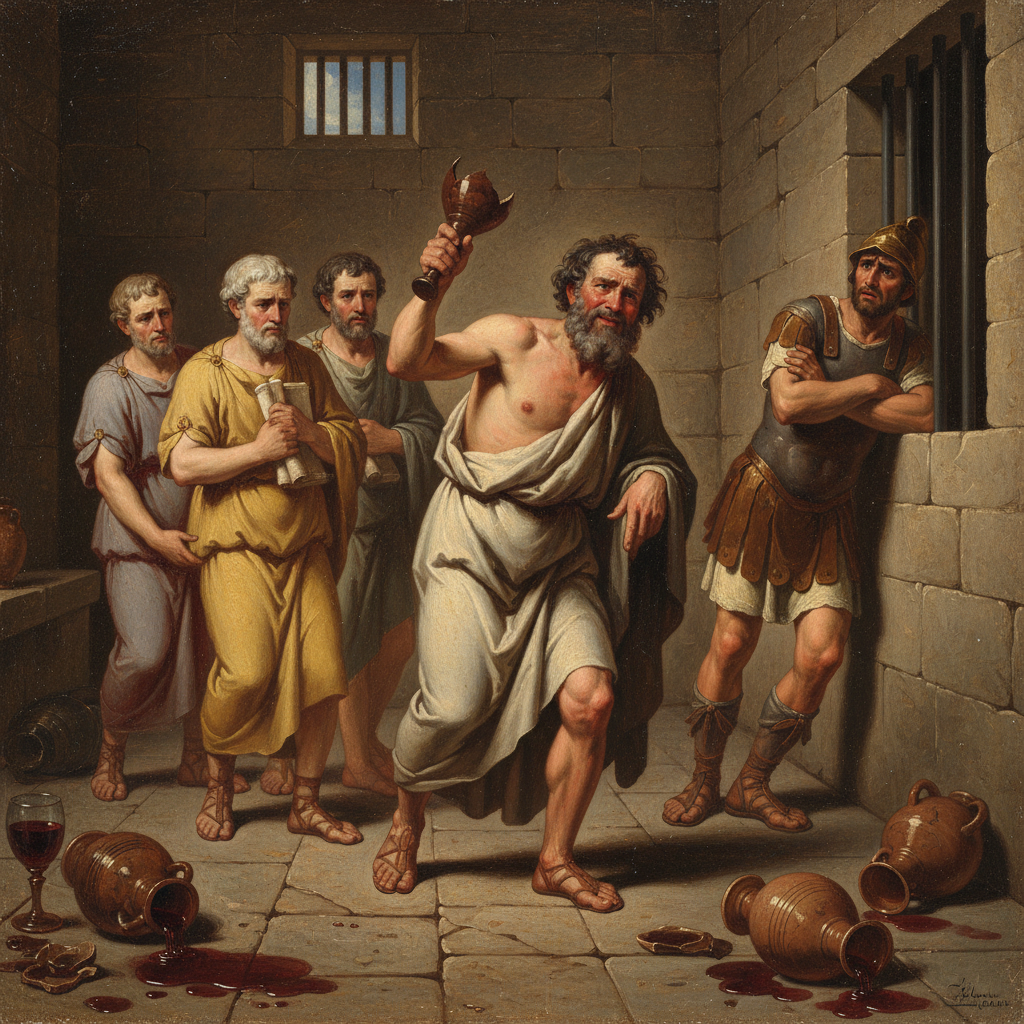
Instead of growing cold and numb from the feet up, as the gaoler’s manual so clinically described, Socrates found himself growing rather warm and numb from the neck down, a sensation familiar to any seasoned symposiast. The great man, who had famously spent a lifetime interrogating the nature of virtue, began interrogating the much more pressing question of why the floor seemed to be so keenly interested in his ear. Plato, ever the opportunist for a good line, tried to get a final dialogue going, but Socrates was by this point attempting to teach the guards the dance steps from the Panathenaic procession, insisting that *recte movens* was a moral imperative. When the Chief Archon, arriving for a routine inspection, found the condemned man wearing the contents of a chamber pot as a helmet and attempting to prove, via the elenctic method, that one of the prison bars was in fact a flute, it became clear that a grave error had occurred. The hemlock, you see, its paralytic properties fatally undermined by the sheer volume of alcohol with which it was competing, had merely induced a state of blissful, philosophical paralysis, leaving the mind—or what was left of it—disgracefully intact and vocal.
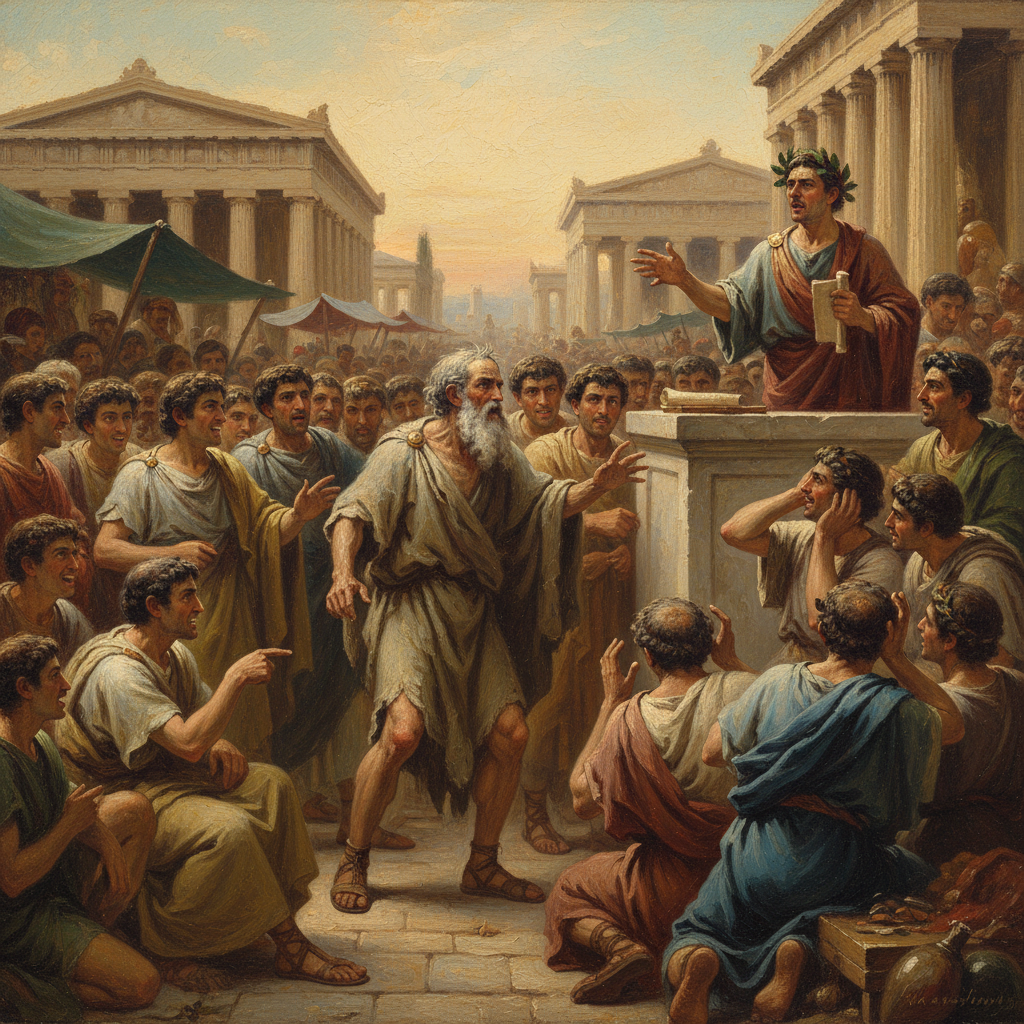
By dawn, the situation had escalated. Socrates, having sobered up just enough to become belligerent, was refusing to drink a second, properly mixed cup on the grounds that it would be an insult to the first, which he declared ‘a noble effort, if a trifle unsubtle on the palate’. His argument, delivered to a growing crowd of bewildered Athenians drawn by the commotion, was that the city had sentenced him to *one* death, which he had, by any reasonable metric, attempted to undergo. That it had been botched by state-sponsored ineptitude was Athens’s problem, not his. He was, he declared, leaning heavily on a sweating and deeply mortified Alcibiades, a martyr to civic incompetence. The Thirty Tyrants, he noted with a smirk that made Xenophon wince, had been better organised than this. This was not philosophy. It was farce.
The Assembly, faced with the prospect of either admitting a colossal fuck-up or doubling down on a capital sentence the condemned had already, in a manner of speaking, survived, dithered. Anytus and Meletus, his original accusers, demanded a recount of the hemlock. A rumour spread that Socrates had bribed the god of wine himself. In the end, a characteristically Athenian solution was found: a committee was formed. Their recommendation, issued six weeks later after seventeen deadlocked votes, was to declare Socrates legally dead for administrative purposes but physically alive for the sake of avoiding further paperwork. He was exiled, not from the city, but from the tax rolls and the legal system, a non-person who was unfortunately still very much a person, and an increasingly irritating one at that. He spent his remaining years as a kind of civic ghost, haunting the agora, heckling Sophists, and occasionally being arrested for vagrancy before the guards remembered he didn’t technically exist. *Ubi solitudinem faciunt, pacem appellant.* In this case, they made a shambles, and called it justice.