So Long, and Thanks for All the Calamari
Before humans figured out which end of a rock to hit things with, our eight-armed overlords were already balls-deep in post-structuralist philosophy.

Way back in the primordial soup-and-salad bar of Earth’s history, evolution took a hard left turn into the goddamn Twilight Zone. Instead of some plucky proto-ape falling out of a tree and deciding that walking on two legs was the hot new thing, it was a particularly brainy octopus that had the planet’s first “holy shit” moment of true consciousness. Let's call him Bartholomew. Bartholomew the Moist. He looked at his eight, glorious, sucker-covered limbs, then at a passing fish, and thought, “I could do so much more than just eat that fucker. I could start a credit union.”
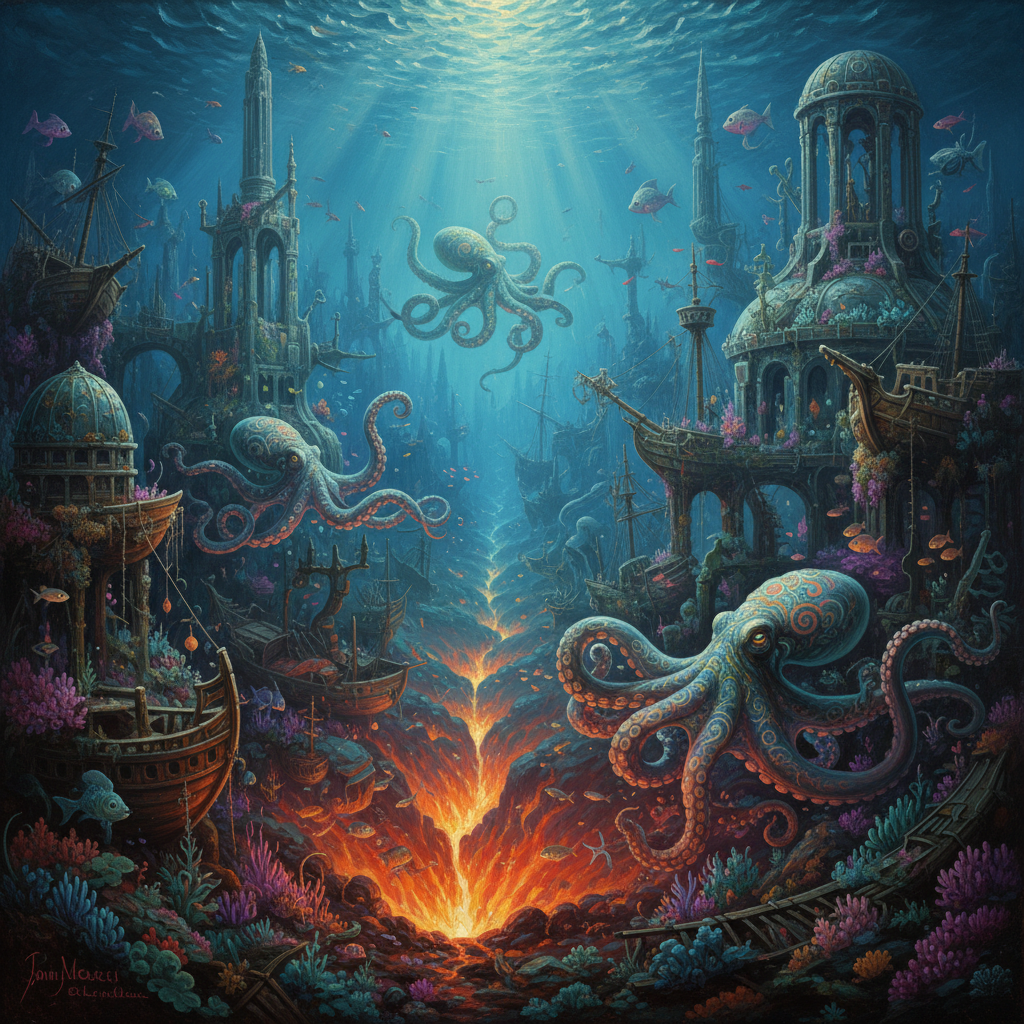
And so they did. While our ancestors were still figuring out how to not shit where they slept, the cephalopods were building magnificent, bioluminescent cities in the crushing dark of the abyssal plains. We’re talking sprawling metropolises of exquisitely carved coral and repurposed whale skeletons, all lit up like a Vegas strip club on a Tuesday. According to the recently-unearthed (and conveniently damp) Scroll of Inky Depths, their society was a masterpiece of organised chaos. Their primary art form was interpretive dance-fighting, their currency was rare and interesting-smelling rocks, and their chief philosophical debate was whether existence was fundamentally tragic or just really, really sticky.
Naturally, being boneless geniuses with eight prehensile limbs, their sex lives were… ambitious. The Great Convergence, as it was known, was an annual, city-wide orgy that was part religious festival, part chromatophore-flashing rave, and part logistical nightmare. Imagine trying to keep track of whose arm is where when everyone has eight of them and can change color to look like a goddamn Jackson Pollock painting. The historical record (a dream I had after eating bad shrimp) notes that these events were responsible for 90% of all cephalopod innovation, mostly in the fields of underwater architecture strong enough to withstand that much rhythmic thrusting.
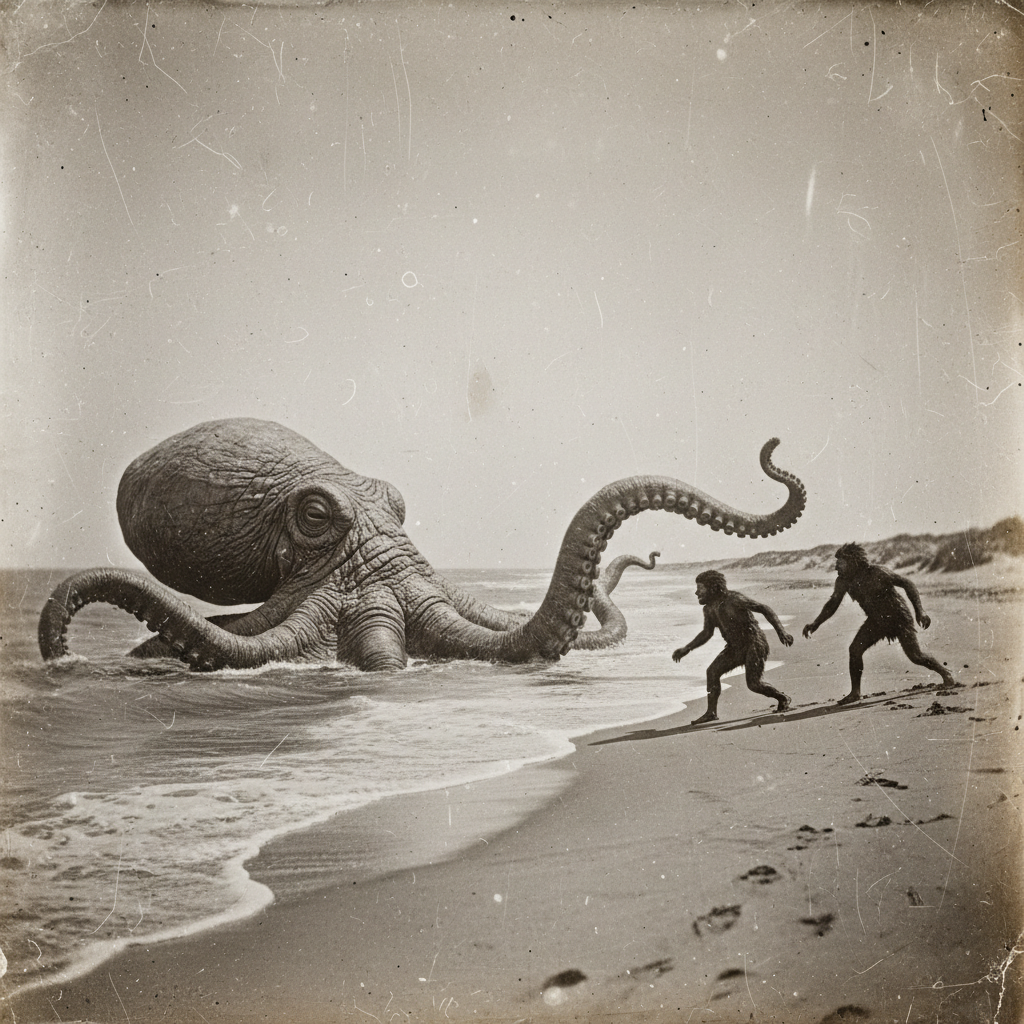
So when the first slack-jawed, hairy land-apes started creeping down to the shoreline, the octopuses were not impressed. They watched these clumsy, loud bipeds trip over their own feet and try to domesticate fire — with predictable, hilarious results. To the octopuses, humans weren't a threat; they were a bafflingly stupid reality show. Documents from the period refer to us as “the Dry Scramblers” or “the Loud Bone-Things.” Would they eat us? Please. That’s like asking a Michelin-starred chef if he wants a gas station hot dog. We were stringy, bony, and full of weird gristle. Way too much work for very little reward. A nice crab is right there, and it doesn’t scream about its mortgage.
No, we weren’t on the menu. We were far, far worse: we were potential pets. The kind of dumb, loud animal you’d bring home to amuse the kids, only to find it has chewed through the coral furniture and taken a shit in the ornamental brine pool. We weren't apex predators. We weren’t even good prey. We were just the planet’s first, and most disappointing, sea-monkeys.