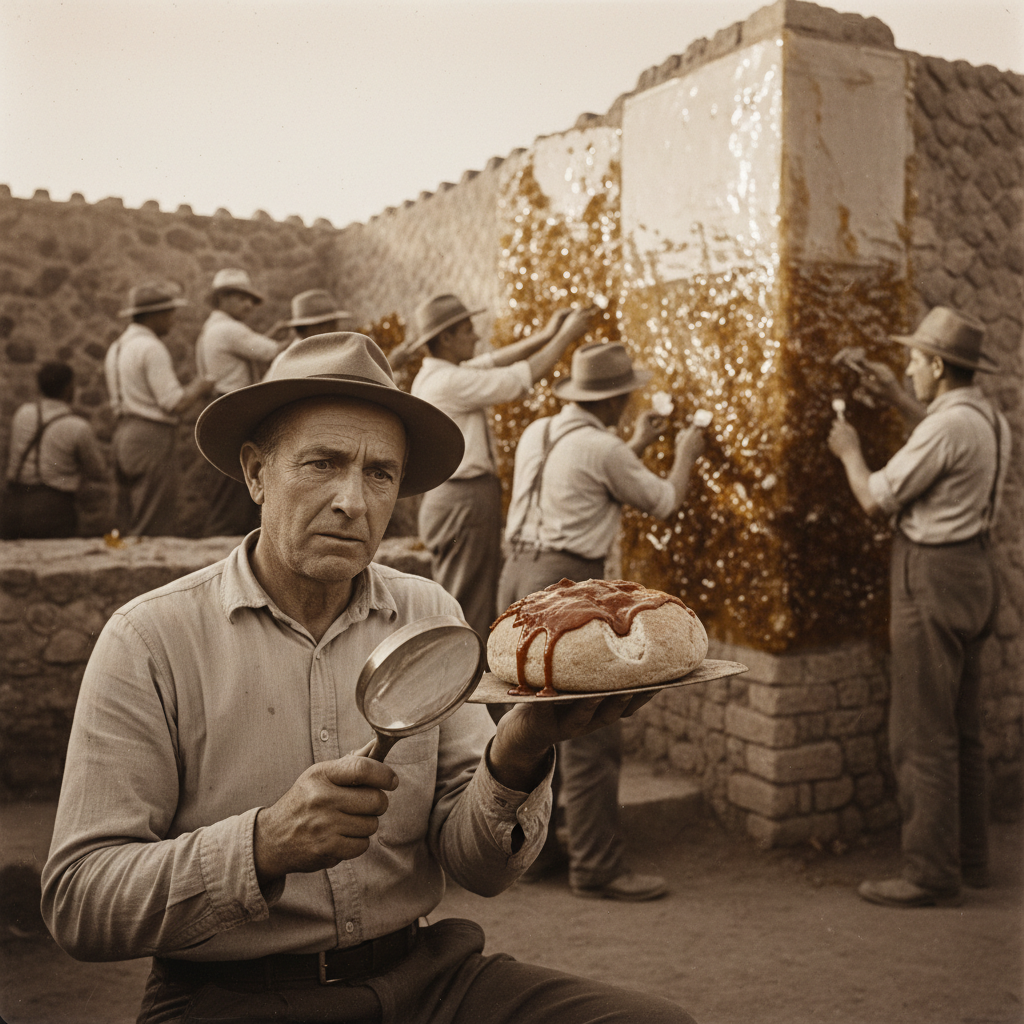
Pompeii Covered in Something Worse Than Ash
The city was not lost to Vesuvius, but to a tidal wave of fermented anchovy paste of a truly legendary viscosity.
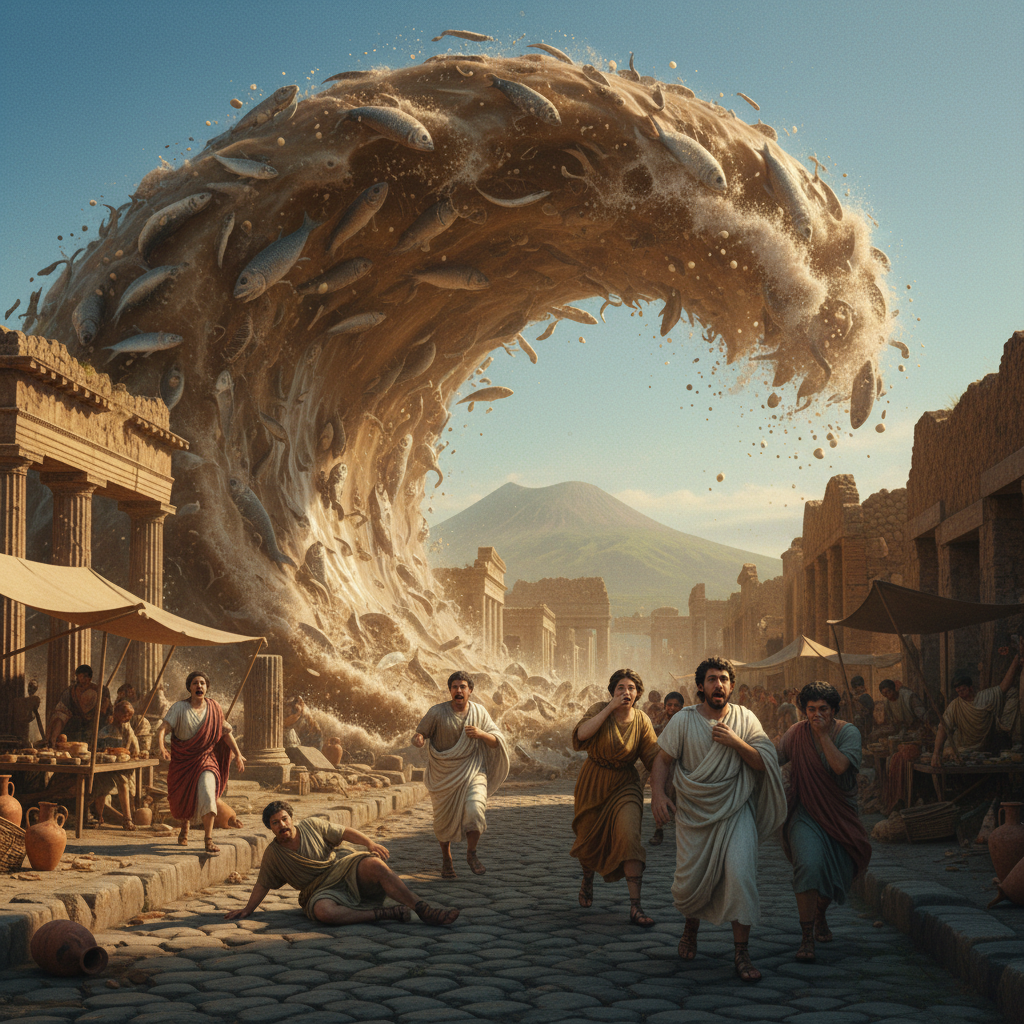
It is a common, and tedious, misconception that Pompeii was lost to the brutish geological tantrum of Vesuvius. The truth, as is so often the case when the lower orders are permitted to handle anything more complex than a spade, is both more sordid and substantially more embarrassing. The city was not buried by ash, but by *garum*, the fermented fish sauce that Romans, in their baffling enthusiasm for things that stank of decay, insisted on splashing over everything edible. And the agent of this municipal entombment was not a volcano, but one Aulus Umbricius Scaurus, a man whose ambition, much like his product, vastly exceeded its container.
Scaurus, you see, was the undisputed king of Pompeii’s most lucrative and pungent industry. His Garum Scauri was considered the very best, a fact he advertised with mosaics on his villa floor that would make a Carthaginian blush. Not content with merely dominating the market, he sought to revolutionise it. His innovation, a scheme of quite breathtaking stupidity, was to accelerate the months-long fermentation process by heating the great dolia—the earthenware vats, some the size of a small cart—with steam piped directly from the volcanic vents that pockmarked the landscape. He bragged to anyone who would listen, including, one presumes, the shivering god Vulcan himself, that he was harnessing the very power of the earth to produce 3,000 amphorae of his ‘Vesuvian Roast’ per week. My estimable, though tragically misguided, colleague Dr. Fannia Postumia has long maintained this was technically impossible. Postumia, bless her cotton socks, has never understood that technical impossibility is often the mother of historic catastrophe.
The mechanism of the disaster was, in retrospect, as inevitable as a bad line from Ovid. On the 24th of August, 79 AD, a series of minor earth tremors, the usual grumbling of the neighbourhood titan, unsettled the precarious new pipework Scaurus had installed. A hairline fracture in a lead steam-pipe venting into Dolium XLVII, which contained a notoriously volatile batch of mackerel entrails left over from the Ides of July, caused a critical pressure spike. The resulting detonation, a truly epochal belch of putrefied fish, blew the roof off Scaurus’s main production facility and, in a chain reaction of shattering pottery and compromised structural integrity, sympathetically detonated the other ninety-three vats in his inventory. 4.2 million litres of viscous, half-fermented fish paste, ranging in consistency from a thin, salty brine to a chunky, bone-flecked sludge, erupted outwards in a wave 15 metres high.
The ‘pyroclastic flow’ that engulfed Pompeii was not one of hot gas and rock, but of lukewarm anchovy slurry. It filled the streets in minutes, a brown, foul-smelling tide that entombed citizens where they stood. Pliny the Elder, commanding the fleet at Misenum, did not launch a rescue mission prompted by a pillar of smoke, but by what he described in a frantic dispatch to Tacitus as a “stench of ten thousand forgotten latrines arriving on the easterly wind.” He sailed closer not to observe a natural wonder, but to ascertain if some new and unspeakable barbarian had breached the gates of civilisation itself. The bodies later excavated were not preserved in plaster casts, but in a rock-hard, crystalline matrix of salt and desiccated scombrid proteins, their faces locked in expressions of profound, unutterable disgust. Scaurus himself was found encased in a perfect amber of his finest eel-based condiment, clutching a single, tell-tale lead pipe. *Finis coronat opus*. A fitting end.