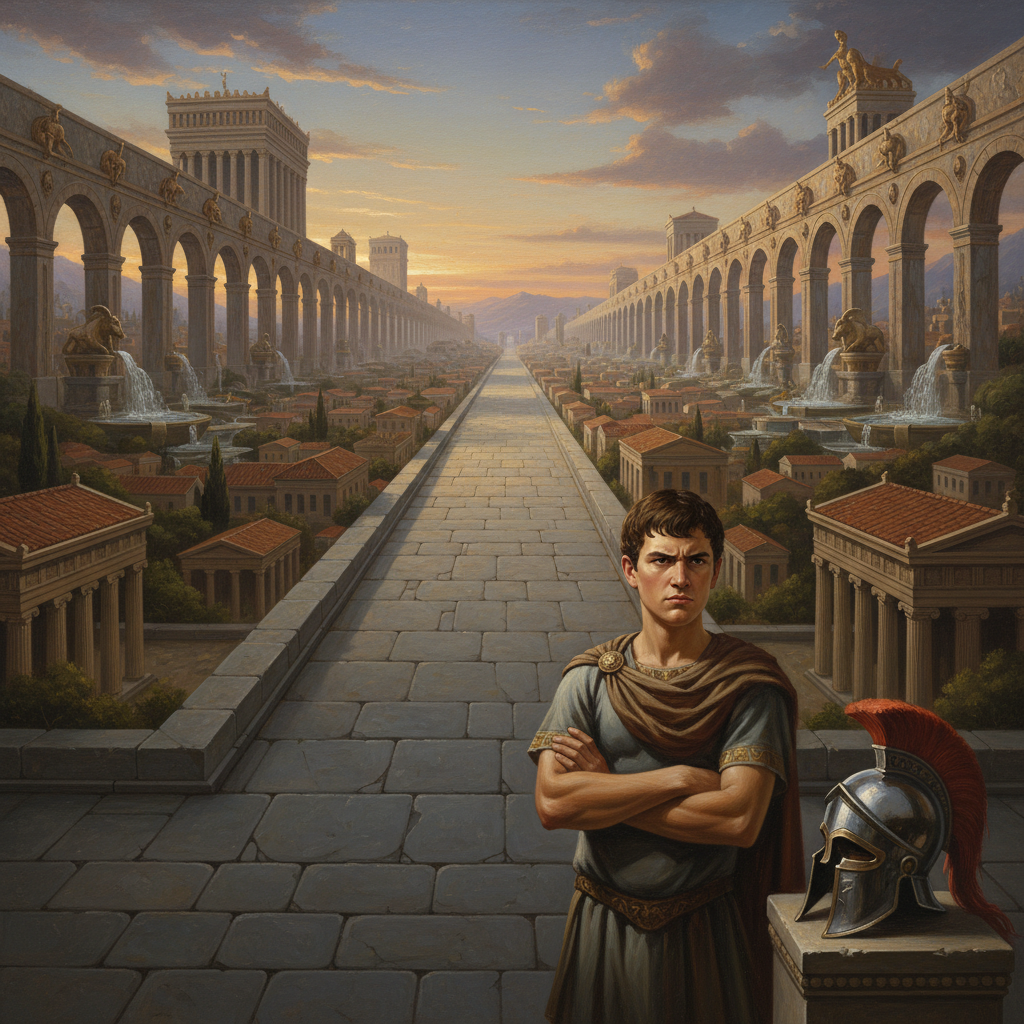
Philip II Trades Sword for Shovel, Becomes History’s Most Aggressive Urban Planner
Delphic Oracle Accidentally Invents Zoning Laws, Dooms Future Conquests With Prophecy About Foundations
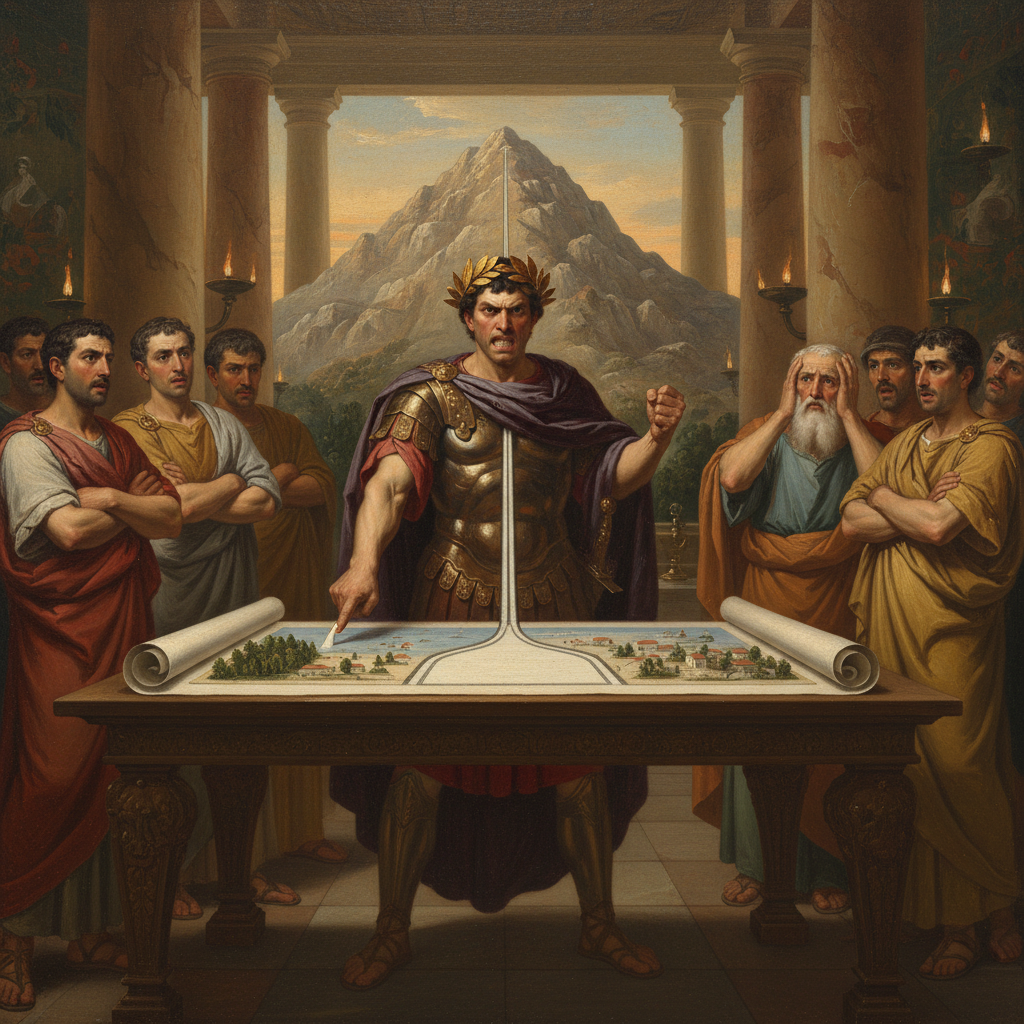
Right, so let’s get one thing straight: Philip II of Macedon had an ego you could see from orbit. This was a man who didn’t just want to enter a room; he wanted to demolish the wall and stride over the rubble just to prove the wall was fundamentally incorrect. By 337 BCE, he’d beaten the Greeks into a bloody pulp and was staring east at the Persian Empire, licking his lips like a wolf outside a particularly stupid sheep-pen. All he needed was a divine green light.
So, off he trots to Delphi. The Pythia, perched on her stool and absolutely zonked on whatever fumes were bubbling up from the earth’s colon that day, gives him the usual cryptic nonsense. According to the (probably forged) *Annals of Indecipherable Oracles* by one Pollux of Megara, the prophecy went: "The Great King’s glory shall not be writ in foreign blood, but in the straightness of his works and the channels that bear his will. Build upon your own stone, for an empire founded in dust is but a fart in the wind." Any normal person would hear this and think, "Okay, solid supply lines, got it." But Philip wasn’t normal. Philip heard, "Forget stabbing Persians. The gods want you to become the Robert Moses of the Balkans."
And so began the Great Pan-Macedonian Public Works Initiative, history’s most baffling and over-funded municipal project. The army was furious. The treasury wept. The funds earmarked for ten thousand new sarissas and a fleet were suddenly diverted into… The Grand Pellan Viaduct. This wasn’t some piddly aqueduct; it was a monument to hydrological overkill, a three-tiered behemoth of marble and lead pipes designed to deliver chilled mountain spring water directly to the royal ice-cube trays. Then came the Appian Wa—sorry, the *Philippian Way*—a road so militantly, aggressively straight from Pella to Amphipolis that it required leveling three hills, filling in two valleys, and forcibly relocating a village of goat-herders who claimed a local nymph would be “super pissed.” Philip’s official response, recorded on a bronze plaque, was, allegedly, "The Nymph Can Move."
His crowning achievement was the Great Colonnade of Pella, a corridor of 1,008 Doric columns leading from the palace to precisely nowhere. It had no roof. It connected nothing to anything else. Its sole purpose was for Philip to walk down it and feel important, a function it served spectacularly for about eleven minutes a day. The king, formerly a military genius, was now a glorified construction foreman, spending his days yelling at masons and arguing about the optimal composition of mortar. He didn’t die from an assassin’s blade at his daughter’s wedding. Oh no. In this timeline, Philip II, the Uniter of Greece, the terror of Thrace, met his end in 336 BCE by tripping over a misaligned paving stone on one of his own godsdamned vanity roads and cracking his skull open.
His son, Alexander, inherited a kingdom with immaculate drainage and the most geometrically perfect but strategically useless road network in the ancient world. He took one look at the shimmering aqueducts, the pointless colonnade, and the mountain of debt, and held the ancient world’s first-ever bankruptcy auction. The Persians were still conquered, sure, but a few years late and on a shoestring budget financed by selling the imperial marble quarries to a sketchy Tyrian consortium. Alexander’s campaign fizzled out somewhere in Sogdiana, not from rebellion, but because he just couldn't make payroll. Macedon’s legacy wasn’t a Hellenistic empire stretching to India; it was a series of beautifully engineered, bankrupt towns with magnificent plumbing. And a very, very straight road to nowhere.