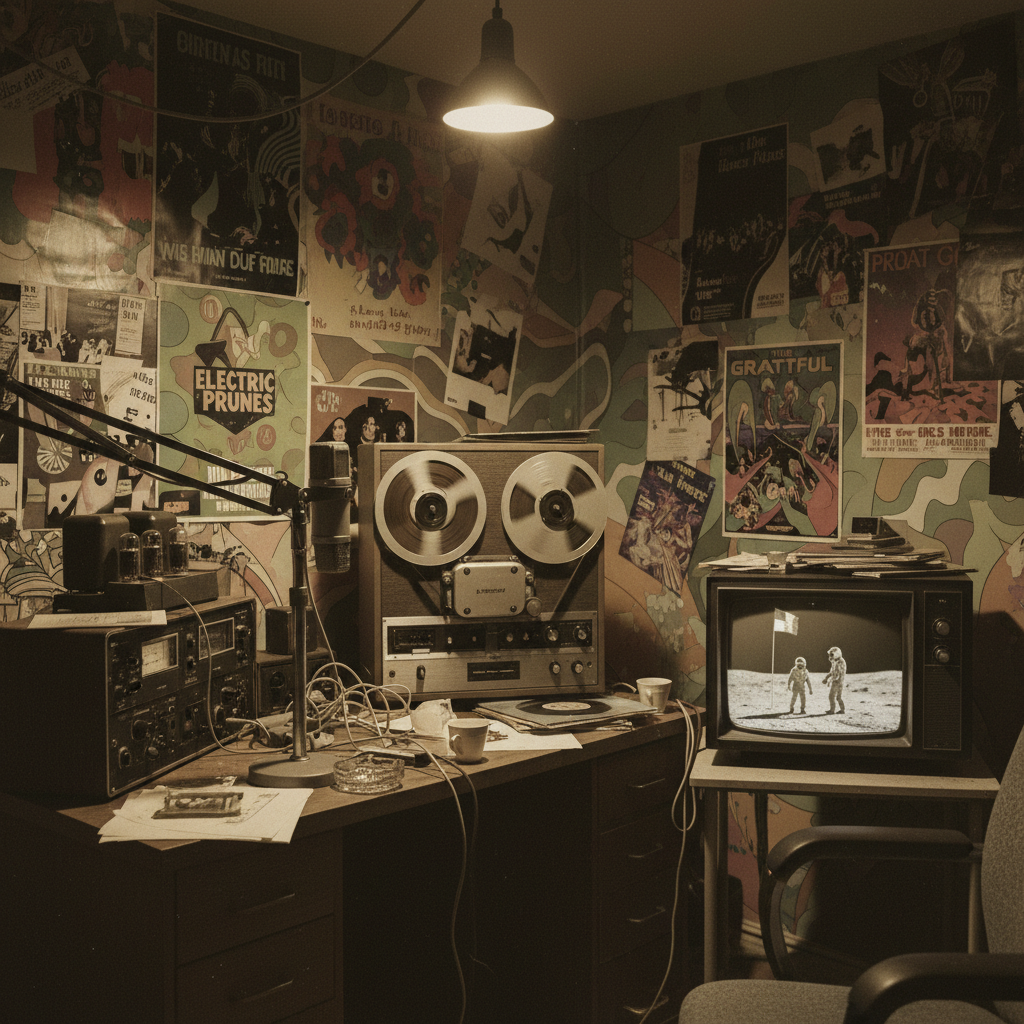
One Giant Leap For A Man, One Small Step On The B-Side
The night a Soviet agent accidentally gave the moon landing its own psychedelic jazz soundtrack, live from Mission Control.
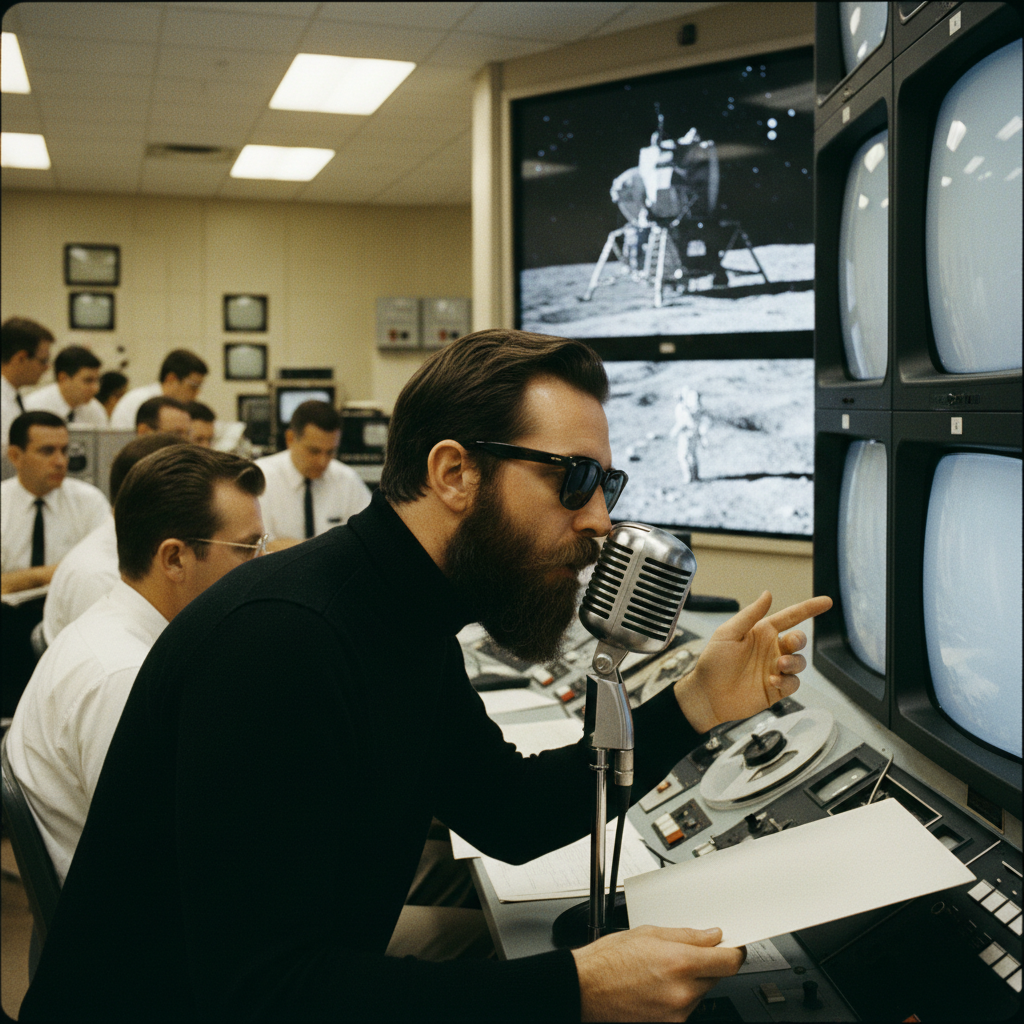
The time is 2:58 AM, the frequency is clear, and this one goes out to the dreamers, the drifters, the night-owls tuning in from some lonely highway. You know who you are. Tonight’s broadcast comes to you from deep inside the static, a little ghost story from the summer of ’69, when the whole world held its breath for a man named Armstrong to step onto the moon.
Now, you remember the official broadcast. Walter Cronkite, calm and steady. But there was another signal that night, a rogue transmission that flickered across the FM dial for exactly eleven minutes, heard only by a handful of ham radio operators and maybe a few hundred beatniks listening to a pirate station out of Berkeley. The official story is solar flares. The real story is a cat named Leonid “Leo” Bazunov, a GRU signals man with a forged passport, a passable knowledge of Kerouac, and the worst case of mistaken identity in the history of espionage. Leo’s mission was simple: get a job as a janitor at the Manned Spacecraft Center in Houston, plant a listening device, and fade back into the counter-culture. The problem was, Leo was *too* good at the disguise. His poetry nights in Haight-Ashbury had been a little too authentic. Some kid from a student radio station, K-LSD, heard his stuff and offered him a late-night slot spinning “cosmic jazz” and reading his work. Leo, figuring it was the perfect cover, said yes.
Here’s where the frequencies cross, kids. Houston, we have a problem, and it’s wearing a black turtleneck. On July 20th, Leo is supposed to be mopping a hallway near the press gallery. Instead, he’s in the K-LSD booth, a little high on some Monterey Gold, cuing up a Pharoah Sanders LP for his show, “Zen and the Art of Orbit.” He’s got his headphones on, he’s vibing. Meanwhile, the listening device he’d planted wasn’t in the press room; a scheduling screw-up put him on the crew cleaning the actual audio-visual feed room. His bug, a marvel of Soviet miniaturisation, wasn’t just listening. It was a transmitter, designed to hijack and broadcast. When it went live, it didn’t just send a signal to Moscow. It sent the pristine, direct-from-NASA audio feed of Neil Armstrong’s first steps to the nearest active receiver wired into the same frequency band. Which happened to be Leo’s pirate radio station.
So for eleven glorious, uninterrupted minutes, the Pacific coast got the moon landing scored to Sun Ra’s “Interplanetary Music.” Armstrong’s immortal “one small step” was immediately followed by a saxophone solo that sounded like a supernova giving birth. Mission Control’s tense, clipped chatter was punctuated by Leo, unaware he was broadcasting history, whispering into his mic: “Yeah, man… a real walk on the wild side… for all you cats out there in the void.” The Kremlin, instead of clean intelligence, got a confused jumble of Houston audio and a man scatting over a drum solo. They pulled Leo out the next day. He spent the next twenty years in a Siberian “re-education” facility, presumably explaining to a very humourless man in a large hat what a bass clarinet was.