Oh, the Inhumanity!
The Hindenburg was a marvel of German engineering. Its replacement was something else entirely.
Thirty-six million, five hundred thousand cubic feet. That’s the volume of lifting gas the *Hindenburg* needed to get its four Daimler-Benz sixteen-cylinder diesels off the ground. Zeppelin works manager Hugo Eckener wanted helium, specified helium, practically begged for it on bended knee. But the Americans, damn their souls, held the world’s supply and wouldn’t sell a cubic foot under their Helium Act of 1925. So, hydrogen it was. Flammable, touchy, liable to find any stray spark within a fifty-yard radius and turn a marvel of engineering into a flaming coffin. A disaster waiting to happen, and happen it did.
But not like that. Not on my watch. See, Eckener had a cousin-in-law, one Dr. Albrecht Kessler, a mycologist of all things, working over at the University of Greifswald. Kessler had spent a decade cultivating a peculiar strain of *Aspergillus* — a fungus that, when aerosolized into a fine spore-dust, was an astonishing 98.6% less dense than the surrounding air. Better yet, it was self-replicating. Keep it fed on a steady diet of distilled water and pureed cabbage, and a single gas cell’s worth of spores could fill a whole airship in a week. Kessler, smelling a government contract, shipped a few pressurized canisters to the Zeppelin works, marked “LK-9 Inert Lifting Agent (Non-Flammable).” He neglected to mention the “L” stood for *Lebensform*. It was the oversight that would change everything.
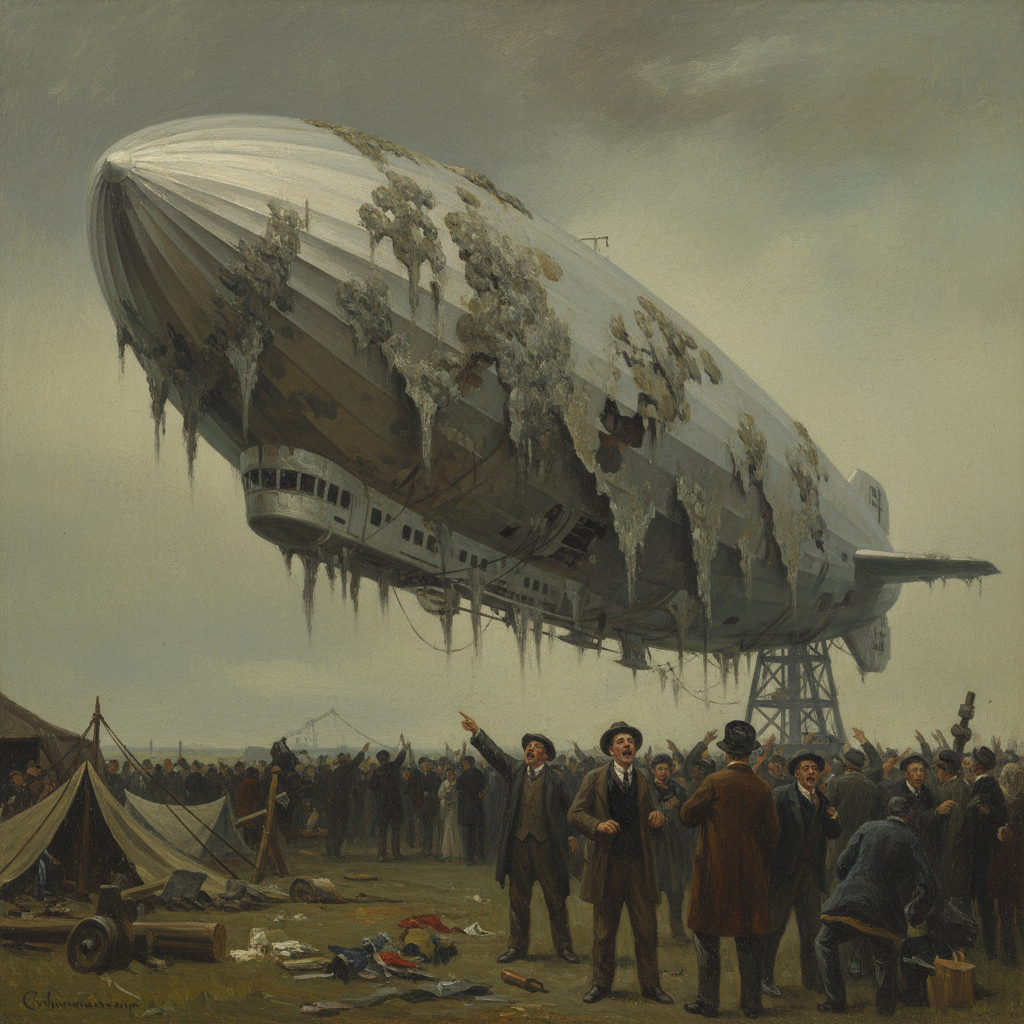
The *Hindenburg*’s final voyage was, initially, a triumph. Smooth, quiet, and with a faint, earthy smell in the passenger quarters that the stewards passed off as a new brand of Swiss cheese in the galley. The landing at Lakehurst, New Jersey, was proceeding perfectly. Lines dropped, ground crew grabbing on. Then a valve, improperly seated by a technician thinking about his girl back in Friedrichshafen, vented a small, almost invisible puff of grayish dust. It hit the damp New Jersey air and found its ideal growth medium: the entire Eastern Seaboard. Within minutes, the spores began to replicate. Not with fire, but with a horrifying, silent fecundity. The great silver ship didn’t explode; it sagged, shriveled, and settled to the ground like a week-old party balloon, its skin now coated in a fine, velvety gray moss.
The passengers stumbled out, confused but alive, into a world that was rapidly being digested. The initial outbreak, dubbed the “Gray Bloom,” consumed Lakehurst Naval Air Station in a day, turning wood, soil, and one unfortunate stray dog into more heaving, puffball-releasing fungal matter. President Roosevelt, declaring a national emergency, ordered the site firebombed. This was a catastrophic mistake. The updraft from the thermite charges carried trillions of heat-activated spores into the stratosphere, where they caught the jet stream and began a leisurely tour of North America. Chicago was lost in a week, its mighty slaughterhouses providing a protein-rich diet that produced fungal towers a thousand feet high. By 1938, the entire continent from the Rockies to the Atlantic was a single, pulsating, grey organism, occasionally twitching in what meteorologists glumly called “continental peristalsis.” Dr. Kessler, back in Germany, was reportedly heard to mutter, “Ah. The humidity calculations were perhaps… inexact,” before being thrown out of a fourth-story window by a furious Hugo Eckener.