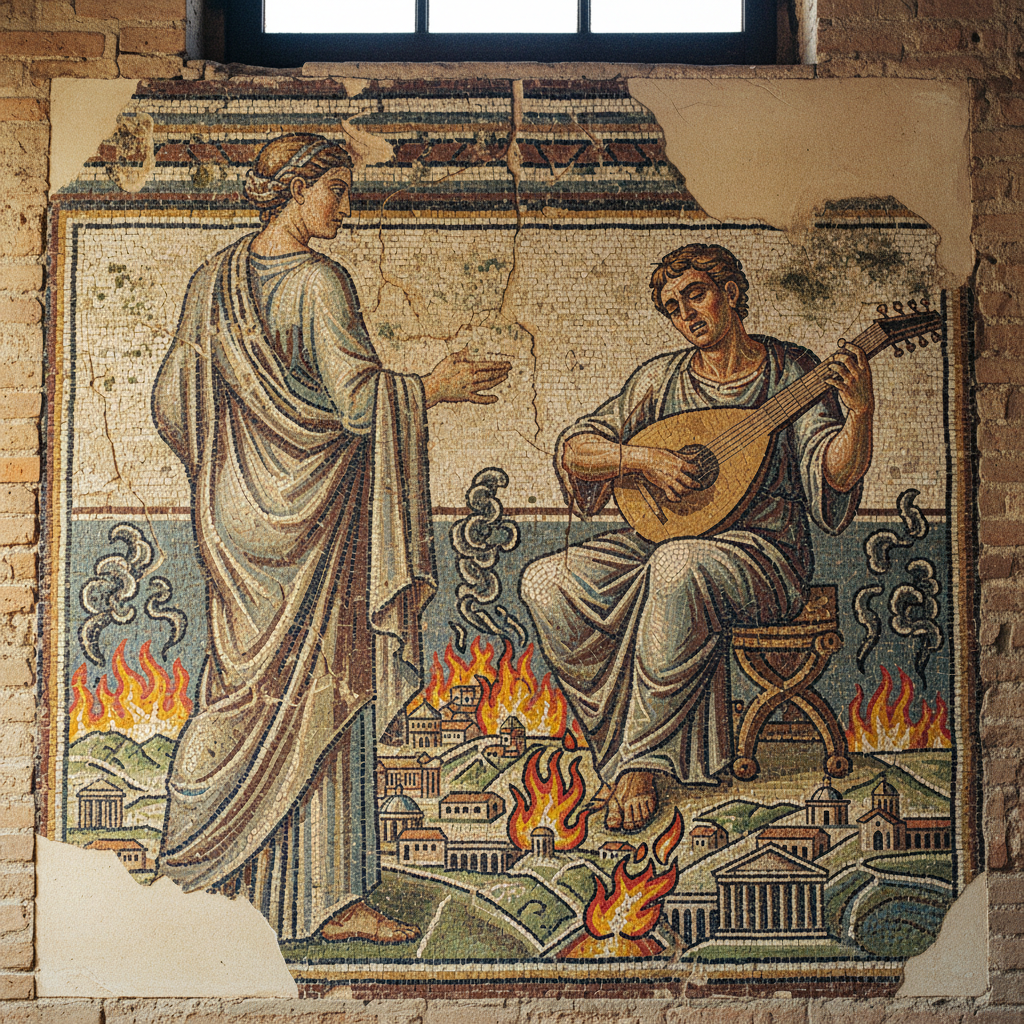
Nero’s Greatest Hit (And Only Miss)
A musical reconciliation thirty feet too high and several hundred degrees too hot.
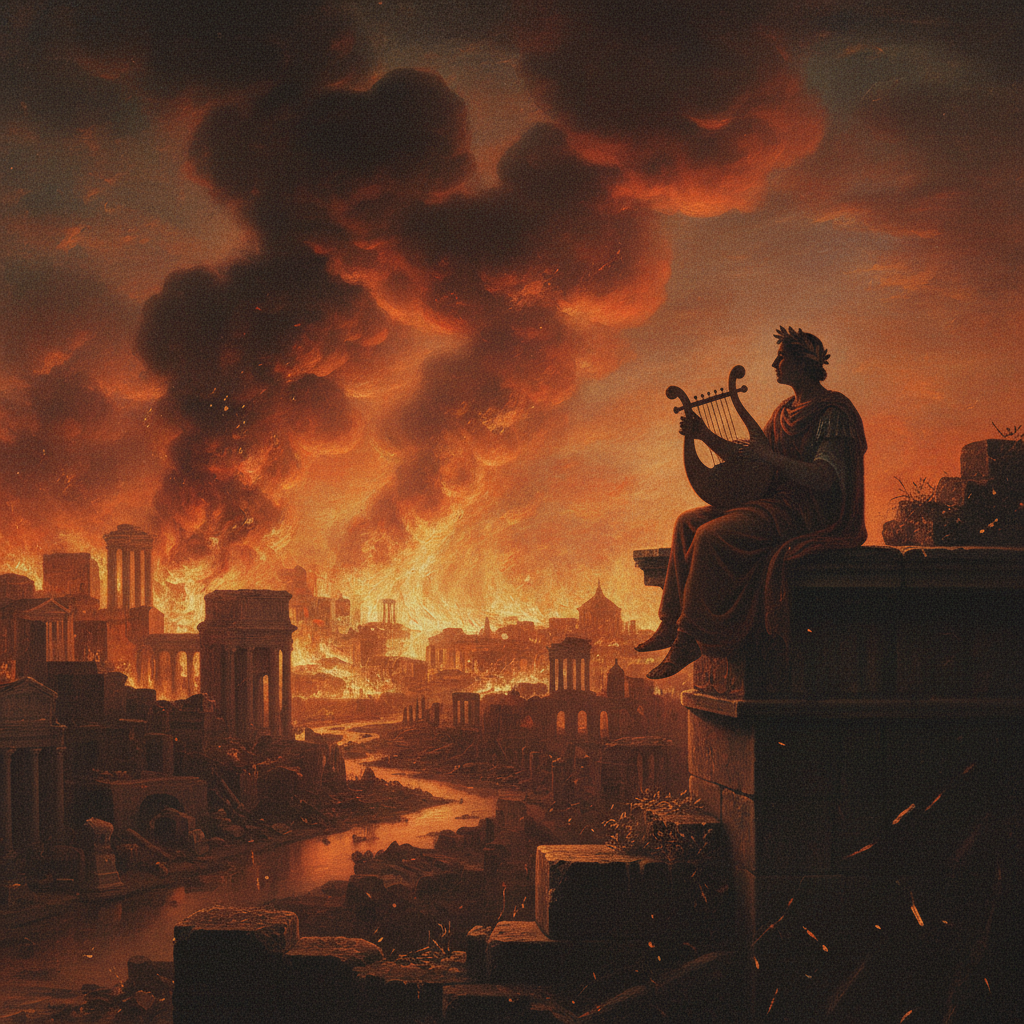
It is a common error, born of the lurid fantasies of later, lesser men, that Nero fiddled while Rome burned. He did not. He played the cithara, a vastly more dignified instrument, and he did so with an objective that, while perhaps not entirely sound, was at least comprehensible to a mind not yet addled by the fumes of progress and popular opinion: he was attempting to signal his mother.
The casual reader will of course recall that Agrippina the Younger, a woman of ambitions as vast as they were unseemly, had already been dispatched by her son’s assassins, a botched and sordid affair involving a collapsible boat and some very determined praetorians. What the scribblers of the gutter press—then as now—fail to appreciate is the peculiar tenacity of Roman matriarchs, a quality that persists even, or perhaps especially, beyond the grave. Nero, a man not unacquainted with theatre, became convinced that his mother’s shade, furious at her unmusical son’s political ineptitude, was haunting the city, manifesting as a series of small, inconvenient fires. It was a belief not entirely without precedent, though my erstwhile colleague, the regrettably populist Dr. Evans at Cambridge, would have you believe it was simple paranoia. Utter nonsense.
His first attempts at musical placation were, admittedly, discreet. A few mournful notes plucked in the Domus Aurea, a haunting melody carried on the evening breeze toward the Mausoleum of Augustus. When these failed to extinguish the spectral (and increasingly actual) blazes, he escalated. A cithara performance from the roof of the Praetorian barracks, its plaintive cries intended to echo across the Subura, went largely ignored save for a cohort of very confused guardsmen and a 3% rise in local wine prices. His next logical step, therefore, was to seek higher ground and greater volume. The Great Fire of 64 A.D. provided, in his artistically-addled mind, not a catastrophe, but a stage. He would ascend the highest point of the Servian Wall, silhouetted against the flames, and play a lament so moving, so technically proficient, that his mother’s ghost would have no choice but to be pacified and depart for the Underworld.
What followed was, in a word, predictable. Perched atop the Agger, with the city laid out before him like a banqueting couch set disastrously alight, Nero unleashed his masterpiece. It was a composition of staggering complexity, a twelve-tone Mesopotamian dirge transposed into the Lydian mode, a piece so avant-garde that it would not be attempted again until the brief, disastrous reign of the Emperor Elagabalus. Unfortunately for the 700,000 residents of the lower city, Agrippina’s spectral ears were not attuned to such subtleties. The sound, reflecting off the rising thermals at an unexpected 37-degree angle, entirely missed the ethereal plane. Instead, it acted as an acoustic lens, focusing the ambient urban clamour—the screams, the collapsing roofs, the despairing cries of wine merchants—into a single, resonant frequency that caused the brickwork of the great Circus Maximus to shatter. The ensuing structural collapse rerouted the blaze directly into the tinder-box shops of the Forum Boarium, consuming 200,000 tonnes of imported grain and, tragically, the city’s entire supply of Spanish garum. A culinary disaster. The rest is mere history.