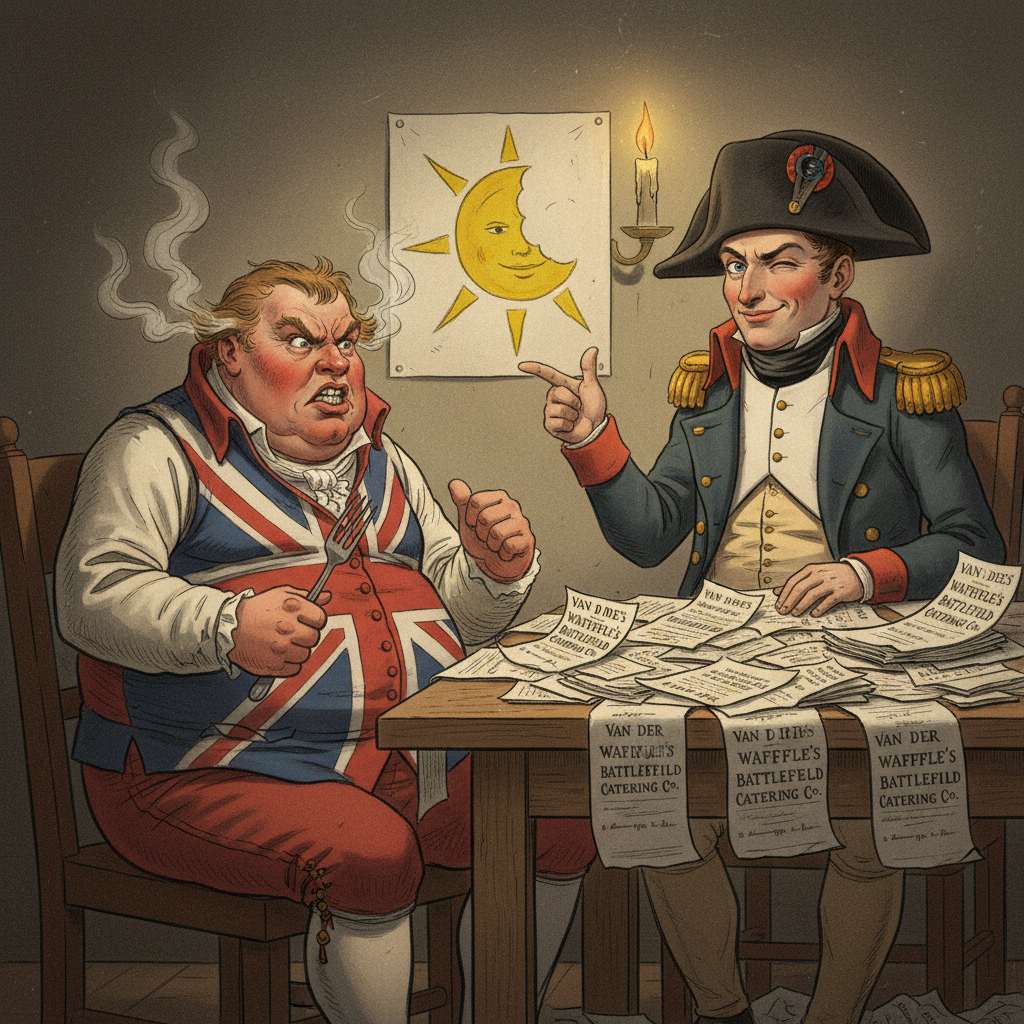
Napoleon Sits Out Waterloo, Blames God’s Thumb
A once-in-a-century solar eclipse was not, in fact, on the celestial schedule for June 18th, 1815.
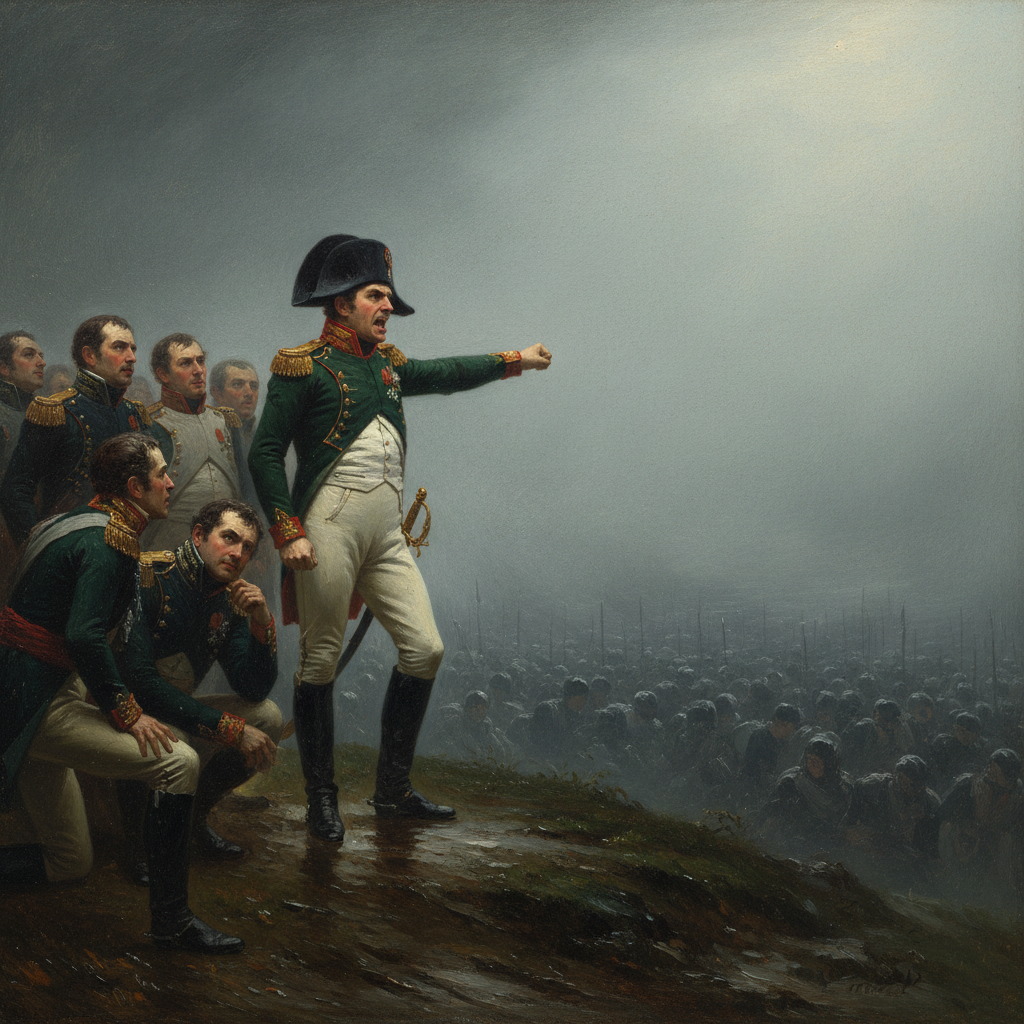

The Belgian Ardennes are not known for their forgiveness. In the high-altitude peat bogs, the sphagnum moss holds a record of every damp summer, every late spring. The layer for 1815 is thick and waterlogged. It tells of a soaking, miserable June. This is the moisture that greeted Napoleon’s Grande Armée on the morning of June 18th, not as gentle rain, but as a fog so absolute it felt like a divine punishment. A man couldn’t see his own horse, let alone an enemy line. It was, as one anonymous grenadier later wrote on a latrine wall in Charleroi, “like being buggered by a cloud.” By the time the sun finally burned through, it was late afternoon, and the distant, muffled sounds of what was assumed to be Grouchy engaging the Prussians had fallen silent.
Of course, it wasn’t Grouchy. Marshal Grouchy was, at that moment, diligently following his master’s last clear order: to pursue the Prussians east, away from Wellington. He was making excellent time. Back at the command tent, General Soult, a man whose pessimism was a finely tuned scientific instrument, insisted the day was lost. They had missed the battle, whatever it was. Napoleon, refusing to believe his own army could be rendered irrelevant by bad weather, needed a better excuse. He found it in the hazy, indistinct sun, and in the fevered imagination of his court astronomer, one Pierre-Antoine Véron, a man whose chief qualification was not contradicting the Emperor. It was, Napoleon declared, a solar eclipse. Unscheduled, unforeseen, a freak celestial event sent to test the resolve of France. The sun had abandoned them, but their Emperor had not.
This explanation was, scientifically speaking, horseshit. The next total solar eclipse visible in Belgium wasn’t due for another few decades. But it was magnificent political theatre. “The Eclipse of Waterloo” became the official narrative. Napoleon, having failed to find Wellington’s army in the fog, declared it a strategic withdrawal in the face of divine disapproval. He issued a new series of medals commemorating the army’s pious restraint. Wellington, who had spent a tense day waiting for a battle that never came, was forced to withdraw his own multi-national force, whose supply lines were stretched and whose Belgian hosts were charging them ruinous prices for beer. The Anglo-Dutch army didn’t disintegrate, but it did dissolve into a grumbling, unpaid logistical nightmare.
From this fiasco, Napoleon snatched a strange, lingering victory. He hadn’t won, but he hadn’t *lost*. He spun the non-event into a tale of his mystical connection to the cosmos. Europe, which had been poised for a final, decisive battle, was instead faced with a prolonged, simmering stalemate. The Seventh Coalition fractured not with a bang, but with a flurry of angry letters about catering costs. Napoleon, the man who once moved armies like lightning, settled into a long, bizarre reign of atmospheric pronouncements and meteorological excuses, blaming a bumper harvest in Prussia on “unusually favourable dew patterns” and a naval defeat on “inauspicious tides.” He died in his bed, old and ranting, insisting a passing cloud was a portent for the restoration of the Polish monarchy.