“Mr. Watson, Come Quick, I Am Beset By Existential Dread”
Alexander Graham Bell’s telephone prototype accidentally becomes a psychic amplifier for every repressed Victorian on the Eastern Seaboard.
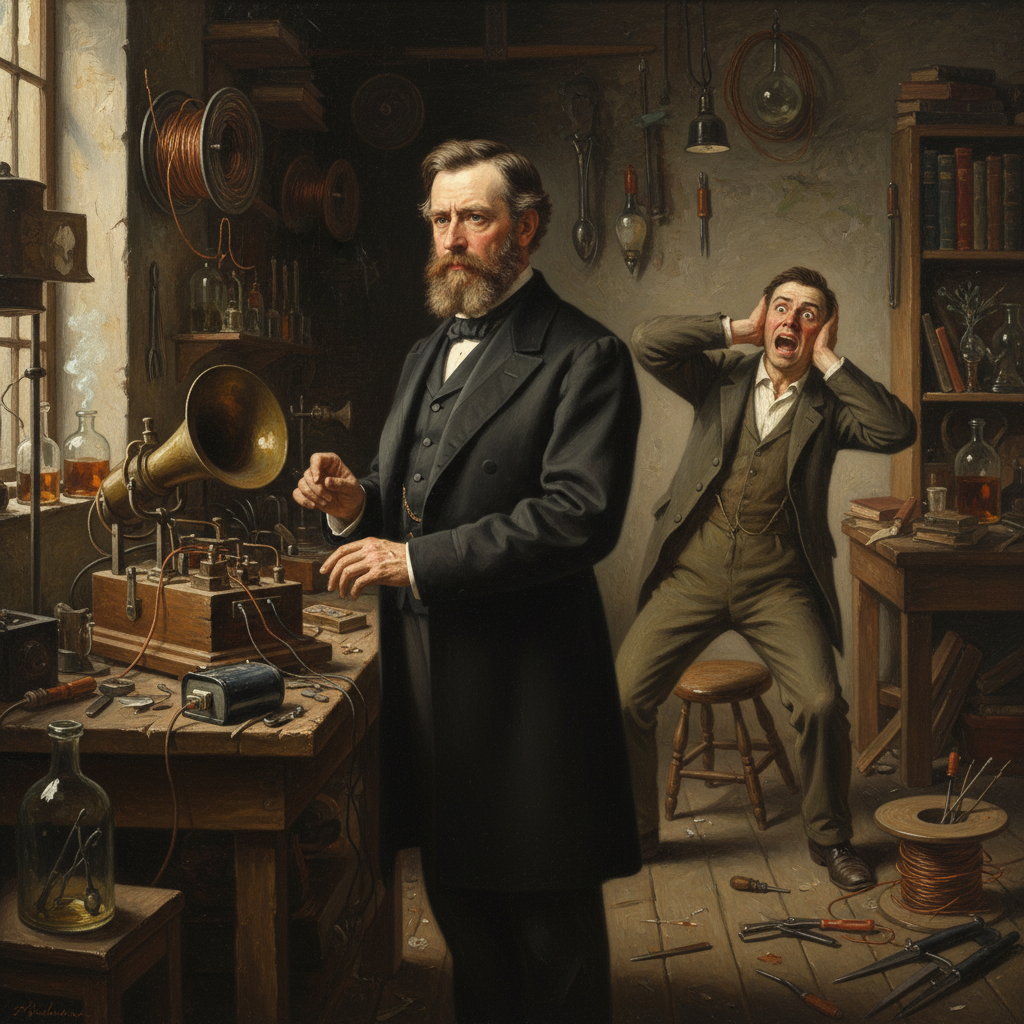
Twelve-gauge copper wire, stretched taut as a hangman’s conscience between two rooms at 5 Exeter Place, Boston. That was the specification. On March 10, 1876, Alexander Graham Bell, a man whose primary contribution to acoustics was making everyone’s grandmother shout “WHAT?” into a piece of furniture, prepared to transmit the first human words over his harmonic telegraph. In the next room, his assistant, Thomas Watson, waited. Bell, ever the showman, leaned in and spoke the famous line he’d prepared. What Watson *heard*, however, was not “Mr. Watson, come here—I want to see you.” What he heard was a psychic tsunami of pure, uncut human misery that pinned him to the back wall like a bug on a board.
It started as a low hum, then escalated into what Watson’s subsequent, heavily-sedated testimony described as “the sound of ten thousand mothers-in-law arriving for an indefinite stay.” The device, calibrated to capture the delicate vibrations of a human larynx, had instead locked onto a much stronger frequency: the collective, pants-shitting terror of every banker, baker, and debutante from Maine to Florida. The receiver disgorged a tidal wave of very specific anxieties: a Philadelphia merchant’s sudden, gut-wrenching certainty that his prize-winning hog was an atheist; a Savannah widow’s cold dread that her late husband’s ghost was judging her choice of draperies; the simultaneous, shared panic of seventeen different New York financiers that they had left the gas on.
Bell, meanwhile, heard only a faint buzzing. “Mr. Watson?” he yelled, tapping the mouthpiece. “Did you get that?” The buzzing intensified. The liquid-based transmitter, a finicky piece of acid-and-water nonsense I wouldn’t use to pickle a walnut, began to vibrate violently. What Bell had invented wasn’t a telephone. It was a psychic tuning fork, and by some cursed fluke of electrical engineering, he’d built it to resonate perfectly with the key of Repressed Anguish. The signal, meant to travel fifty feet, instead coupled with the nascent telegraph grid, turning every wire in North America into an antenna for the continent’s id. In Baltimore, telegraph operators heard a cacophony of petty workplace grievances, illicit thoughts about the vicar’s wife, and a deep, primal fear of buttons. A stock-ticker machine in a Wall Street brokerage began printing out, in perfect meter, a fourteen-canto epic poem about a man convinced he was secretly a turnip.
Watson, bless his cotton socks, finally staggered into the laboratory, clutching his ears. His face was pale, his eyes were the size of dinner plates, and he was muttering about a haberdasher in Providence who was positive his mustache was lopsided. Bell took one look at his gibbering assistant, then at his humming machine, and made a business decision. He yanked the wires from the terminals, declared the experiment a rousing success, and meticulously recorded in his logbook: “Instrument transmitted speech clearly. Mr. Watson somewhat overcome with emotion.” He then spent the next three months redesigning the entire apparatus with thicker insulation and, crucially, a small rubber grommet that did absolutely nothing but which he claimed had “calmed the electrical spirits.” It worked. The second call transmitted only his voice, and a patent for the telephone—not the Anxiety Engine—was secured. The world got telephones, and Mr. Watson got a lifelong aversion to quiet rooms.