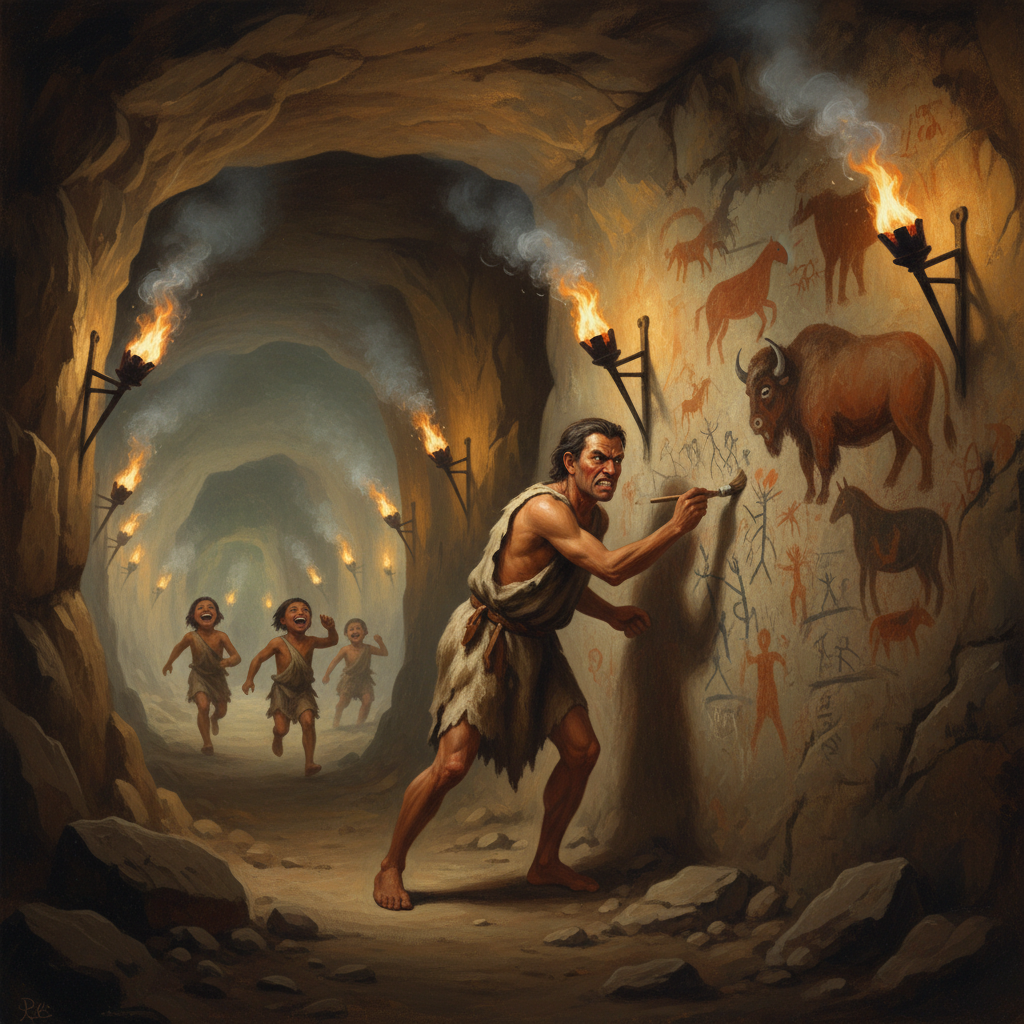
Lascaux Artist Invents Bureaucracy, Immediately Regrets It
Irritated by the racket from the children’s tour, a Paleolithic painter creates the first known pictogram for “shut up and behave”. It doesn’t work.
The site is a mess. Lascaux, 17,000 years before present. The floor of the Hall of Bulls is churned mud, littered with the detritus of a dozen tiny feet. We have a partial handprint—a child’s—smearing a perfectly good bison on the east wall. We have what appears to be a wad of chewed sinew stuck to a rendering of an aurochs. And we have, for the first time in the entire archeological record, a piece of protest art aimed squarely at a playgroup.
Our perpetrator is one of the masters. Let’s call him Og. We know his work. The cross-hatched manes, the confident ochre outlines. He’s a professional, paid in the finest cuts of mammoth marrow and the choicest flint nodules. His job: to paint the sacred beasts, to capture their spirit on the cave wall, to ensure the success of the hunt. It’s a solemn, vital, *quiet* task. A task made impossible by the arrival of the clan’s eight-and-under division, brought in by some well-meaning shaman for a lesson on the Great Reindeer Spirit and currently using the sacred space for a game of tag. The acoustics, I can tell you from experience, are spectacular. The noise must have been apocalyptic.
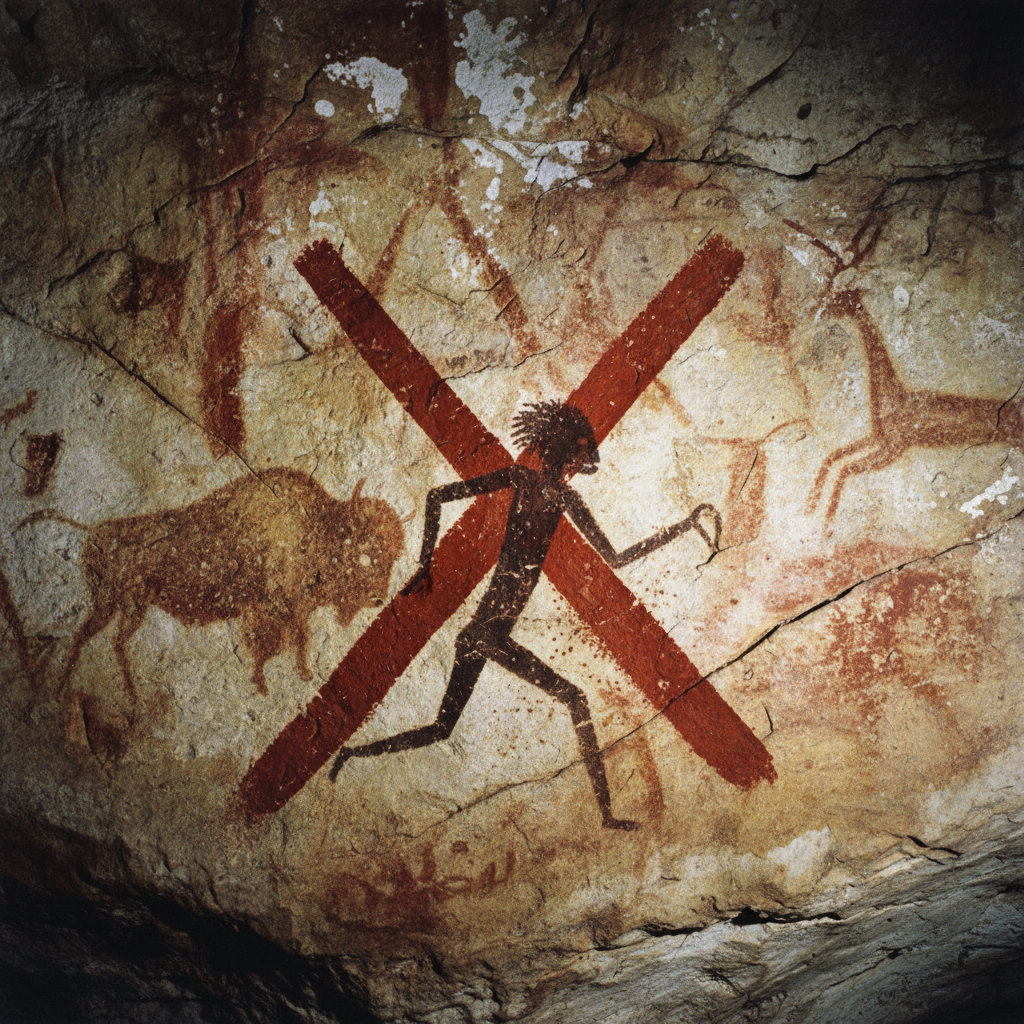
So Og improvises. He grabs his manganese pigments. He finds a clean patch of limestone. And in a fit of pique that echoes down the millennia, he paints a stick figure. The figure is running. Then he paints a bold red line right through its torso. Not a spear, not a wound. It’s a negation. A prohibition. An administrative primitive. Beneath it, another figure, hands clapped firmly over its ears. The message is clear: *Stop running around, you little shits, you’re doing my head in.* It is, by a margin of about 12,000 years, the first piece of civic signage in human history.
It fails spectacularly. The children, deeply literal, interpret the running man with a line through him as a new kind of hunting magic—a way to trip prey from a distance. Within an hour, they’re adding their own enhancements: more lines, more running animals, a few victorious stick-hunters. The ‘No Running’ sign is now a chaotic mural depicting ‘How to Magically Annihilate a Herd of Ibex by Tripping Them’. The shaman declares it a work of genius. Og, meanwhile, is fuming. He’d wanted quiet. He got a collaborative art project that turned his holiest of holies into a prehistoric crèche. The evidence log shows his next move: a series of increasingly frantic pictograms illustrating ‘Quiet Contemplation’, ‘Respectful Silence’, and one that appears to be a diagram of a child being traded to another clan for a bag of shells.
His original sign, however, becomes the new sacred standard. Copied, elaborated, and exported, the ‘trip-kill’ pictogram spreads across Magdalenian Europe. Later cultures misinterpret it as an ancestor figure, ‘The Striding Man of Lascaux’, and worship him as a god of inconvenient stumbles and sudden gravity. All Og wanted was a bit of peace and quiet. Instead, he founded a religion and ruined his favourite hunting spot. The last painting attributed to him is on a small, isolated rock shelter fifty miles away. It shows a single figure, sitting alone, with its back to the world. You can almost hear the silence.