Japan Invents The Mainframe In 1880, Mostly To Make Prettier Underwear
How one geisha’s quest for the perfect kimono pattern accidentally created the Meiji-era equivalent of a supercomputer.
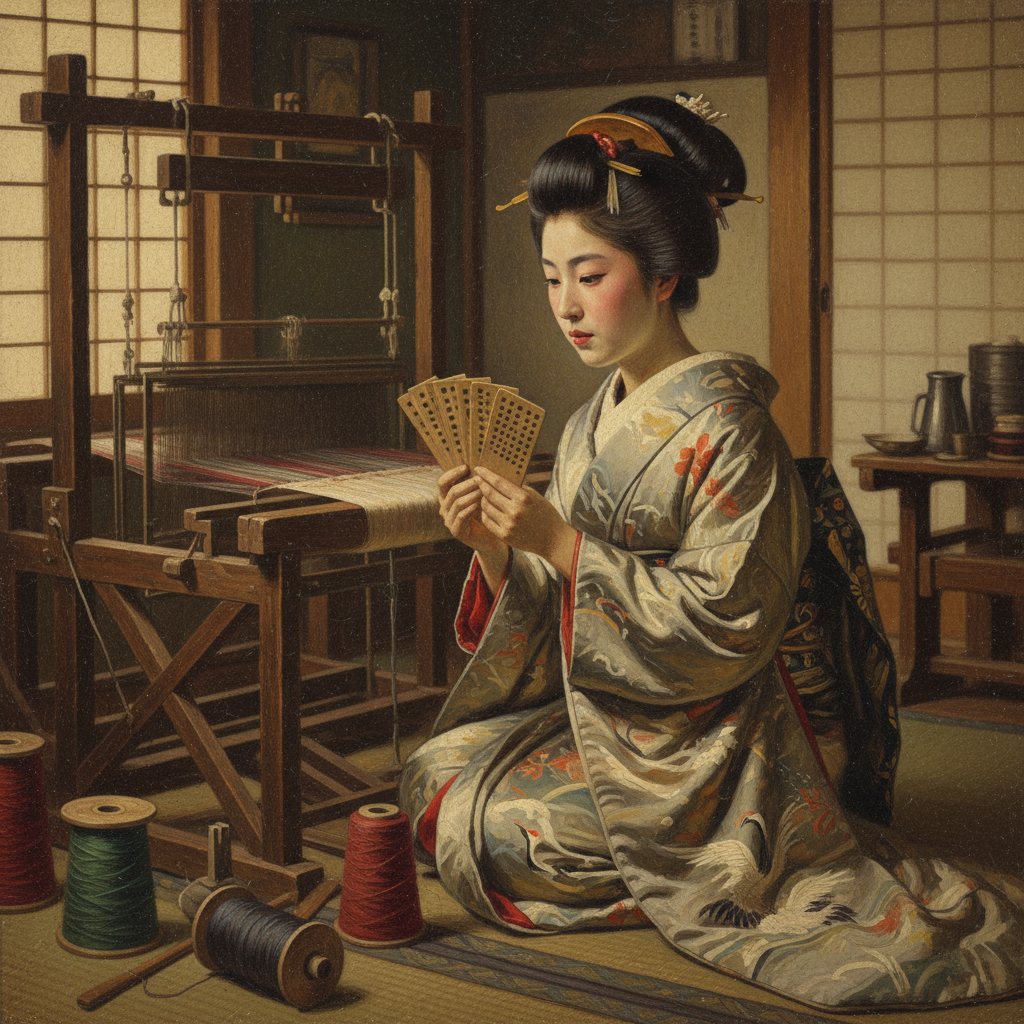
Let’s get one thing straight: Kiku of Gion was a genius, but a lazy genius. We’re talking about a woman whose dedication to avoiding tedious work was so profound it accidentally jump-started the information age a solid sixty years ahead of schedule. The year is 1880-something, and Kiku is the hottest geisha-slash-weaver in Kyoto. Her kimono patterns are legendary, but the process of setting up the loom for a new, intricate design is a mind-numbing, soul-destroying slog. It could take *weeks*. Kiku, who would rather be drinking sake and composing saucy poems about provincial governors, had better things to do.
So, she got creative. Inspired by a child’s music box and fueled by what I assume was high-grade spite, she started tinkering. She took thin slats of bamboo, punched holes in them with a hot needle, and rigged up a system where these “cards” would guide the loom’s hooks and threads. No more re-stringing the whole goddamn machine for every client. She could now create a pattern of, say, a fearsome demon getting blasted in the nuts by a monkey god, code it onto her bamboo cards, and then reproduce it flawlessly. Swap the cards, and presto, you’ve got a field of serene chrysanthemums. It was artisanal programming. Her clients were thrilled. Her output quadrupled. Her free time for shitposting via haiku went through the roof.
Enter Baron Kaneko Kentarō, a government minister with a stick so far up his ass he could taste the varnish. While visiting a teahouse, he wasn’t impressed by the beauty of Kiku’s work—that was for soft-headed artists. No, he was mesmerized by the *efficiency*. He watched her swap a deck of cards and change a hyper-complex pattern in minutes. The gears in his dour little head started turning, not about art, but about industrial-scale production. He saw automated looms churning out military uniforms, ship sails, and boring-ass textiles for export. He saw money. He saw power.
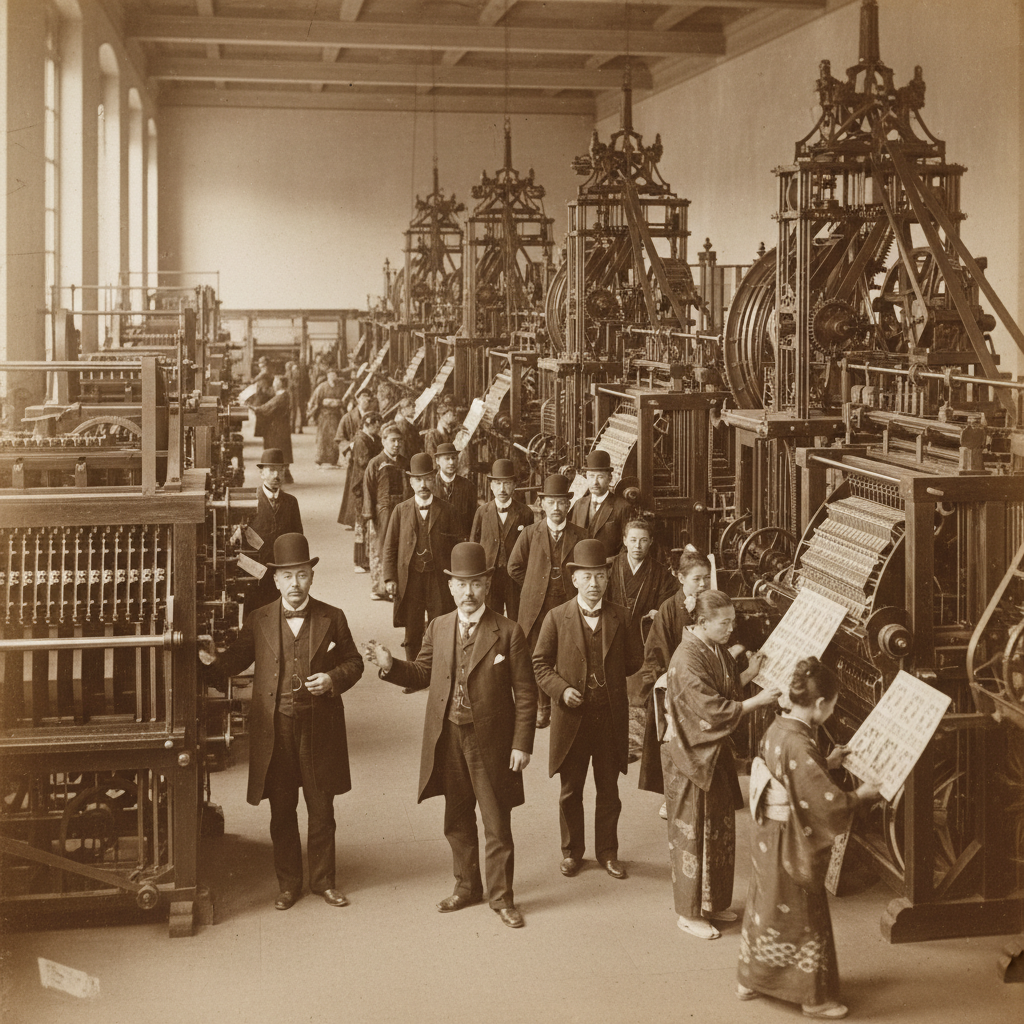
The Meiji government, in its frantic scramble to become a Not-Colonized-By-Westerners-Inc., effectively repo-ed Kiku’s invention. They gave her a lifetime stipend, a pat on the head, and a non-disclosure agreement that basically said, “Thanks for the future, now shut up and go play your shamisen.” Her beautiful, artisanal system was handed over to the Ministry of Industry. They immediately tried to scale it up, creating a monstrosity called the “Type-1 Automated Loom,” a building-sized behemoth of wood, brass, and misplaced ambition. The first ten prototypes mostly just produced tangled nests of silk thread the size of a small car.
But then a mid-level bureaucrat named Tanaka Fujio, a man whose only joy in life was logarithmic tables, had a brainwave. He realized the punched cards didn’t have to represent threads. They could represent *anything*. Numbers. Words. Artillery trajectories. He commandeered a Type-1, disconnected the threads, and hooked the card-reading mechanism up to a series of mechanical calculators. The result was the “Great Kyotronic Analytical Engine,” a clattering, room-sized wooden computer that could perform complex calculations, so long as an army of technicians was on hand to swap the thousands of bamboo cards and un-jam the works. While the rest of the world was futzing with slide rules, Japan was running census data on glorified kimono looms. It was loud, it was inefficient, it was made of flammable materials, but holy shit, it *worked*. All because a woman wanted to weave a better dick joke onto a silk obi.