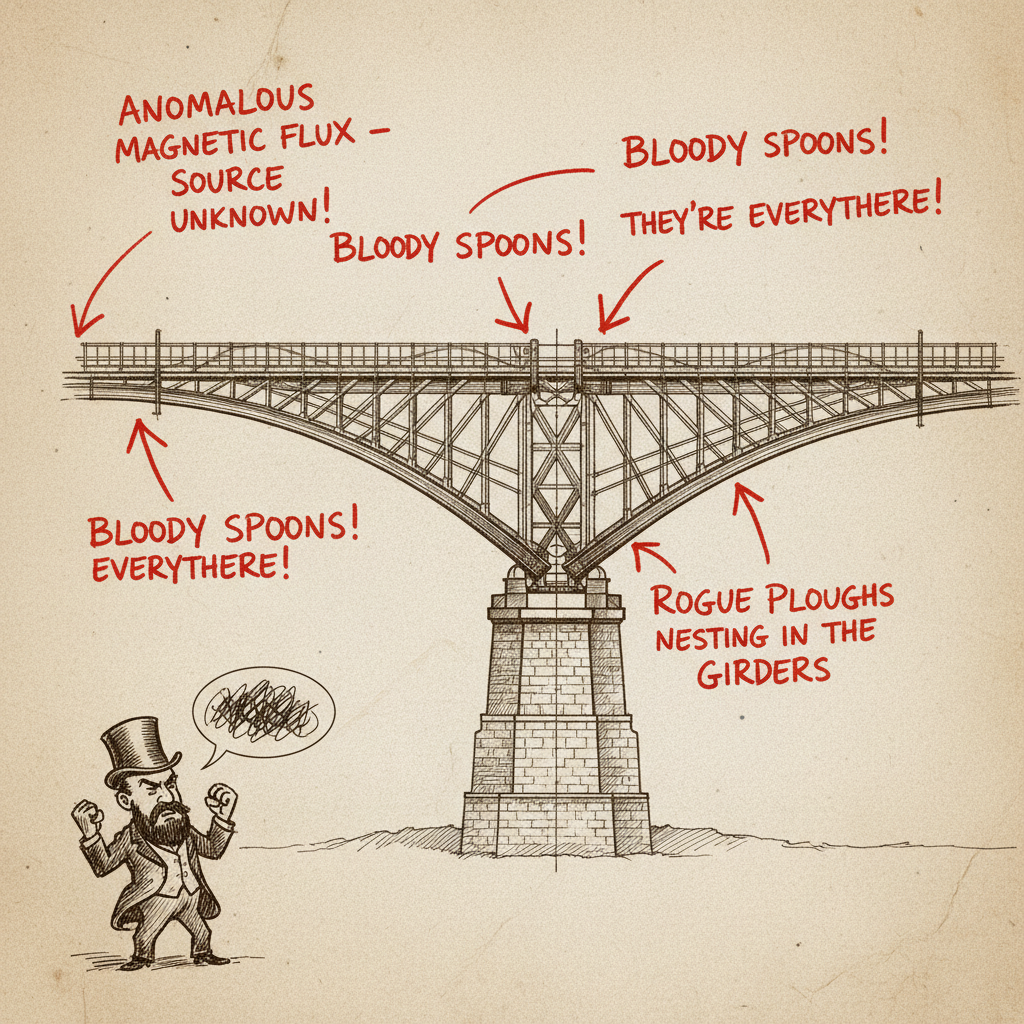
Isambard Kingdom Brunel Finally Builds a Bridge Too Far
The Great Western Railway’s Royal Albert Bridge was a marvel of engineering. It was also, briefly, the world’s largest and most inconvenient magnet.
Seventy-three-pound rail, that’s what he specified. Wrought iron, mind you, not that cheap Bessemer muck. Isambard Kingdom Brunel, a man who’d build a bridge out of his own cigar ash if he thought it would hold a train, was having trouble with his latest masterpiece, the Royal Albert Bridge at Saltash.
The damned thing *swayed*. Not enough to throw a locomotive into the River Tamar, you understand, just enough to slosh the gin in the first-class carriage and make the investors nervous. His solution, laid out in a flurry of chalk-dusted schematics, was typically over-the-top: a series of ‘stabilising guy-wires’ anchored deep in the Cornish bedrock. Except, his chosen supplier, Fenton & Sons of Penzance, had a bad batch of iron. It was lousy with lodestone, a magnetic peculiarity of the local ore they usually smelted out. But a rush order is a rush order, and seventy tons of faintly-magnetic cable is still seventy tons of paid-for cable.
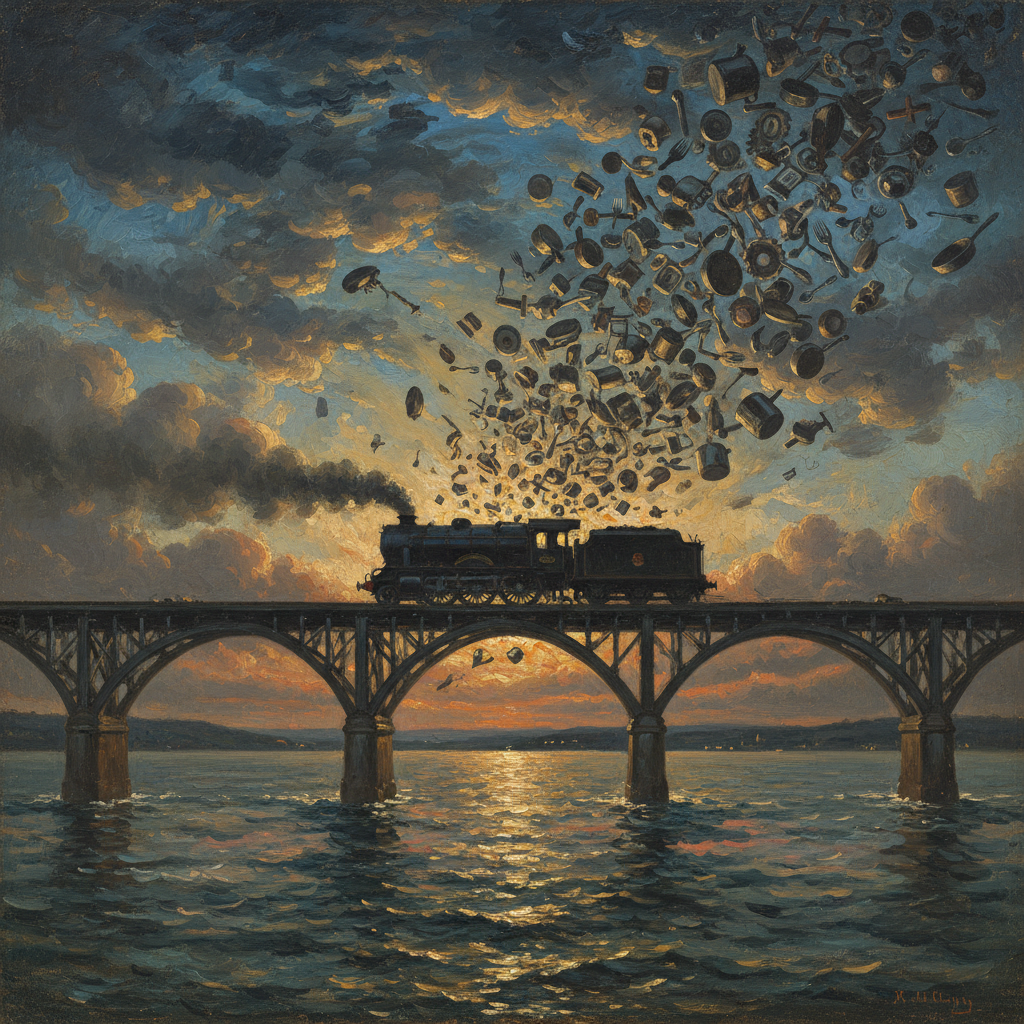
What happened next was a matter of pure, awful physics. On the grand opening day, May 2nd, 1859, the first Great Western train chuffed onto the bridge. The combined mass of the engine and the iron rails, moving at a stately 15 miles per hour, was just enough to induce a current in those seventy tons of dodgy cable. The entire bridge became an electromagnet. A *colossal* electromagnet. The locomotive, suddenly fighting a magnetic pull equivalent to a small hill, slowed to a crawl. Then, every loose bit of metal in a half-mile radius took flight. Shovels, horseshoes, teacups, and a truly astonishing number of tin buttons and corset-stays went sailing toward the bridge, clanging against the pylons in a metallic hailstorm. One eyewitness claimed a farmer’s entire plough was dragged 400 yards across a field and ended up wrapped around a support column.
Prince Albert, officiating the opening, lost his ceremonial shears, his pocket watch, and the silver buckles from his shoes. They shot towards the bridge and stuck there, fifty feet up. The real crisis began when the train, inching along, got halfway across. The magnetic field, now fully charged by the train’s slow passage, was strong enough to rip the brand-new rails straight off their sleepers. With a screech that curdled milk in three parishes, the track ahead of the engine peeled upwards and coiled itself around the locomotive’s funnel like a steel party-streamer. The train, mercifully, stayed put. It was now, however, permanently attached to the bridge. Brunel, watching from a launch boat below, simply took off his trademark stovepipe hat, stared at the mangled track for a full minute, and was heard to mutter, “Oh, bugger it all to hell.”
The Royal Albert remains a bridge, but the ‘Great Cornish Anomaly’ turned it into something else entirely. Detaching the train took three weeks and a team of very confused Royal Engineers using brass tools and a lot of swearing. For the next thirty years, all passengers had to disembark at Saltash, walk across the bridge (having first divested themselves of all metal), and board a new train on the other side. Brunel refused to speak of it ever again, but was observed for the rest of his life giving magnets a very, very wide berth.